
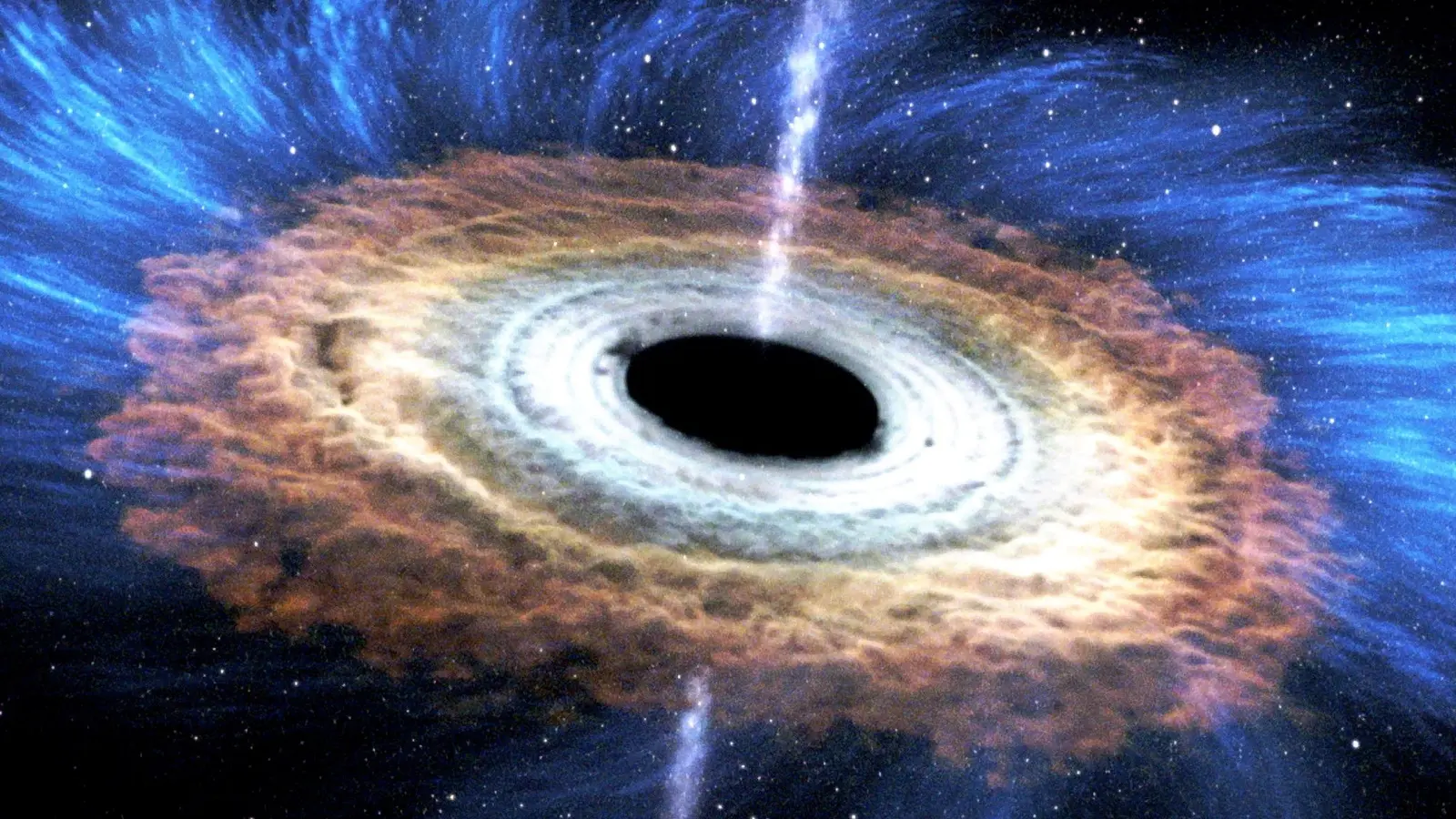
A violent stellar disruption recorded in 2024 gave astronomers their clearest evidence yet that a black hole can literally twist spacetime around itself. By tracking synchronous X-ray and radio oscillations from a galaxy known as LEDA 145386, researchers saw a paired accretion disk and jet wobble in a way best explained by frame-dragging — the relativistic effect predicted by Lense and Thirring.
Observations reveal a precessing black hole
In January 2024 the Zwicky Transient Facility (ZTF) flagged a sudden brightening in LEDA 145386, a galaxy about 400 million light-years from Earth. The optical flare fit the signature of a tidal disruption event (TDE): a star that wandered too close to a supermassive black hole and was torn apart by tidal forces. The black hole in this galaxy is estimated to be roughly 5 million times the mass of the Sun — large enough that relativistic effects, though normally subtle, can become observable when chaos unfolds.
Following the optical detection, astronomers organized a rapid, multiwavelength campaign. X-ray instruments recorded dramatic swings in brightness every 19.6 days, with flux variations of more than an order of magnitude. At the same cadence, radio emission from the source also rose and fell — but with changes spanning more than four orders of magnitude. Crucially, the X-ray and radio modulations were synchronized.
That synchronicity is the smoking gun. X-rays originate primarily from the hot, inner regions of the accretion disk as stellar debris spirals inward, while the radio waves are produced by synchrotron processes in a relativistic jet launched near the black hole's poles. When both bands fluctuate together at a repeating period, it points to a rigidly coupled disk-and-jet system that is precessing — wobbling like a spinning top around the black hole's spin axis.

What frame-dragging is and why it matters
Frame-dragging, also called the Lense-Thirring effect, arises because rotating mass drags spacetime along with it. A helpful analogy is stirring honey with a spoon: the honey nearest the spoon turns fastest and the twist fades with distance. For Earth, frame-dragging has been measured with precise satellites, but the effect is tiny. Around a supermassive black hole, however, rotation generates a strong gravitomagnetic field that can torque the inner disk and nearby matter on observable timescales.
In this TDE, models that couple a precessing accretion disk to a jet reproduce the observed amplitude and phase of the X-ray and radio oscillations. As co-first author Yanan Wang of the Chinese Academy of Sciences explains, 'Such cross-band, high-amplitude, and quasi-periodic synchronous variability strongly suggests a rigid coupling between the accretion disk and the jet, which precesses like a gyroscope around the black hole's spin axis.'
Astrophysicist Cosimo Inserra of Cardiff University frames the result in historical context: 'This is a real gift for physicists as we confirm predictions made more than a century ago. Not only that, but these observations also tell us more about the nature of TDEs — when a star is shredded by the immense gravitational forces exerted by a black hole.'
Scientific context, methods and modeling
TDEs are infrequent and brief compared with more steady accretion sources, but their transient brightness makes them ideal laboratories. When stellar debris forms an accretion disk, some material falls inward and radiates in X-rays, while magnetic fields can channel other material into bipolar jets that shine in radio. The LEDA 145386 event was monitored with optical discovery from ZTF followed by X-ray telescopes and coordinated radio observations, allowing researchers to measure timing, amplitude, and spectral properties across bands.
Numerical simulations and analytic models of Lense-Thirring precession indicate that a misaligned disk around a spinning black hole will undergo rigid-body precession under certain conditions. The observed 19.6-day periodicity, the coupling between disk and jet, and the tremendous radio variability collectively match predictions for frame-dragging acting on a 5-million-solar-mass black hole.
Santiago del Palacio of Chalmers University summarized the observational strategy: 'When a new TDE was discovered by an optical telescope, it triggered us to start observing the black hole in different wavelengths as quickly as possible. That rapid response is what let us see the repeating signal before it faded.'
Why this discovery advances gravity physics and astrophysics
- Testing general relativity: The detection is a real-time demonstration of frame-dragging on scales and in regimes where strong gravity dominates — a complementary probe to gravitational-wave and black-hole-imaging tests.
- Disk–jet coupling: The synchronous variations argue for a tight dynamical link between the inner accretion flow and the jet-launching region, informing models of jet formation and magnetic-field structure.
- Measuring black hole spin: Precession depends on the black hole's spin and the disk’s geometry; with more events like this researchers can constrain spins for otherwise quiescent black holes.
Beyond the immediate science, the study highlights the power of wide-field optical surveys (ZTF, and soon the Vera C. Rubin Observatory) to find TDEs early, and the importance of rapid, multiwavelength follow-up using X-ray observatories and radio arrays to capture transient dynamics.
Expert Insight
'Observing frame-dragging in action transforms a theoretical prediction into an empirical tool,' says Dr. Elena Marconi, a fictional but realistic-sounding astrophysicist specializing in high-energy phenomena. 'Each well-sampled TDE gives us not only a snapshot of relativistic physics but also a laboratory for measuring how jets are born and how they respond to strong gravity.' Her point underlines how combined timing and spectral data can map both the geometry and the physical drivers of these explosive events.
Conclusion
The LEDA 145386 tidal disruption event presents one of the clearest astrophysical cases where a spinning black hole twists spacetime and forces a disk–jet system to precess. By synchronizing X-ray and radio observations, astronomers obtained a dynamic view of general relativity at work and opened a practical route to measure black hole spin and jet physics using transient events. With new survey telescopes and coordinated multiwavelength networks coming online, similar discoveries should become more common — providing ever-richer tests of gravity in the cosmos.

“The cosmos has always fascinated me. I write about space missions, astronomy, and the technologies pushing humanity beyond Earth.”

Discussion
Leave a Comment