

Researchers at the Institute for Neurosciences (IN), a joint centre of the Spanish National Research Council (CSIC) and Miguel Hernández University of Elche (UMH), report that the body uses two distinct molecular systems to detect cold. The skin relies primarily on the TRPM8 ion channel, while internal organs such as the lungs and stomach depend on TRPA1. This division helps explain why a cold breeze, icy airways, and a frozen drink produce such different sensations.
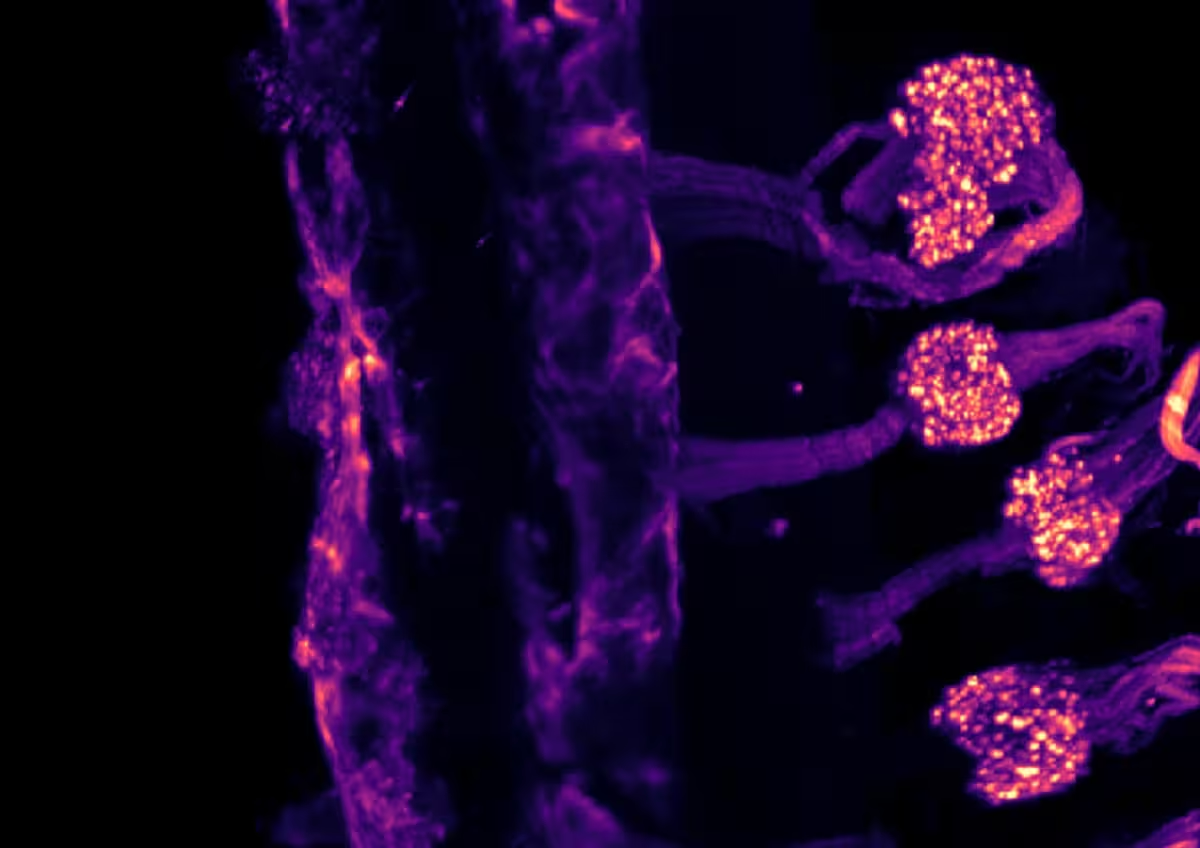
Light-sheet microscopy image showing the expression of the ion channel TRPM8 in the sensory ganglia of a mouse during embryonic development, following tissue clearing using the iDISCO technique.
Two sensors, two experiences of cold
Sensory biology has long treated cold detection as a single pathway, but the new study overturns that simplification. In skin, TRPM8 is the dominant transducer for environmental cold; it is finely tuned to detect modest temperature drops and trigger protective behaviours such as seeking warmth or shivering. Inside the body, however, researchers found that TRPA1 plays the leading role in registering cold in visceral tissues. That means the nerve signals generated by a chilled fingertip are routed differently and encoded differently from the signals created when icy air hits the lungs or a cold beverage touches the throat.

Eva Quintero, Pablo Hernández-Ortego, Ana Gómez del Campo, Félix Viana and Katharina Gers-Barlag, IN CSIC-UMH researchers.
How the team demonstrated distinct cold pathways
The investigators combined live-cell calcium imaging and electrophysiological recordings to observe sensory neurons as they responded to cooling. They compared neurons from the trigeminal ganglion, which conveys sensations from the face and skin surface of the head, with neurons from the vagal ganglia, which relay input from internal organs. Pharmacological blockers that selectively inhibit TRPM8 or TRPA1 helped identify which channels drove responses in each neuronal population.
Genetic experiments strengthened the case. Mice engineered to lack TRPM8 showed impaired cold responses in skin-related neurons, while mice missing TRPA1 had reduced cold sensitivity in neurons connected to internal organs. Gene expression analyses confirmed that the two ion channels are differentially expressed across sensory ganglia, aligning molecular presence with physiological function.
Why different tissues need different cold detectors
Function determines form. The skin’s role is to sense external conditions and trigger rapid behavioural responses that protect the whole organism. TRPM8 is optimized for that role, responding to environmentally relevant cooling. Conversely, internal organs have distinct regulatory demands: detecting cold in the airways or gut can influence breathing patterns, digestion, and reflexes that are more about internal homeostasis than immediate escape.
As Félix Viana, co-director of the Sensory Transduction and Nociception laboratory at IN, notes, 'The skin is equipped with specific sensors that allow us to detect environmental cold and adapt defensive behaviors.' He adds, 'In contrast, cold detection inside the body appears to depend on different sensory circuits and molecular receptors, reflecting its deeper physiological role in internal regulation and responses to environmental stimuli.'
Implications for medicine and basic science
Understanding that TRPM8 and TRPA1 serve tissue-specific roles opens new avenues for treating disorders of cold sensitivity. Neuropathies and other conditions can produce abnormal cold perception, manifesting as painful cold allodynia or diminished ability to sense dangerously low temperatures. Targeted therapies that modulate the specific ion channel dominant in a given tissue could reduce side effects and increase efficacy.
Katharina Gers-Barlag, first author of the paper, commented, 'Our findings reveal a more complex and nuanced view of how sensory systems in different tissues encode thermal information. This opens new avenues to study how these signals are integrated and how they may be altered in pathological conditions, such as certain neuropathies in which cold sensitivity is disrupted.'
The work is part of a broader international effort funded by the Human Frontier Science Program and supported by Spain's National Plan for Scientific and Technical Research and Innovation, the Severo Ochoa Programme for Centres of Excellence, and the Valencian Regional Government. Those collaborations aim to trace the molecular foundations of cold perception across species that live in extreme environments, bridging molecular neuroscience with ecology and evolution.
Expert Insight
Dr. Maria Torres, a sensory neuroscientist not involved in the study, explains why the finding matters beyond basic biology: 'This research clarifies why cold feels so variable. Clinicians often see patients whose cold sensitivity is limited to one part of the body. If we consider that different nerves and channels encode cold for different tissues, it becomes easier to design targeted diagnostic tests and treatments. The distinction between TRPM8 and TRPA1 is an important piece of that puzzle.'
Conclusion
The discovery that skin and internal organs use distinct molecular sensors for cold reshapes our understanding of thermal perception and offers practical paths toward treating sensory disorders. By mapping how TRPM8 and TRPA1 distribute and function across sensory ganglia, researchers have provided a clearer picture of how the nervous system registers and responds to temperature. Future studies will explore how these pathways interact during complex sensations—when a person breathes cold air while touching a cold surface—and whether selective modulation of these channels can relieve pathological cold sensitivity.

“The cosmos has always fascinated me. I write about space missions, astronomy, and the technologies pushing humanity beyond Earth.”

Discussion
Leave a Comment