
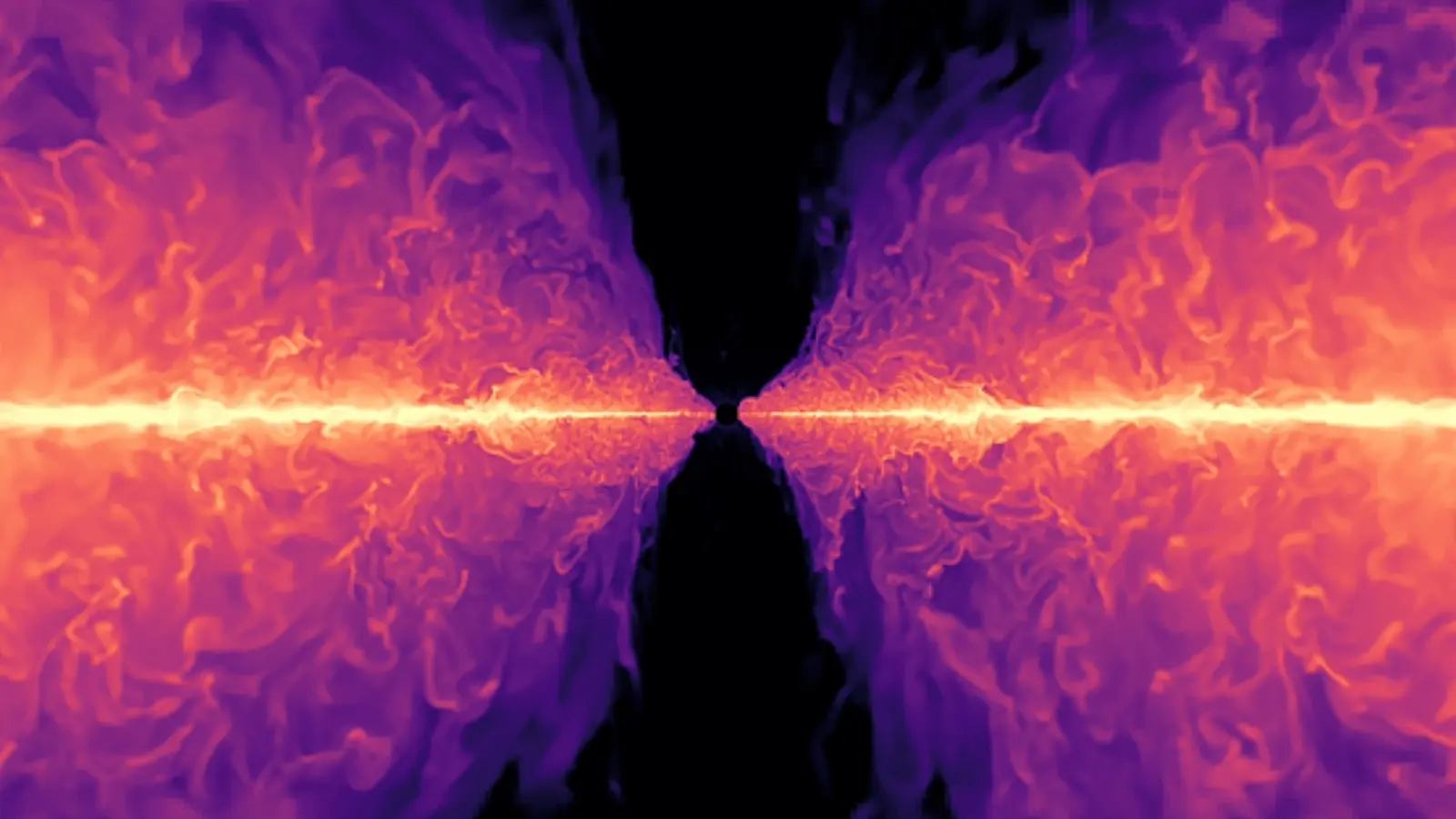
Advanced simulations on two powerful supercomputers have produced the most detailed picture yet of how stellar-mass black holes swallow gas and launch it back into space. By combining observations, measured spins and magnetic fields with fully relativistic radiation physics, researchers have lifted longstanding simplifications and revealed structures that control accretion rates, jets and observable radiation.
A clearer look at accretion near black holes
Black hole borderlands are extreme arenas: gravity stretches space and time, ionized plasma races at relativistic speeds, magnetic fields twist and light itself is bent. Until now, many models relied on mathematical shortcuts to keep calculations tractable. The new study from the Flatiron Institute replaces those approximations with a self-consistent numerical treatment of radiation, fluid dynamics and general relativity, producing simulations that match a wide range of observed behaviors across different black hole systems.

When a stellar-mass black hole attracts enough material, a dense accretion disk forms. The simulations show that in fast-spinning, high-accretion-rate cases the disk becomes much denser toward the inner regions. High density and strong magnetic fields carve an inner funnel that channels inflowing gas and focuses outgoing radiation into a narrow beam. That beam is only visible from certain angles, explaining why some sources appear unusually bright while others of the same type remain faint.
Winds and jets emerge naturally from the modeled flows. Radiation trapped by an optically thick disk can be converted into kinetic power, driving powerful outflows. Magnetic field geometry turned out to be a decisive factor: field lines guide material inward and collimate jets outward, shaping both the mass inflow and the observables astronomers detect in X-ray and radio bands.
Why the realistic treatment of radiation matters
One key advance in these simulations is treating photons as they really behave within curved spacetime. The code integrates Einstein's general theory of relativity with the microphysics of plasma, magnetic fields and light-matter interactions. According to lead researcher Lizhong Zhang from the Flatiron Institute, 'This is the first time we've been able to see what happens when the most important physical processes in black hole accretion are included accurately.' The team notes that any over-simplifying assumption can alter outcomes drastically because these systems are highly nonlinear.
Practically, this means the models follow how photons propagate, scatter and are absorbed in the warped spacetime close to the event horizon. That precision matters when predicting spectra, variability, and the timing of flares. The simulations converge to known solutions for waves and shocks in limiting cases, giving researchers confidence that the algorithm captures both small-scale plasma behavior and large-scale relativistic effects.
Implications for observations and outstanding puzzles
These simulations bridge a gap between high-resolution images of supermassive black holes and the harder-to-interpret light from smaller, stellar-mass systems. While instruments like the Event Horizon Telescope produce direct images of supermassive cores, emission from stellar-mass black holes typically requires spectral and timing analysis. The new models reproduce features seen across different observational classes and offer explanations for puzzling phenomena, such as sources that emit much less X-ray radiation than expected — the so-called 'little red dots.'
The team suggests that many qualitative aspects of their results could extend to supermassive black holes as well. Although the simulations use opacities tuned to stellar-mass accretion, key mechanisms like funnel formation, magnetic collimation and angle-dependent radiation release are likely to apply across mass scales. That raises the possibility of testing the models against Sagittarius A* and other galactic nuclei as higher fidelity observations become available.
Expert Insight
Dr. Anna Reyes, an observational astrophysicist who studies accreting X-ray binaries, comments: 'These simulations are a major step forward because they let us connect what theory predicts with what telescopes actually see. The angle-dependent beaming and the role of magnetic geometry help explain why two similar systems can look so different. This kind of modeling will be crucial as next-generation X-ray and radio observatories deliver richer datasets.'
The research, published in The Astrophysical Journal, relied on two high-performance supercomputers to combine survey data, spin measurements and magnetic diagnostics. That computational heft allowed the team to avoid earlier simplifying assumptions and to include physically realistic opacities, photon transport and relativistic dynamics in a single framework.
Conclusion
By treating radiation, magnetism and relativistic gravity together, the new simulations reveal how dense inner disks, magnetic fields and narrow funnels govern the inflow and outflow of matter around stellar-mass black holes. The work narrows the gap between theory and observation, suggests pathways for interpreting low-X-ray emitters, and lays the groundwork for applying the same methods to supermassive black holes like Sagittarius A*. As observational capabilities improve, these models will be a vital interpretive tool in high-energy astrophysics.

“My work centers on sustainability, energy, and environmental science — examining how innovation can lead to a greener future.”

Discussion
Leave a Comment