
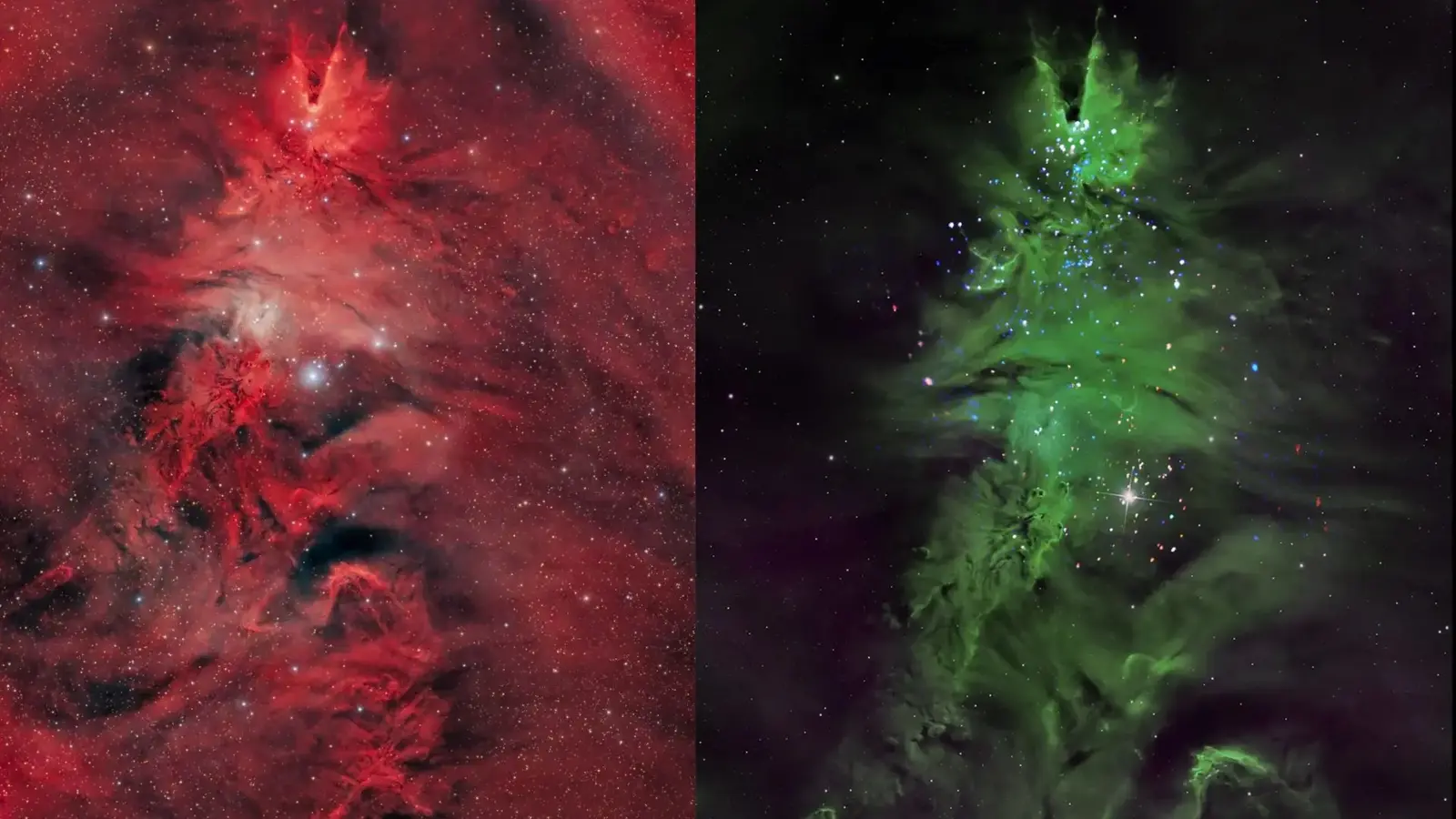
A sprawling stellar nursery 2,700 light-years away is glowing like a festive ornament. The region known as NGC 2264 — home to the visually striking Christmas Tree Cluster, the Cone Nebula and the Fox Fur Nebula — showcases how newborn stars sculpt and illuminate their surroundings across tens of light-years.
Glowing clouds of gas and dust form the Christmas Tree cluster in the star-forming region NGC 2264, where newborn stars light up the surrounding nebula like celestial ornaments. The Cone Nebula crowns the scene at the top, while the swirling Fox Fur Nebula spreads below, creating a festive cosmic tableau nearly 80 light-years wide. Credit: Copyright Michael Kalika
What shapes this cosmic tree?
NGC 2264 is a complex of interstellar gas, dust and young stars located in the constellation Monoceros, near the plane of the Milky Way. Dense clouds of molecular hydrogen provide the raw material for star formation. When pockets of that gas collapse under gravity, protostars form and eventually ignite nuclear fusion. The intense ultraviolet radiation and stellar winds from these young, hot stars then interact with the surrounding gas and dust, carving out pillars, bright rims and shadowed lanes.

Emission versus reflection
Two physical processes create the region’s vivid colors. Emission nebulae glow when hot, ionizing radiation excites hydrogen atoms, which then emit light — usually red from H-alpha emission. Reflection nebulae, by contrast, shine by scattering starlight off small dust grains; that scattered light often appears bluish because shorter wavelengths scatter more efficiently. In NGC 2264, both effects are present: red emission from ionized hydrogen and blue-tinted reflection around some stars.
Key features: S Monocerotis, the Cone and the Fox Fur
At the cluster’s visual center sits S Monocerotis (S Mon), a bright and variable O- or B-type star whose strong radiation helps illuminate nearby clouds. Above S Mon, observers see a loose triangular arrangement of young stars that gives the region its holiday nickname: the Christmas Tree Cluster.
The Cone Nebula caps the formation as a dramatic pillar of dark dust and gas shaped by the erosion from nearby massive stars. Below it, the Fox Fur Nebula spreads into a textured, tangled mass of illuminated gas and filaments. The contrasting silhouettes and glowing surfaces make NGC 2264 a favorite target for both professional telescopes and amateur astrophotographers.
Scale, distance and visibility
Although this structure occupies about 1.5 degrees on the sky — roughly the width of three full moons laid side by side — its great distance makes its true span immense: nearly 80 light-years from tip to tip. Located some 2,700 light-years from Earth, NGC 2264 is best seen during winter months from mid-northern latitudes and can be captured with modest telescopes or long-exposure cameras when skies are dark and clear.
Beyond the visual spectacle, NGC 2264 is scientifically valuable. Studies of its pre-main-sequence stars, protoplanetary disks and feedback from young massive stars help astronomers understand how stellar clusters form, evolve and influence future generations of stars. Observations across wavelengths — optical imaging, infrared surveys and radio maps of molecular gas — combine to reveal the region’s structure and timeline.
Observing and future study
Amateur and professional observers continue to monitor NGC 2264 for variable stars, jets from protostars and changes in nebular illumination. Upcoming survey missions and instruments with improved infrared sensitivity will probe the dusty cores where the youngest protostars hide, while high-resolution spectroscopy can map gas motions and chemical composition. Together, these studies help place the Christmas Tree Cluster in a broader context of galactic star formation.

“The cosmos has always fascinated me. I write about space missions, astronomy, and the technologies pushing humanity beyond Earth.”

Discussion
Leave a Comment