
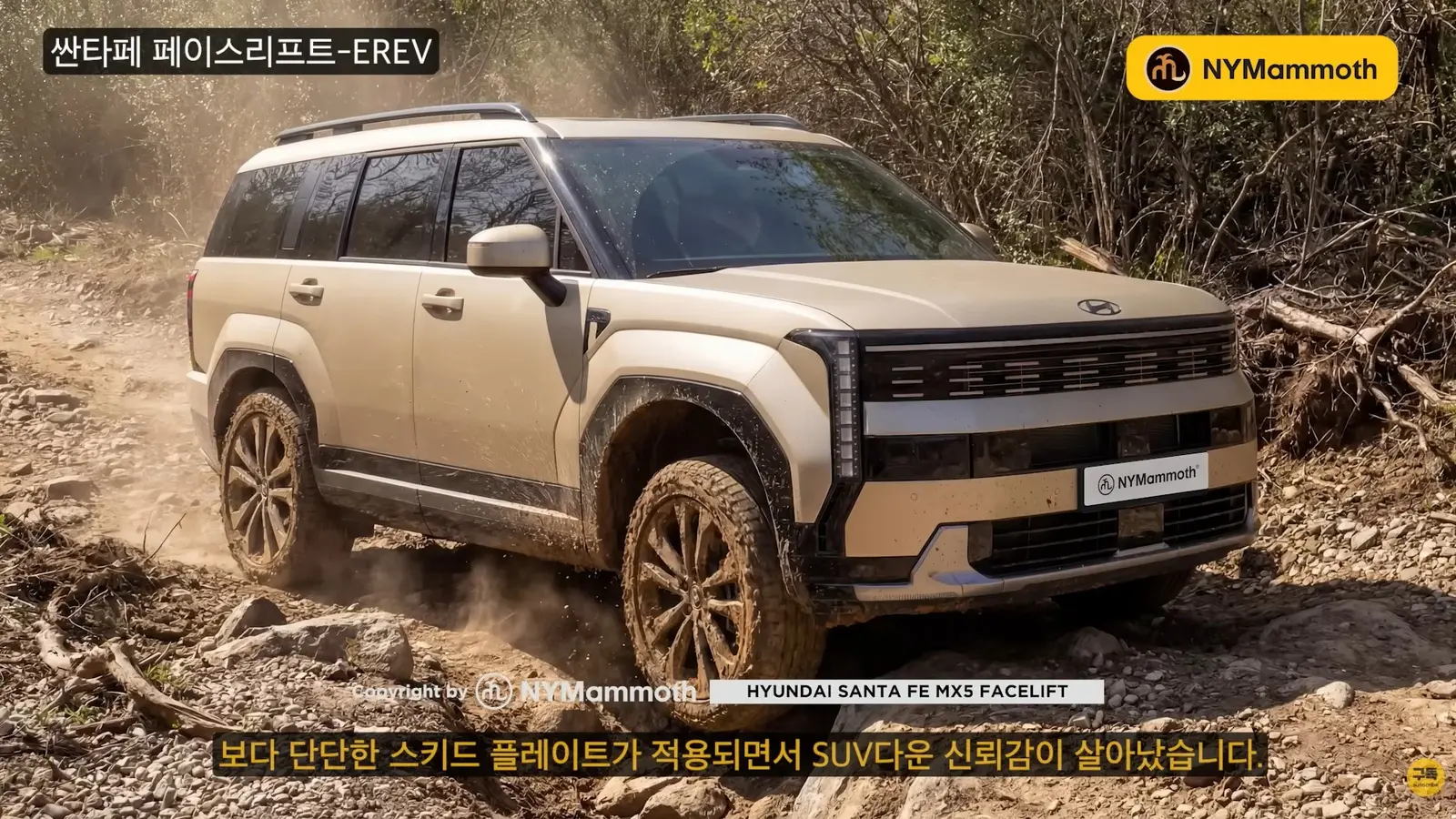
Digital facelift teases a new direction for the Santa Fe
Hyundai's momentum in North America remains strong, and while monthly deliveries can dip, the brand posted record retail and total sales through the first eleven months of the year. Riding that wave, digital artists and car fans are already speculating about how Hyundai might evolve its mid-size Santa Fe — and one recent CGI project imagines a 2027 mid-cycle refresh that introduces sharper styling and an extended-range EV (EREV) powertrain.
Why a facelift would make sense
The current, fifth-generation Santa Fe (MX5) only landed for the 2024 model year, so a full redesign is not imminent. Still, some buyers and enthusiasts find the rugged, boxy look polarizing despite healthy sales. With rivals refreshing lineups frequently and buyer tastes shifting toward electrified SUVs, an early mid-cycle update could keep Santa Fe competitive against models such as the Toyota Highlander, Honda Passport, and Ford Edge.

What the CGI concept shows
Created by New York-based digital artist NYMammoth, the unofficial render reimagines the Santa Fe with a much cleaner front end and LED-focused graphic elements. Instead of Hyundai's current 'H' motif integrated into the headlight clusters, the concept uses vertical LED signatures and turns the grille plane into an LED display — a look inspired by Hyundai's newer Palisade family design but with its own personality.
The artist stages the refreshed Santa Fe in multiple scenarios: urban streets, weekend trailheads, and improvised overlanding setups — signaling a dual-purpose identity for buyers who want both daily comfort and outdoor capability. He also offers alternate colorways and a behind-the-scenes look at his creative process, underscoring how enthusiast feedback shapes these visual exercises.
Key visual changes (concept)
- Vertical LED daytime running lights replacing the 'H' motif
- Grille treated as an LED surface with integrated lighting cues
- Subtle bumper and wheel redesign to emphasize a more squared, premium stance

EREV: what it is and why it matters
One of the more interesting parts of the CGI project is the suggested EREV powertrain. EREV stands for extended-range electric vehicle: an EV-first architecture that carries a small internal-combustion generator to recharge the battery and extend driving range when needed. Hyundai's interpretation, as shown in the concept, leans toward a two-motor arrangement rather than the more complex three-motor layouts some manufacturers explore.
In this simplified two-motor EREV setup:
- One motor performs primary propulsion duties.
- The second motor can function as a drive unit, while a small engine acts as a range-extending generator when battery charge is low.
The result is an EV-like driving experience with reduced range anxiety and simpler packaging compared with full hybrid or plug-in systems that rely heavily on the combustion engine for propulsion.
Performance and positioning
Because this is a speculative digital rendering, detailed specs are not provided. But if Hyundai were to introduce an EREV option on the Santa Fe, buyers could reasonably expect:
- Electric-first driving with an internal combustion range extender
- Competitive electric-only range for daily commuting (benchmark: PHEV-class 30–50 miles) when configured appropriately
- Smooth, instant electric torque with on-demand generator support for long trips
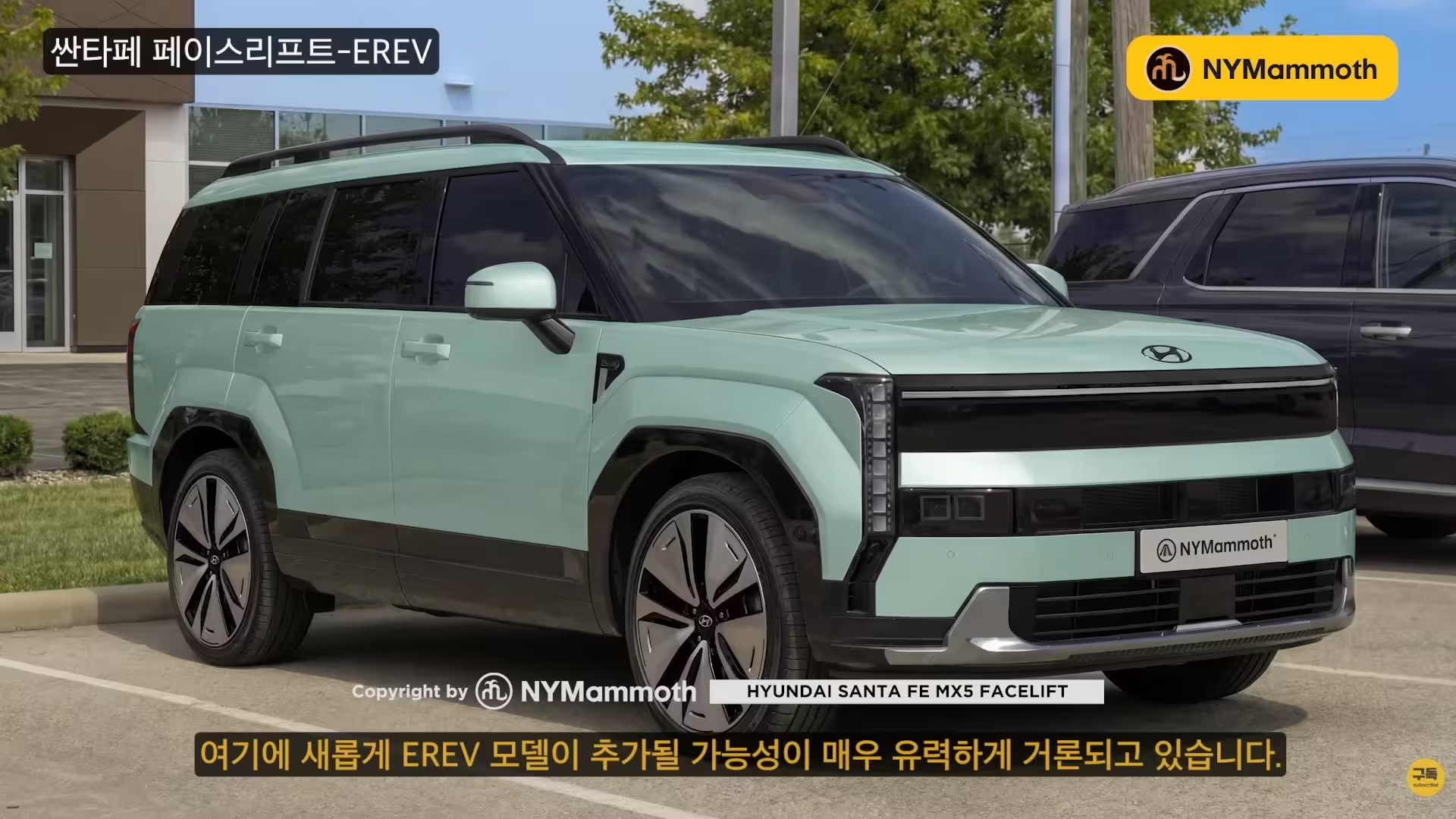
Such a powertrain would position the Santa Fe between traditional hybrids and full-battery SUVs — appealing to shoppers who want near-EV driving behavior without commitment to charging infrastructure on long journeys.
Market implications and what to watch
Hyundai sits fourth in the US market alongside Kia, behind Ford, Toyota (TMNA), and GM, and sold roughly 823,000 units in the recent reporting period — outperforming Kia's previous records. To maintain that trajectory, Hyundai needs to keep its model mix fresh and answer shifting consumer demand for electrification.
Questions to follow:
- Should Hyundai roll out EREV technology on a mainstream model like the Santa Fe or debut it on a larger flagship like the Palisade?
Will conservative buyers embrace a boxier, more LED-heavy look, or prefer incremental updates?
'Digital projects like this are useful because they test ideas before engineering budgets are committed,' says one industry observer. 'They spark conversation about styling, technology and market fit.'
Whether Hyundai adopts this precise visual language or EREV packaging for the Santa Fe, the concept highlights two truths: consumers want more options in electrified crossovers, and styling refreshes can help sustain interest between full redesigns. For now, the CGI render is a thought experiment — but it offers a clear view of how the Santa Fe could evolve to meet changing tastes and electrified market demands.

“Cars are evolving faster than ever. I cover electric vehicles, smart mobility, and the future of transportation worldwide.”

Discussion
Leave a Comment