
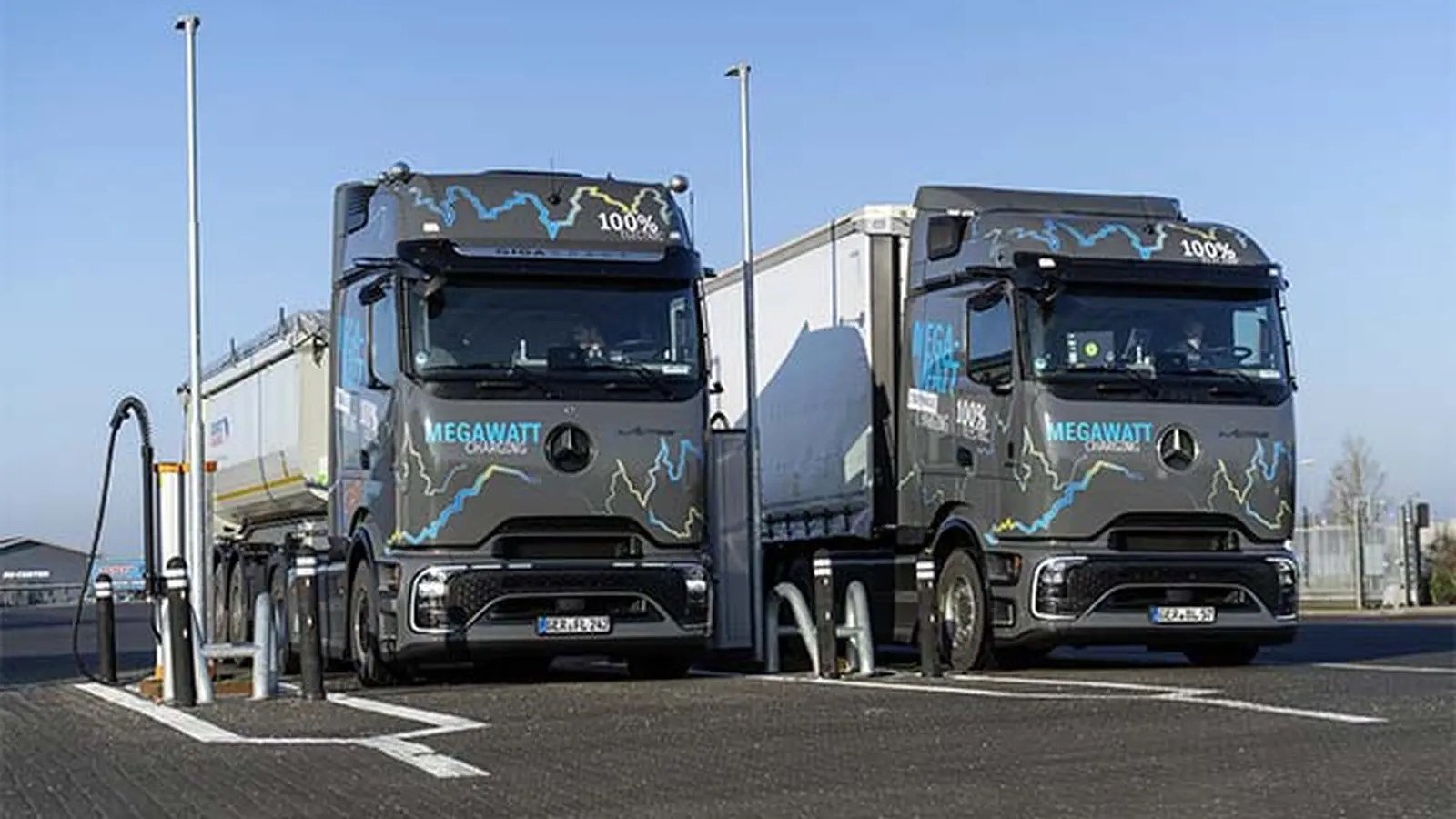
Mercedes-Benz Trucks is taking megawatt charging out of the lab and onto Europe’s highways. In a real-world endurance run spanning roughly 2,400 kilometers, the company is validating the Megawatt Charging System (MCS) with two prototype Mercedes-Benz eActros 600 electric trucks—aiming to prove that ultra-fast charging can work reliably in daily long-haul conditions, including cold-weather operation.
A 2,400 km stress test for the next era of truck charging
The route begins at Mercedes-Benz’s plant in Wörth am Rhein, Germany, and continues through the Netherlands, Belgium, and Denmark before finishing in Linköping, southern Sweden. The idea isn’t simply to rack up miles; it’s to repeatedly charge and drive in different countries, climates, and grid environments—exactly the kind of variation fleet operators face in cross-border logistics.
Along the way, the eActros 600 test trucks are scheduled to recharge at a mix of public and private MCS truck charging locations. That matters because megawatt charging infrastructure is still emerging in Europe, and early installations can differ in hardware design, cooling strategies, and power delivery behavior.
Why Mercedes is focusing on “compatibility” first
MCS promises charging power of up to 1,000 kW—far beyond today’s widely used CCS (Combined Charging System) solutions for heavy-duty vehicles. But the real make-or-break factor is interoperability: a truck must communicate and charge smoothly across chargers from different manufacturers, with consistent performance and safety.
Mercedes-Benz Trucks says its engineers are closely monitoring real-world metrics such as:
- Charging curve behavior (how power rises and tapers during a session)
- Average charging power over time
- Station-to-vehicle communication and stability
- Thermal management under high-current loads
- Reliability of the overall MCS charging infrastructure in daily use
Peter Ziegler, Head of E Charging Components at Mercedes-Benz Trucks, underscored the key engineering hurdles: “The key challenges in megawatt charging lie in harmonizing the vehicle with various charging systems. At the same time, the extreme charging currents in MCS charging place high demands on thermal management. The current test run provides an important opportunity to evaluate these aspects under real-world operating conditions.”
MCS vs CCS: what megawatt charging changes for fleets
For commercial EV adoption, charging time is more than convenience—it’s utilization. The faster a battery-electric truck can get back on the road, the closer it comes to the operational rhythm of diesel long-haul transport.
With MCS, Mercedes-Benz points to a headline figure that will catch any fleet manager’s attention: the eActros 600 can charge from 20% to 80% in about 30 minutes under suitable conditions. Compared with current CCS-based heavy-duty charging, that step-up in power can turn mandated driver breaks into productive “energy stops,” rather than downtime.
The business case: more uptime, more flexible routes
Mercedes argues that megawatt charging could improve long-haul logistics planning by enabling:
- More predictable turnaround during regulated rest periods
- Higher daily mileage targets with intermediate top-ups
- Better route flexibility as public charging expands
There’s a catch, of course: public MCS truck charging sites are still limited in Europe. In the near term, early benefits may favor fleets that can access private depot or corridor charging—especially freight forwarders running fixed routes.
Standardization: CharIN’s role in building a pan-European network
MCS isn’t just a Mercedes project. The standard is being driven by CharIN (Charging Interface Initiative), working alongside truck manufacturers to align global requirements. The goal is a uniform, heavy-duty fast-charging interface—so a battery-electric truck can plug in anywhere across borders with minimal friction.
If standardization succeeds, it could accelerate a true pan-European charging network for electric heavy-duty trucks, reducing fragmentation and improving confidence for operators investing in battery-electric transport.
Mercedes eActros 600 specs: built for long-haul EV reality
The eActros 600 is positioned as Mercedes-Benz Trucks’ battery-electric flagship for long-distance haulage. Its core hardware is designed to deliver usable energy, durability, and payload practicality—three topics that often define whether an electric truck can work beyond regional delivery.
Battery and chemistry
The truck uses three battery packs rated at 207 kWh each, for a total installed capacity of 621 kWh. Mercedes highlights lithium iron phosphate (LFP) cells, chosen for their long service life and strong usable-capacity characteristics. Unlike some other cell chemistries, LFP can allow more than 95% of installed capacity to be used—helping stretch real-world range without simply adding more battery mass.
Range, payload, and weight ratings
With its newly developed, highly efficient electric drive axle and over-600-kWh battery pack (the reason behind the “600” name), Mercedes targets around 500 km of range without intermediate charging. Importantly, that figure is stated under realistic operating conditions: a 40-ton gross train weight.
The truck is engineered for a combined gross train weight of up to 44 tons. With a standard semi-trailer, Mercedes cites roughly 22 tons of payload in the EU, with potential variations depending on national regulations.
What this test signals for the electric truck market
The most telling line in Mercedes-Benz’s long-haul EV strategy is the daily-distance ambition: the eActros 600 is expected to cover well over 1,000 kilometers per day when intermediate charging is aligned with legally required driver breaks—assuming MCS charging access.
That “assuming” is exactly why this cross-Europe test matters. Megawatt charging is the hinge between impressive specs on paper and battery-electric trucks becoming a mainstream option for long-haul freight. By validating MCS in winter conditions and across multiple charger providers, Mercedes-Benz Trucks is effectively stress-testing the ecosystem—vehicle, infrastructure, and standards—at the same time.

“I cover automotive innovation, electric vehicles, and the future of mobility — where technology meets sustainability.”

Discussion
Leave a Comment