
4 Minutes
Two flagship silicon designs from late 2025 — Qualcomm's Snapdragon 8 Gen 5 and MediaTek's Dimensity 9500 — duked it out in benchmarks and feature rounds. Both promise top-tier performance, advanced AI, and modern camera and connectivity tech, but the champions differ depending on what you value most: raw speed, gaming, power efficiency, or imaging smarts. Here’s a clear breakdown to help you pick.
Where the numbers land
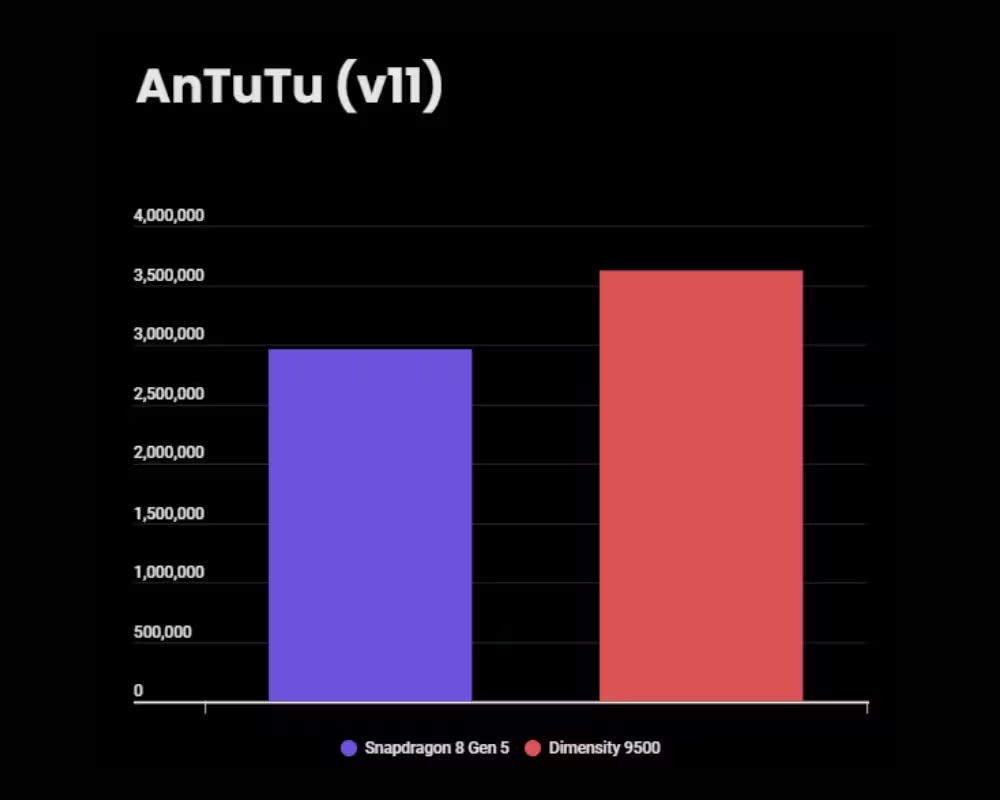
Benchmarks give the Dimensity 9500 an early lead. On Geekbench, the Dimensity posts a roughly 21% higher single-core score (3,452 vs 2,837) and about 8% higher multi-core (10,128 vs 9,352). AnTuTu amplifies that gap: the Dimensity hits 3,622,840 compared with the Snapdragon’s 2,961,236 — largely thanks to much stronger GPU and memory subscores.
Those AnTuTu details tell the story: MediaTek’s SoC outscored Qualcomm by a large margin on GPU (1,364,441 vs 974,402) and memory (602,541 vs 382,729). UX and CPU scores were closer, but the heavier graphics and memory advantages push Dimensity ahead in overall system benchmarks. Keep in mind, these tests used a OnePlus 15R (Snapdragon) and a Vivo X300 Pro (Dimensity), so OEM tuning and thermal design shape real-world results.

Architectural differences that matter
Under the hood, the two chips take different approaches. Snapdragon 8 Gen 5 pairs Qualcomm’s third‑generation Oryon cores in a 2+6 layout (two primes and six performance cores) with an Adreno 840 GPU and the Hexagon NPU. MediaTek’s Dimensity 9500 uses newer Cortex C1-series cores in a 1+3+4 arrangement (C1‑Ultra prime plus C1‑Premium and C1‑Pro clusters) and a Mali‑G1 Ultra MP12 GPU, plus the NPU 990.
- CPU: Dimensity’s peak clocks are higher, which helps in single‑thread bursts and heavy multi‑core loads.
- GPU: Dimensity shows stronger raw graphics numbers and explicit support for 120fps ray‑traced mobile gaming; Snapdragon leans on its Adreno stack and Snapdragon Elite Gaming features for smoother frame pacing and lower latency.
- NPU: Both support agentic and multimodal AI workloads — useful for on-device processing like smarter image pipelines and real-time assistants.
Camera, memory and connectivity
Imaging and I/O are close but different. Qualcomm’s Spectra triple AI ISP is a 20‑bit pipeline aimed at computational photography and advanced segmentation, while MediaTek’s Imagiq 1190 ISP boasts similar raw sensor support and high‑res capture. Memory speeds tip in MediaTek’s favor (LPDDR5X up to 5.3 GHz vs Snapdragon’s up to 4.8 GHz), and both support UFS 4.1 storage.
On connectivity, Snapdragon often pulls ahead in modem maturity and carrier support: Qualcomm advertises peak 5G downloads up to 10 Gbps (Snapdragon X50 modem) versus MediaTek’s 7.4 Gbps peak. Wi‑Fi 7 and Bluetooth 6.0 support appear in both camps, but carrier aggregation and real‑world modem behavior can favor Qualcomm in certain regions like North America.
Real-world takeaways: which should you choose?
If you chase raw benchmarks, gaming performance, and memory bandwidth, the Dimensity 9500 is the more compelling chip — it delivers higher synthetic scores and better GPU throughput, which translates to higher framerates and snappier heavy workloads on tuned devices. It also looks efficient on paper thanks to C1‑series cores.
But for balanced camera processing, wider modem compatibility, and often a more affordable device selection, Snapdragon 8 Gen 5 remains a very sensible option. Qualcomm’s ISP and connectivity stack give it an edge in computational photography and carrier‑dependent performance, and manufacturers frequently price Snapdragon phones competitively.
Bottom line: choose Dimensity 9500 for maximum on‑paper performance and top‑tier gaming; pick Snapdragon 8 Gen 5 if you want strong all‑round imaging, broader modem support, and value. And remember — phone design, thermal tuning, and OEM software optimizations matter just as much as raw silicon.
Source: gizmochina


Comments
Reza
Is this even true? Benchmarks vs real life, phones often nerf stuff, plus heat throttling. Show me gaming 1v1 tests, not just AnTuTu
chipflux
Wow, Dimensity stomps the GPU and memory, didn't expect that. Snapdragon still wins on modem/camera tho. OEM cooling and tuning gonna decide real games, not numbers...

Leave a Comment