
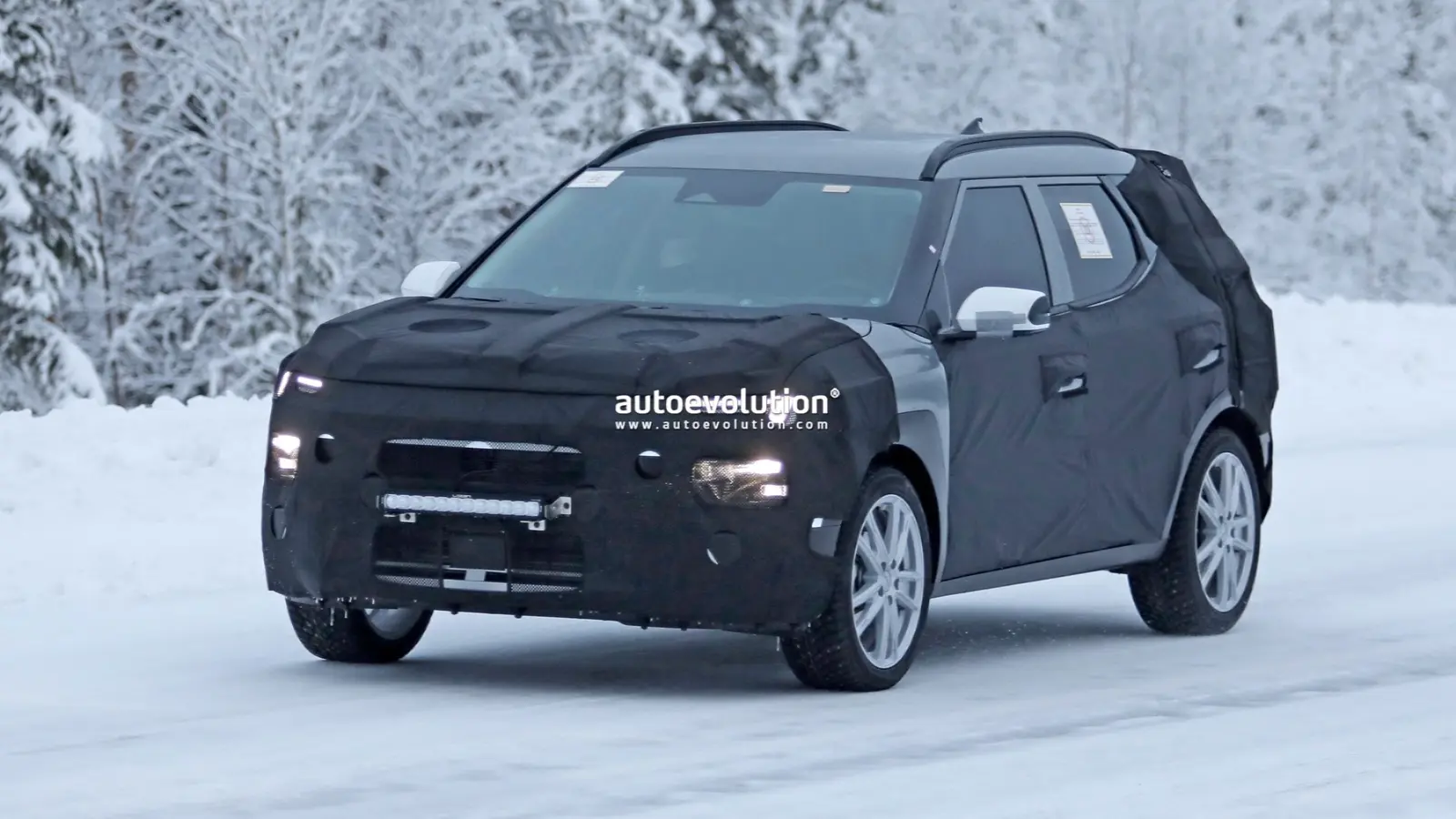
New Bayon prototype braves Arctic test routes
Hyundai's subcompact crossover, the Bayon, has been sighted undergoing cold-weather testing near the Arctic Circle — and the second-generation model looks noticeably more rugged and boxier than the outgoing car. Slated to arrive in showrooms in 2027 and internally known as the BC4, the refreshed Bayon appears aimed at sharpening its road presence in Europe and other markets where B-segment SUVs remain highly competitive.
Design: tougher stance, sharper lighting
Even under heavy camouflage, the new Bayon projects a more upright silhouette. Photographs reveal a squarer front and rear, a rectangular grille treatment and eye-catching split headlights that create a stronger face than the current model. At the rear, revised taillight signatures distinguish the newcomer from the outgoing Bayon, hinting at a more modern lighting graphic.

A few design highlights spotted so far:
- Boxier roofline and more vertical tailgate for improved load space
- Broader track and longer wheelbase for better stability and presence
- Split headlight layout and new taillight signature for a fresh identity
Chassis and suspension: practical choices
Under the skin, spy shots suggest Hyundai has opted for a coupled torsion-beam rear axle on this prototype. This semi-independent solution lets designers keep the cargo floor low and maximize trunk volume — a priority in the B-segment where practicality matters. While torsion beams save space and cost, they typically sacrifice some ride compliance and cornering finesse versus a multi-link setup.

Up front, the Bayon is expected to retain independent MacPherson struts, but with revised springs and damping. An anti-roll bar linked with rods aims to reduce body roll and keep handling composed through twisty roads.
Interior and tech: a more modern cabin
Hyundai appears to be upgrading the cockpit for a tech-forward experience. Expect a fully digital instrument cluster, a larger touchscreen infotainment system and expanded driver-assistance features. Safety kit is likely to be beefed up across the lineup, reflecting rising market expectations and stricter regulations in Europe.

Powertrains: familiar engines, with hybrid on the horizon
Under the hood, Hyundai will likely continue offering Smartstream petrol units in Europe. The current Bayon uses a 1.0-liter T-GDi three-cylinder turbo that produces roughly 90 PS (89 hp) and 172 Nm (127 lb-ft). Some markets also get a naturally aspirated 1.2-liter four-cylinder (about 79 PS). Transmission choices on the first-generation model included five- and six-speed manuals and a seven-speed dual-clutch automatic (DCT).
With Euro 7 rules approaching, a hybrid option is widely expected for 2027, though details remain unclear — it could be a mild-hybrid or a fuller self-charging hybrid depending on the platform and market.
Market positioning and outlook
Not sold in the United States, the Bayon is primarily aimed at European and Indian buyers who want a compact crossover with practical packaging and affordable running costs. The second-gen Bayon's larger footprint, updated styling and added tech should help it remain a strong contender in the crowded B-segment.
Quote: "The new Bayon is shaping up to be a more mature, space-focused rival — with modern tech and practical upgrades at its core."
Key takeaways:
- Launch expected in first half of 2027, initially in Europe
- Boxier, more rugged styling with improved interior space
- Torsion-beam rear axle for increased cargo volume
- Continuation of Smartstream petrol engines; hybrid likely due to Euro 7
For buyers and enthusiasts, the 2027 Bayon promises sensible evolution rather than radical change: more space, sharper styling and modernized tech while keeping the practical foundations that made the first-generation model successful.

“I cover automotive innovation, electric vehicles, and the future of mobility — where technology meets sustainability.”

Discussion
Leave a Comment