
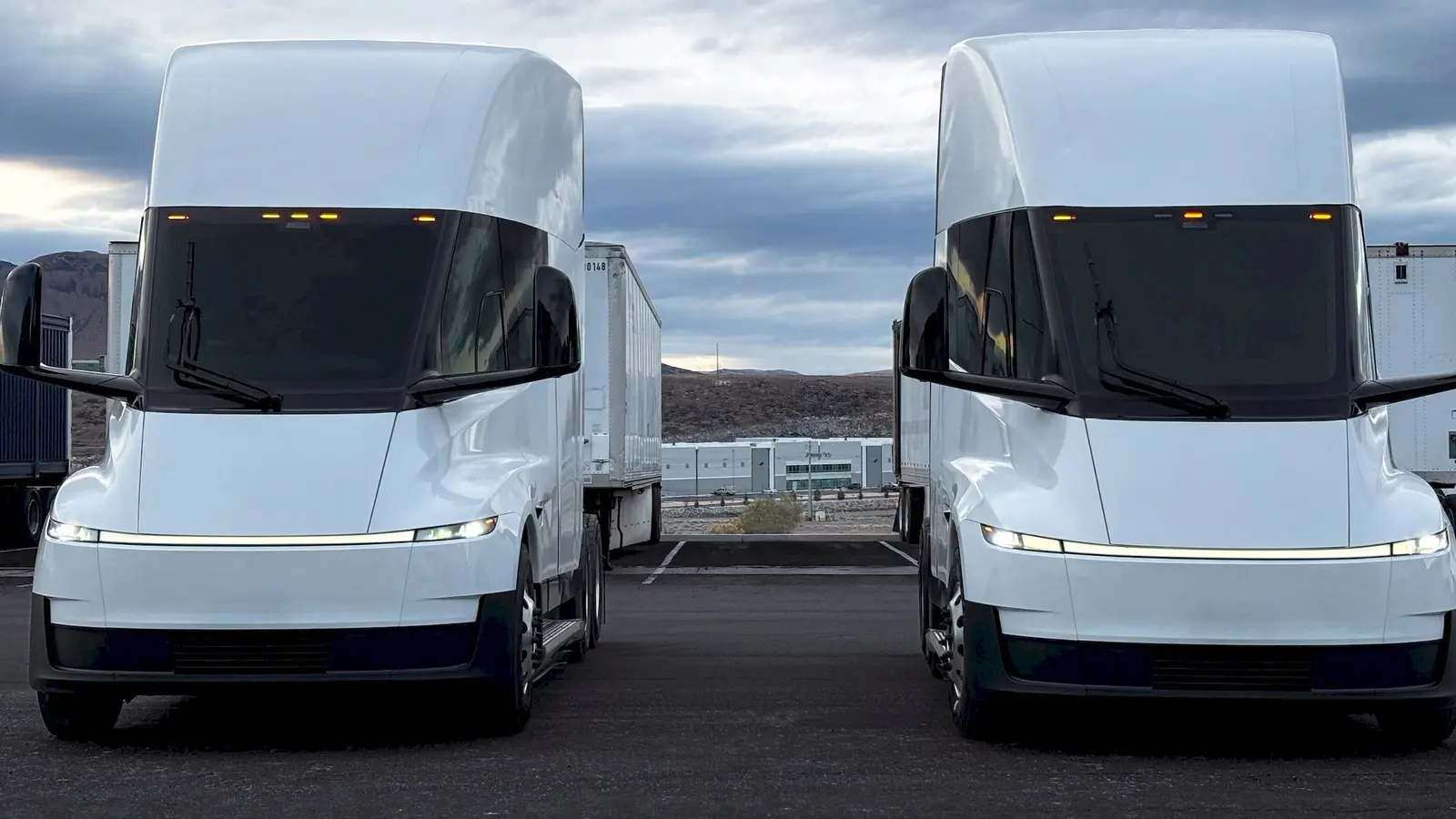
Tesla freezes Semi specifications ahead of volume production
Tesla has published the official specifications for its long-awaited Semi as the company marches toward volume production at its Nevada facility. After nearly a decade of development and pilot deliveries, the electric Class 8 truck’s technical sheet is now locked — and the numbers largely mirror the prototype promises that first captured the industry’s attention.

Two trims, familiar figures
Tesla is offering the Semi in two trims: Standard Range and Long Range. Both retain the same core architecture — three independent motors powering the rear axles and a gross combination weight rating of 82,000 lb (37,195 kg) — but differ in battery capacity and usable driving range.
- Standard Range: approximately 325 miles (523 km)
- Long Range: approximately 500 miles (805 km)
Energy consumption is listed at around 1.7 kWh per mile, a figure fleets will scrutinize when comparing total cost of ownership with diesel tractors. Those metrics are central to adoption decisions for long-haul fleets weighing fuel and electricity costs, range requirements, and charging infrastructure readiness.

Motive power and charging
Tesla quotes drive capability of "up to 800 kW" from the three rear motors — a headline number that equates roughly to 1,070 hp but likely reflects a peak output rather than a continuous rating. That wording suggests peak power bursts for on-ramps or steep grades, with sustained power limited by thermal and battery constraints.
A major selling point is charging speed: the Semi uses the Megawatt Charging System (MCS) 3.2 port. The Long Range model supports a claimed peak of 1.2 MW, enabling roughly a 60% state-of-charge gain in about 30 minutes under ideal conditions. For fleet operations, that can translate to significantly reduced downtime versus slower chargers.
Other practical features include an ePTO (electric power take-off) rated up to 25 kW (about 34 hp), which lets the truck power refrigeration units, hydraulic pumps or other auxiliary equipment without idling a diesel engine.

Autonomy and market positioning
Tesla describes the Semi as "designed for autonomy," implying integration with its Full Self-Driving (FSD) software and driver-assist hardware. How regulators and customers will adopt SAE-level autonomy in heavy trucks remains an open question, but autonomy readiness is increasingly part of procurement conversations for large fleets focused on safety and long-term operating costs.
So far Tesla has completed limited fleet pilot deliveries to companies such as PepsiCo and DHL. Those trials have provided real-world feedback on uptime, charging logistics, and total cost of ownership — data Tesla can use to refine production ramp plans and dealer/fleet support.
Production outlook and industry context
Tesla committed to beginning volume production at a dedicated Nevada factory in 2026. That pledge comes at a time when the company’s broader vehicle production forecasts have been scaled back from earlier, more aggressive targets. Still, unlike some recent Musk-era product promises, the Semi appears to be holding to its original performance objectives.
Fleet buyers will judge the Semi against legacy diesel tractors and competing electric Class 8 offerings on metrics such as range, charging throughput, payload capability, reliability, and lifecycle cost. Real-world factors — electricity prices, depot charging capacity, and driver workflows — will influence how quickly fleets shift to electric trucks.

Key takeaways
- Tesla’s volume-production Semi aligns closely with prototype specifications.
- Two trim levels: 325-mile Standard Range and 500-mile Long Range.
- MCS 3.2 charging at up to 1.2 MW (Long Range) supports fast replenishment.
- Design targets autonomy readiness and includes practical features like a 25 kW ePTO.
Quote: "The Semi’s published specs show Tesla is serious about delivering an electric truck that meets fleet expectations — but the industry's real test will be production cadence, uptime, and total cost of ownership."
As production ramps in 2026, the Semi’s success will depend as much on charging networks, operational support and economics as on headline range and power numbers. For truck buyers and EV watchers, the next 12–24 months will reveal whether Tesla’s Class 8 challenger can move from impressive prototype to reliable backbone of zero-emission freight.

“Cars are evolving faster than ever. I cover electric vehicles, smart mobility, and the future of transportation worldwide.”

Discussion
Leave a Comment