
If you were waiting for a desktop-platform shake-up from Intel, the leak that just surfaced will make you sit up. A source known as "Jaykihn" has sketched out the company's planned 900-series chipset family for the upcoming Nova Lake-S processors, and the roadmap looks calculated, not accidental.
Five chipset SKUs are named: Z990, Z970, W980, Q970 and B960. All of them will land on motherboards using a new LGA 1954 socket and are timed to arrive alongside Intel's Nova Lake-S desktop CPUs in the second half of 2026. The list reads like a tiered lineup: two overclocking-capable parts at the top, a workstation variant, and two business/entry models toward the bottom.
The Z990 is positioned as the flagship. According to the leak it exposes up to 48 PCIe lanes overall, with 12 lanes listed as PCIe 5.0 and another 12 as PCIe 4.0; the report does not fully itemize the remaining routes. Z990 supports both multiplier overclocking and base-clock adjustments, making it the most flexible option for enthusiasts who want to push CPU and memory frequencies. Storage and I/O balance are strong here too: eight SATA 3.0 ports, a pair of USB4/Thunderbolt 4 ports, and five USB 3.2 ports rated at 20 Gbps.
A step down, the Z970 keeps many of the flagship's traits but narrows the tuning toolkit. It allows multiplier-based overclocking for CPU and memory but drops base-clock tweaking. The Z970 is focused on PCIe Gen4, offering 14 PCIe 4.0 lanes and no native PCIe 5.0 lanes in the chipset itself. Its storage and I/O are also pared down: four SATA ports, a single USB4/Thunderbolt 4, and up to two 20 Gbps USB 3.2 ports—enough for mainstream and higher-end gaming builds that don't need the absolute top-tier connectivity.
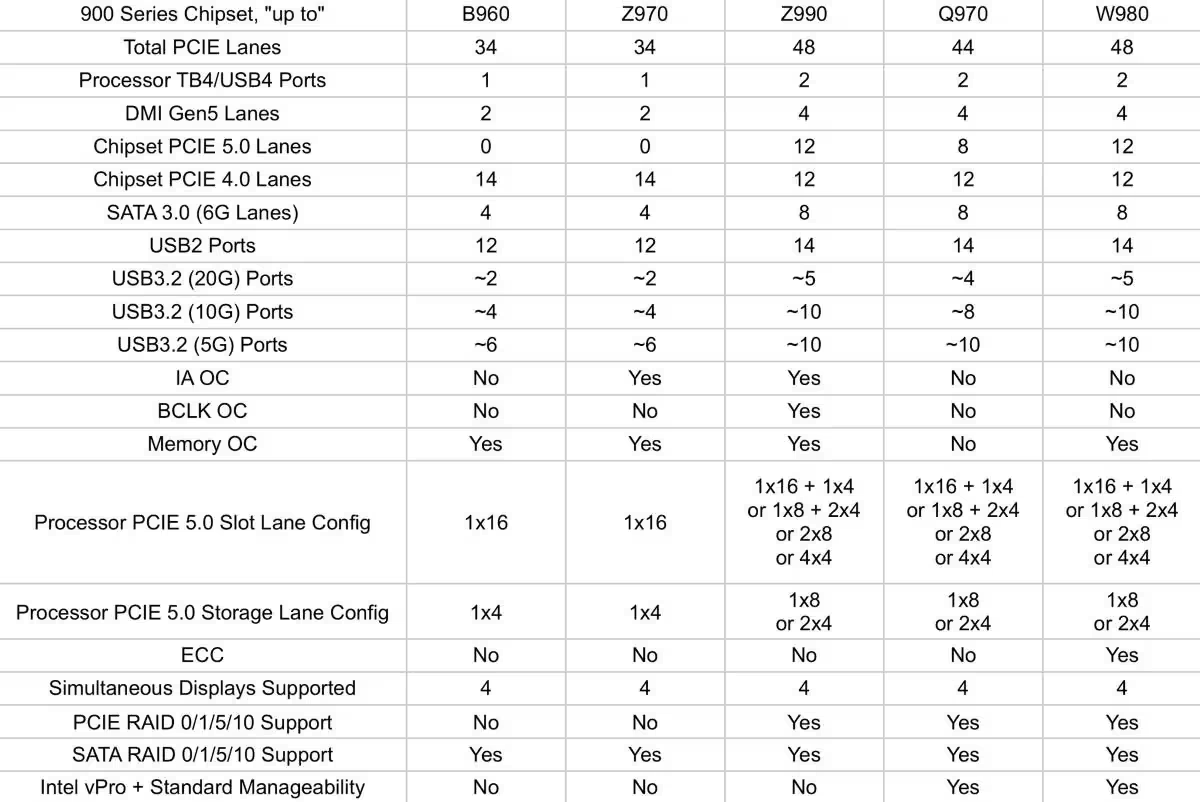
The W980 reads like a workstation cousin to the Z990: similar lane counts, SATA capacity and high-speed USB support, but without any processor or memory overclocking. Think stability-first, performance-second—ideal for content creators and pro workstations that need the connectivity of a flagship board without the tuning unpredictability.
On the more conservative end of the spectrum, Q970 and B960 are aimed at corporate and budget desktop markets. Details are thinner for these two, but the leak implies fewer PCIe routes, reduced SATA counts and extra management features typical of enterprise-focused chipsets. These parts are the ones OEMs will drop into business desktops and thin-client machines where reliability and remote manageability matter more than peak frame rates.
Intel's timeline, as confirmed by company leadership, pins Nova Lake and the new LGA 1954 platform for the second half of 2026. The chips themselves are said to be built on Intel's 18A process node, will top out at 52 CPU cores in the high-end SKU, and will include integrated Xe3 graphics.
What this leak signals is a deliberate segmentation: extreme connectivity and tuning for enthusiasts, workstation-grade throughput without overclocking, and lighter, manageable options for business. Motherboard makers will have room to design boards that stretch from compact gaming systems to full-blown professional workstations. Expect more clarity as motherboard prototypes and BIOS details leak closer to launch—until then, the LGA 1954 era already looks like it will rewrite how Intel bundles I/O and tuning across price points.


“I cover emerging technologies, digital innovation, and the intersection of tech and everyday life. My goal is to make complex trends accessible and inspiring.”

Discussion
Leave a Comment
Comments (2)
Promising roadmap but feels kinda overhyped. Too many SKUs and vague lane splits, OEMs will decide who wins. Waiting for BIOS and board pics...
Is this even true? LGA1954 and 48 lanes, 18A node + 52 cores sounds wild. Leak is detailed but where are the rest of the PCIe routes? hmm