
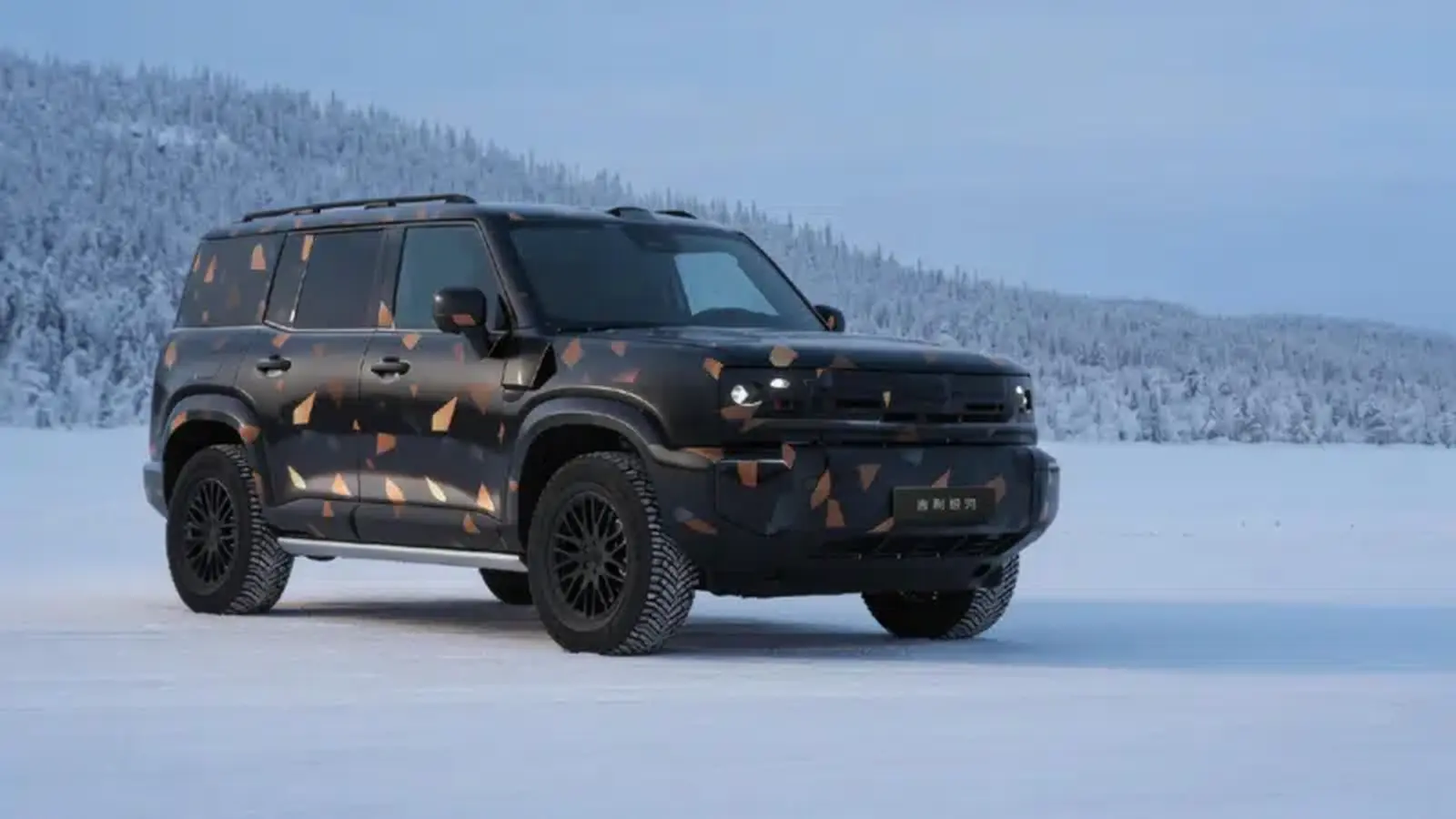
There’s a certain kind of confidence in testing a new off-roader where the roads look like they were carved out of ice. Geely has just dropped fresh images of its upcoming rugged SUV running cold-weather trials at the Colmis proving ground near Arjeplog, Sweden—inside the Arctic Circle, no less. And the message is pretty clear: this isn’t a soft-roader playing dress-up.
The still-camouflaged SUV is widely seen as the production-ready evolution of the Geely Galaxy Cruiser concept shown last year. In silhouette, it’s instantly familiar—boxy proportions, upright stance, chunky wheel arches, and the kind of short overhangs that hint at real trail intentions. If you’ve ever glanced at a Land Rover Defender and thought, “That shape just works,” you’ll understand the direction Geely is taking here.
Geely says the Arctic program focused on climate control performance, powertrain efficiency, and grip in punishing conditions. That’s not just marketing theater. Extreme cold exposes weak battery thermal management, inconsistent traction calibration, and cabin heating systems that can’t keep up—especially in electrified vehicles. Testing in Arjeplog territory is where automakers go to see what breaks first.

A concept car grows up without losing the tough-guy stance
Even under disguise, the production model shows several telltale changes versus the concept. Up top, there appears to be a single LiDAR unit mounted on the roof, joined by additional sensors that suggest advanced driver-assistance ambitions. The bumpers look more road-legal and practical, too—less show car, more survivable in the real world.
Some of the details are refreshingly traditional for a modern SUV. Door handles look conventional rather than flush. The lighting units appear large and functional. Out back, there’s a swing-out tailgate with a rear-mounted spare wheel—an old-school off-road cue that still makes sense when you’re far from a tire shop. Ground clearance also looks generous, reinforcing the idea that Geely wants this to be more than a lifestyle prop.
Geely officials have previously indicated the Galaxy Cruiser will head to global markets, positioning it to challenge established names—explicitly including the Land Rover Defender. Whether it can genuinely compete on capability is the big question, but the intent is no longer subtle.

Official technical specs are still under wraps, but the brand has already pointed to a plug-in hybrid setup. One likely route is shared hardware with the AWD Geely Galaxy M9, which pairs a 1.5-liter combustion engine with three electric motors. In that configuration, output is a claimed 640 kW (848 hp) and the battery is listed at 41.5 kWh—numbers that, if carried over, would put this SUV in serious performance territory for a PHEV off-roader.
Then there’s the headline-grabber: a “swimming mode.” Geely has previously suggested the Galaxy Cruiser can cross small bodies of water at up to 8.5 km/h. That’s the sort of feature that sounds like science fiction until you remember how quickly EV-era engineering is blurring the line between novelty and genuine utility.
Tech is expected to be a major pillar, too. The SUV will likely use Geely’s G-Pilot H7 assisted driving suite, reportedly leveraging more than 30 sensors and Nvidia’s Drive Thor chip with up to 700 TOPS of computing power. If accurate, that positions the Galaxy Cruiser not just as a rugged SUV, but as a rolling tech showcase aimed at the premium end of the market.
As for the reveal, the most likely stage is the Beijing Auto Show in late April 2026. Until then, these Arctic test shots are Geely’s way of saying the project is real, it’s progressing fast, and it’s coming for the square-jawed off-road crowd.

“Cars are evolving faster than ever. I cover electric vehicles, smart mobility, and the future of transportation worldwide.”

Discussion
Leave a Comment