
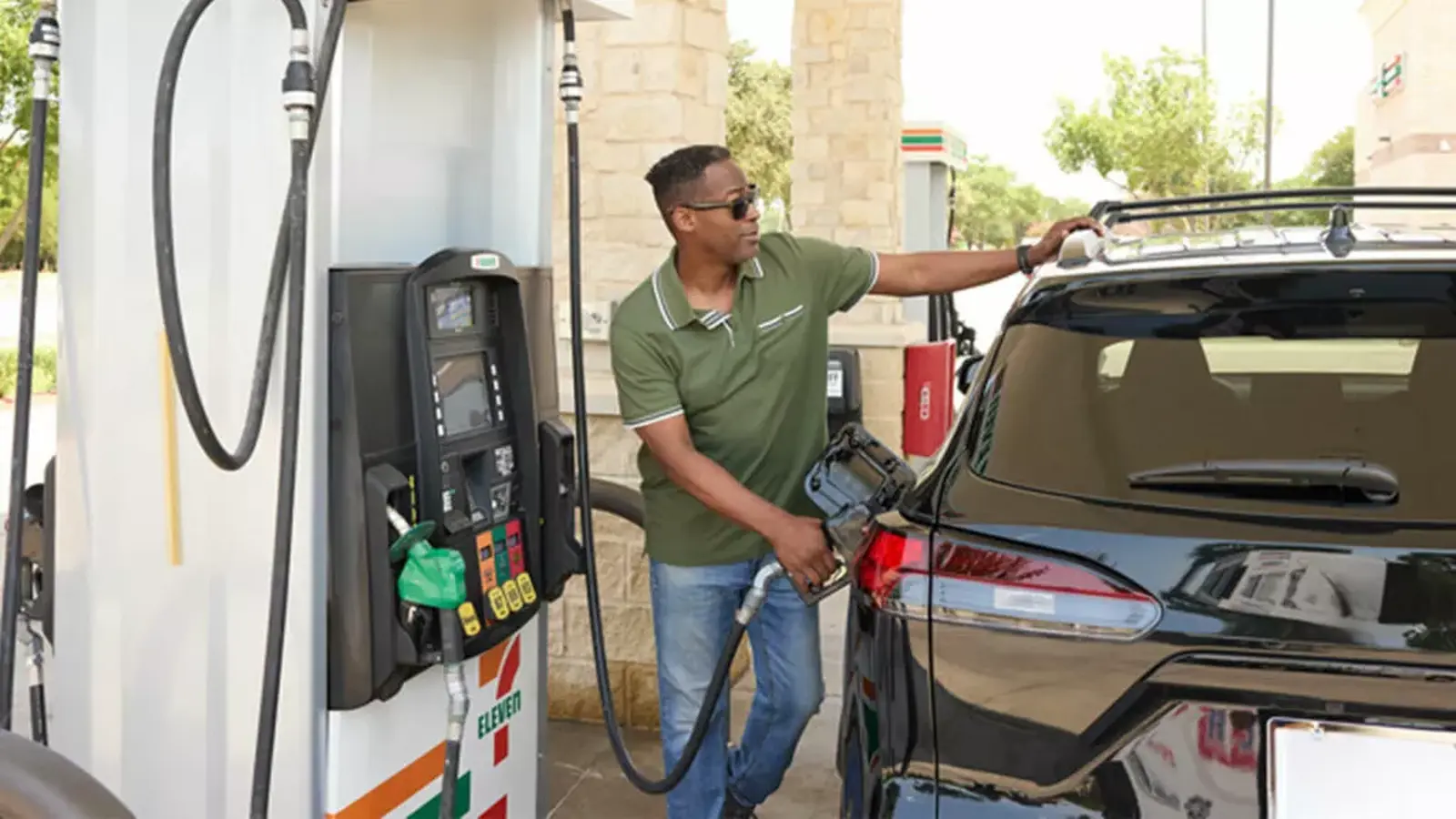
Drivers woke up to a different number on the pump—again. Overnight, the U.S. average price of regular gas jumped by about 11 cents, the kind of move that usually takes weeks, not a single news cycle.
The spark is geopolitical, not seasonal: fuel markets reacted fast after the United States and Israel carried out a joint strike on Iran. When the Middle East heats up, traders don’t wait around to see how the story ends. They price in risk immediately—and motorists feel it first.
On Monday, the national average sat at $2.997 per gallon. By Tuesday it had climbed to $3.109, an increase of 11.2 cents in a day. Zoom out slightly and the jump looks even sharper: regular is up 15.8 cents versus a week ago, and it’s roughly 23 cents higher than a month ago, when the average was $2.883.
Year-over-year, the picture is messy rather than comforting. Regular unleaded is essentially flat—about a penny cheaper than this time last year—but other grades are moving the wrong direction. Mid-grade and premium are higher, and diesel has taken the most noticeable hit, rising from $3.652 a year ago to $3.891 now.
The national average hides a brutal reality
As always, “average” is doing a lot of work. California remains the most expensive state to fill up, with drivers paying around $4.674 per gallon—painfully close to the psychological $5 line. At the other end of the scale, Oklahoma is hovering near $2.624. Same country. A roughly $2 gap for the exact same daily commute.
There is one small relief: today’s prices are still well below the modern record of $5.016 per gallon, set on June 14, 2022. But markets aren’t signaling a cool-down yet.
West Texas Intermediate crude rose about 5.01% to $74.80, a move that tends to work its way into refined fuel costs with a lag. Early estimates floating around the market suggest another ~20 cents per gallon could be in play, depending on where oil settles and whether shipping routes, production, or regional security deteriorate further.
And that’s the real issue for drivers planning the next few weeks: nobody can put a clean timeline on this. U.S. Secretary of War Pete Hegseth said there is no end date for military operations, while arguing the mission is limited and not aimed at nation-building. In his words: “This is not Iraq. This is not endless… a clear, devastating, decisive mission: destroy the missile threat, destroy the navy, no nukes.” Limited or not, uncertainty is fuel-market rocket propellant.
Here’s where the national averages stand now (all per gallon):
- Regular: $3.109 (yesterday $2.997; week ago $2.951; month ago $2.883; year ago $3.097)
- Mid-grade: $3.609 (yesterday $3.486; week ago $3.459; month ago $3.391; year ago $3.566)
- Premium: $3.978 (yesterday $3.861; week ago $3.826; month ago $3.752; year ago $3.922)
- Diesel: $3.891 (yesterday $3.770; week ago $3.727; month ago $3.630; year ago $3.652)
- E85: $2.421 (yesterday $2.359; week ago $2.299; month ago $2.287; year ago $2.495)
If you’re trying to game the timing, the uncomfortable truth is that local station pricing can adjust faster than most paychecks. In moments like this, the best “strategy” is boring: shop around, avoid panic fills, and keep an eye on crude prices and any escalation headlines—because that’s what’s steering the sign out front.

“I cover automotive innovation, electric vehicles, and the future of mobility — where technology meets sustainability.”

Discussion
Leave a Comment