
5 Minutes
At big tech shows, most screens blur together after a while. Then something strange appears—something so bright, so thin, or so oddly engineered that it forces you to stop scrolling past booth displays. That moment happened again at Mobile World Congress when TCL quietly rolled out a collection of experimental panels that hint at where smartphone and laptop displays may be heading next.
Some of the technology had already surfaced earlier this year at CES, but seeing it running across multiple real devices gave the announcement a different weight. TCL, one of the world’s major display manufacturers, brought an entire portfolio: ultra‑efficient smartphone OLEDs, inkjet‑printed panels for laptops and foldables, and even a tiny micro‑LED meant for augmented‑reality glasses.
A new take on pixel precision
The centerpiece is TCL’s so‑called Super Pixel display architecture. Instead of relying on conventional sub‑pixel rendering, TCL slightly increases the number of sub‑pixels inside the OLED layer—about 1.8% more than typical designs. It sounds minor. In practice, the company claims it sharpens images noticeably while also simplifying the workload on the display controller.

The result is efficiency. TCL says the architecture cuts energy consumption by roughly 25% while still enabling refresh rates that climb to 165Hz, a level typically reserved for gaming displays.
Three smartphone panels demonstrated how the technology could scale. Each measures 6.9 inches, but their internal architecture differs.

The first pushes image clarity with a 1,200 × 2,608 resolution and a pixel density of 420 ppi. Built on an 8T LTPO backplane, the panel supports adaptive brightness up to 2,000 nits and integrates Full in Active Area (FIAA) design. Even the bezels look ambitious: around 0.5mm at the top and bottom and roughly 0.8mm on the sides.
A second 6.9‑inch variant focuses on efficiency rather than raw specs. TCL positions it as a benchmark power‑saving OLED. It still uses 8T LTPO and maintains the same 420 ppi density, but internal optimizations reduce display driver IC power by about 10% while lowering chipset power consumption by around 25% compared with conventional OLED implementations.

The third version switches to a 7T LTPS structure. This one dynamically scales its refresh rate from 60Hz all the way to 165Hz while maintaining the same density and reaching a 2,000‑nit high brightness mode.
But the smartphone panels weren’t the only attraction.
TCL also highlighted a manufacturing approach that could reshape OLED production itself: inkjet‑printed OLED, often shortened to IJP OLED. Instead of relying on traditional vacuum deposition, the organic materials are deposited using a printing process. That shift promises simpler fabrication, potentially lower costs, and easier scaling for different panel sizes.
.avif)
One demonstration panel targeted laptops. The 14‑inch IJP OLED display measures just 0.77mm thick and weighs only 77 grams—numbers that hint at extremely light ultrabooks or new classes of portable displays.
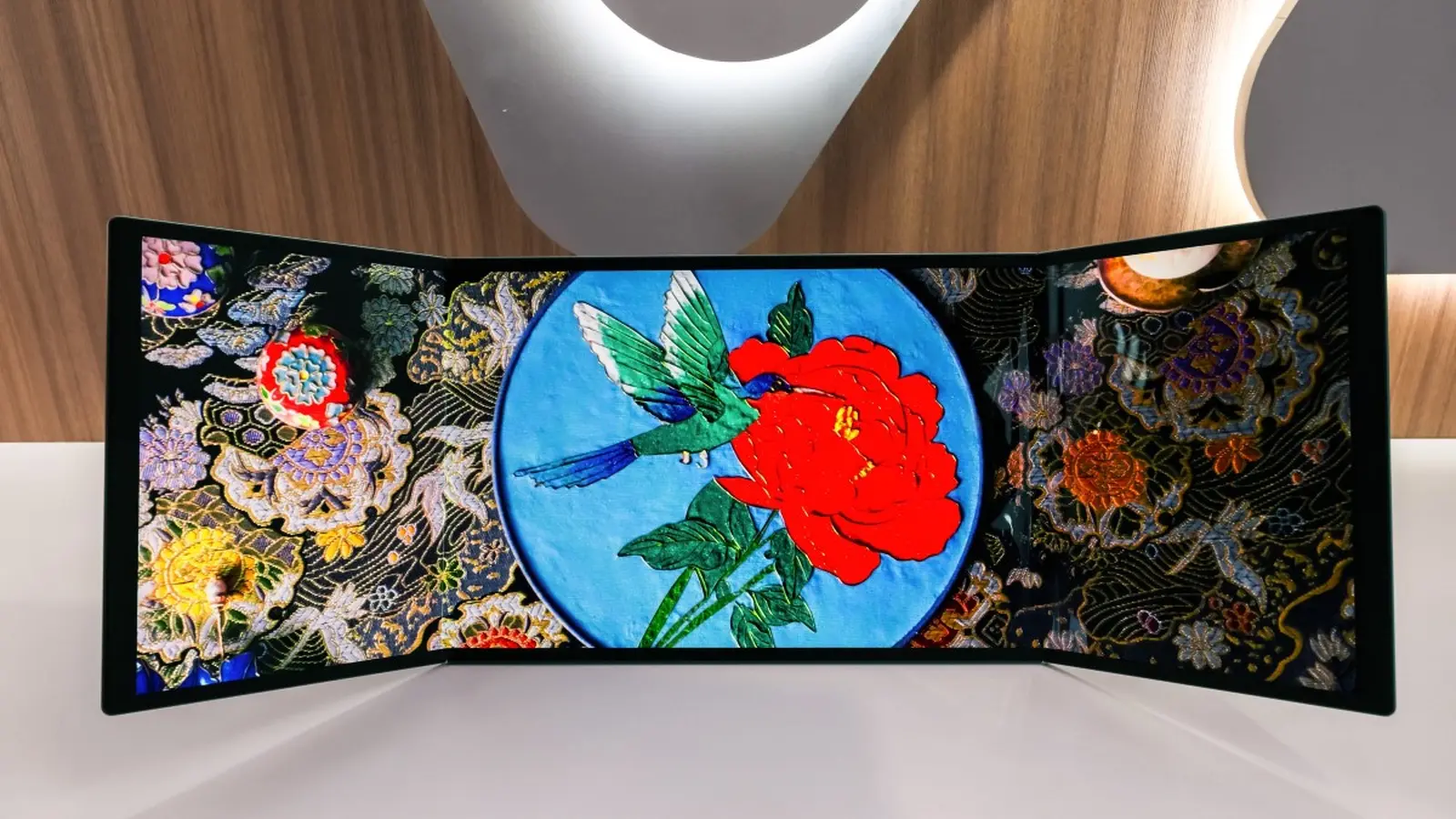
Then things got more experimental. TCL showed a tri‑fold portable monitor that expands from 16 inches to 28 inches when fully opened. The device measures only 4.48mm thick and uses what the company calls the world’s largest waterdrop hinge to handle the multi‑fold design.

Even smartphones could benefit from the printing method. A 5.65‑inch IJP OLED panel demonstrated a dense 490 ppi resolution and a Real Stripe RGB pixel arrangement, which typically produces cleaner text and more natural color rendering.
Brightness, however, may be where TCL is pushing hardest. One prototype OLED panel reached a staggering peak brightness rating of 15,000 nits. Realistically, that figure likely refers to localized HDR highlights rather than sustained brightness across the entire screen—but even so, it signals how aggressively manufacturers are chasing outdoor visibility and HDR performance.

Not every innovation focused on raw brightness. TCL also previewed a 6.9‑inch OLED panel designed for eye comfort, equipped with a second‑generation circular polarizer intended to reduce glare and deliver what the company describes as a more "book‑like" reading experience.

And tucked among the larger displays was perhaps the most futuristic component of all: a silicon‑based Micro LED display built for AR glasses. Despite its tiny 256 × 86 resolution, the panel packs an astonishing 5,080 pixels per inch and reaches a peak brightness around 4 million nits—numbers necessary for tiny optics used in augmented‑reality systems.

None of these technologies will redefine consumer devices overnight. But taken together, they reveal something bigger: the next wave of displays isn’t just about sharper screens. It’s about efficiency, new manufacturing methods, foldable form factors, and brightness levels that once seemed absurd.
At MWC, TCL didn’t just show screens. It showed a glimpse of the display lab experiments that may quietly shape the next generation of phones, laptops, and wearable devices.


Comments
labcore
wow that tri-fold monitor tho, 16 to 28 inches??.. imagine carrying that, ultra thin 4.48mm, feels like sci-fi finally trickling down. hope prices arent crazy
mechbyte
15,000 nits? 4 million nits for micro LED?? sounds over the top. If that's real then battery and eye safety must be insane, no? kinda skeptical tbh

Leave a Comment