
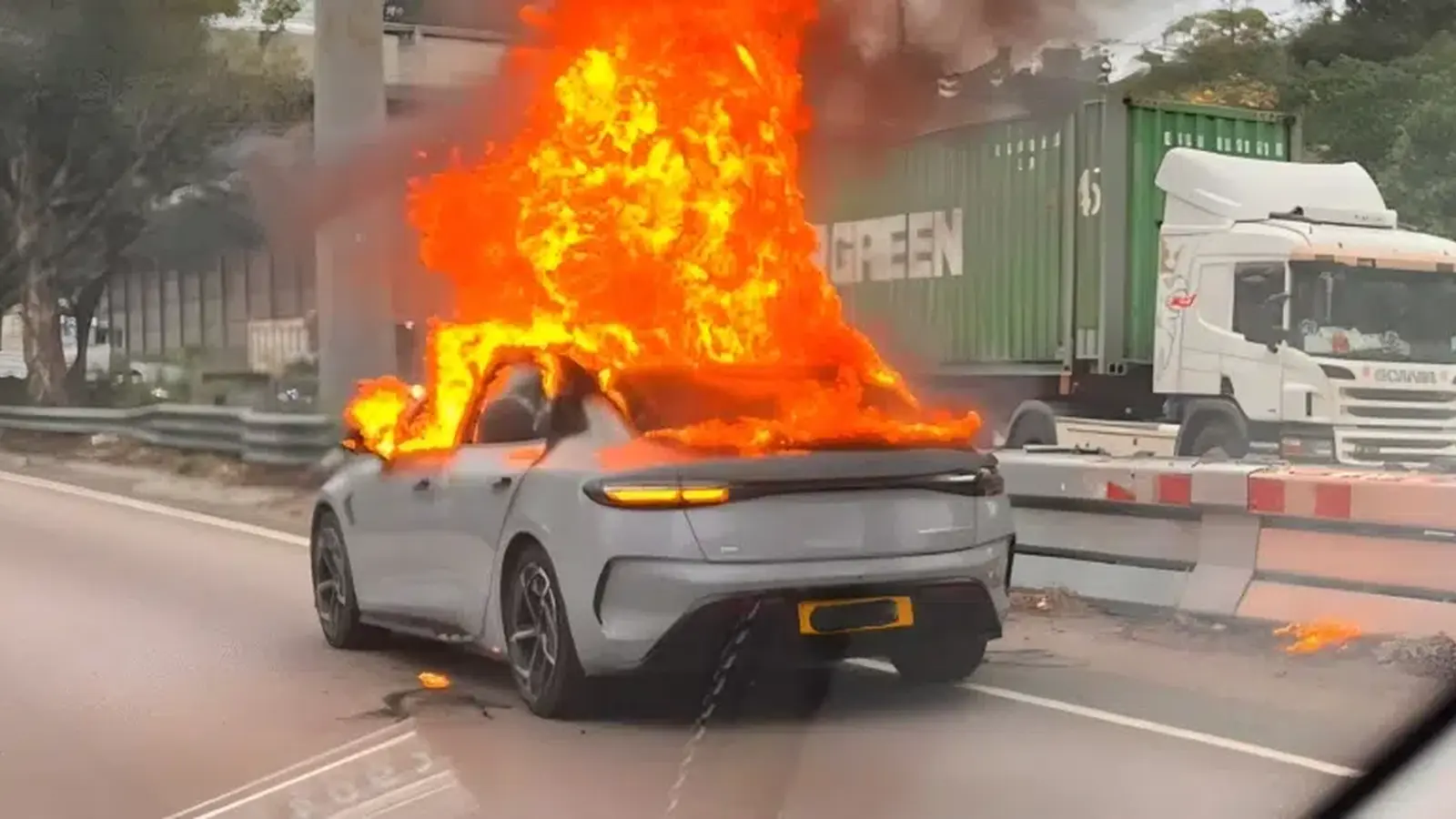
Mid‑afternoon traffic on Hong Kong’s Tuen Mun Road was moving as usual—until a silver electric sedan suddenly began to smoke. Within moments, flames curled out of the cabin of a BYD Seal heading toward Hung Shui Kiu, sending nearby drivers scrambling and forcing traffic to a standstill near the busy Tsing Tin Interchange.
The incident unfolded at around 2:01 p.m. on March 3, 2026. According to local reports, the female driver reacted quickly. She pulled over and exited the car just before the fire intensified. By the time emergency crews from the Hong Kong Fire Services Department arrived, the blaze had already consumed much of the upper cabin. Firefighters managed to bring it under control by 2:19 p.m., preventing it from spreading to surrounding vehicles.
At first glance, many assumed the worst—a battery fire in an electric vehicle. But the investigation told a very different story.
A power bank, not the car
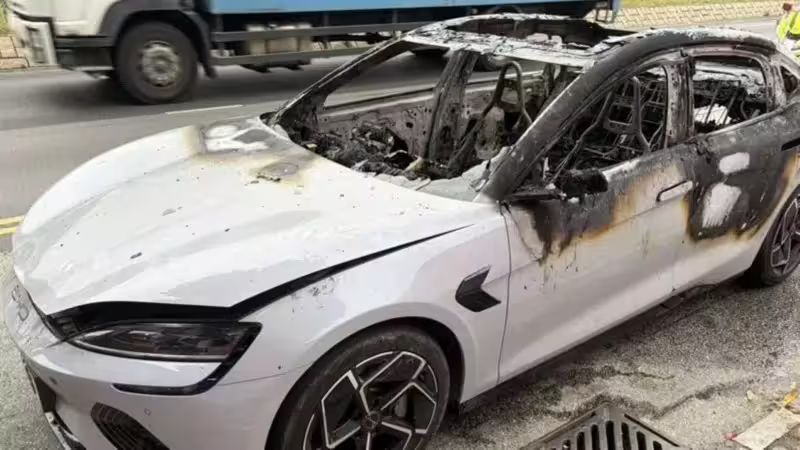
Technical inspectors later examined the vehicle at a BYD service facility. Their conclusion was surprisingly mundane: the ignition source wasn’t the EV itself. Instead, it was an external portable power bank that had been left on the passenger seat.
The device is believed to have suffered a short circuit or thermal runaway, a known risk with damaged or defective lithium battery accessories. The resulting heat ignited the surrounding interior materials, triggering the cabin fire.
BYD issued a statement clarifying that none of the vehicle’s mechanical or high‑voltage electrical systems initiated the blaze. Despite the dramatic images of a charred interior circulating online, the car’s core EV components remained unaffected.

That includes the Seal’s much‑discussed Blade Battery pack.
Engineers confirmed that the battery and structural chassis were still intact after the fire. Temperatures inside the cabin were high enough to melt plastics and crack glass, yet the battery cells themselves never entered thermal runaway.
The reason lies in chemistry. BYD’s Blade Battery uses lithium iron phosphate (LFP), a formulation known for significantly higher thermal stability than the nickel‑manganese‑cobalt (NMC) chemistry used in many other EVs. LFP cells generally require temperatures exceeding roughly 500°C to trigger runaway reactions—more than double the threshold typical of NMC packs.
Just as important is the pack’s construction. The battery sits inside a honeycomb‑like aluminum structure designed to isolate heat and protect individual cells. In this case, that structure acted as a barrier between the burning cabin and the battery compartment.
The result: severe interior damage, but no battery ignition.
The Seal itself is built on BYD’s e‑Platform 3.0 architecture and uses Cell‑to‑Body (CTB) integration, meaning the battery pack is part of the vehicle’s structural frame. This approach helps deliver torsional rigidity of about 40,500 Nm/°, a figure often associated with high‑end performance sedans.

Safety engineering extends beyond the battery. The model includes a center airbag designed to reduce passenger‑to‑passenger impact injuries during side collisions, as well as an automated eCall system that can notify emergency responders after major accidents.
The Hong Kong incident arrives at a time when the Seal is rapidly gaining traction in the region’s EV market. Deliveries in the city are estimated at around 4,200 units in 2025, placing it directly against the Tesla Model 3, which moved roughly 5,800 units during the same period.
Both sedans carry five‑star Euro NCAP safety ratings, yet their engineering philosophies differ. BYD leans heavily on LFP chemistry and structural battery integration, while Tesla uses a mix of LFP and higher‑nickel NMC cells depending on the variant.
Price also shapes the competition. After local incentives, the BYD Seal starts near $30,000 in Hong Kong, undercutting the Tesla Model 3’s approximate $34,500 entry price.
For investigators, though, the takeaway from the Tuen Mun Road fire is simpler than the broader EV rivalry: sometimes the most dramatic car fires don’t begin with the car at all.

“I cover automotive innovation, electric vehicles, and the future of mobility — where technology meets sustainability.”

Discussion
Leave a Comment