
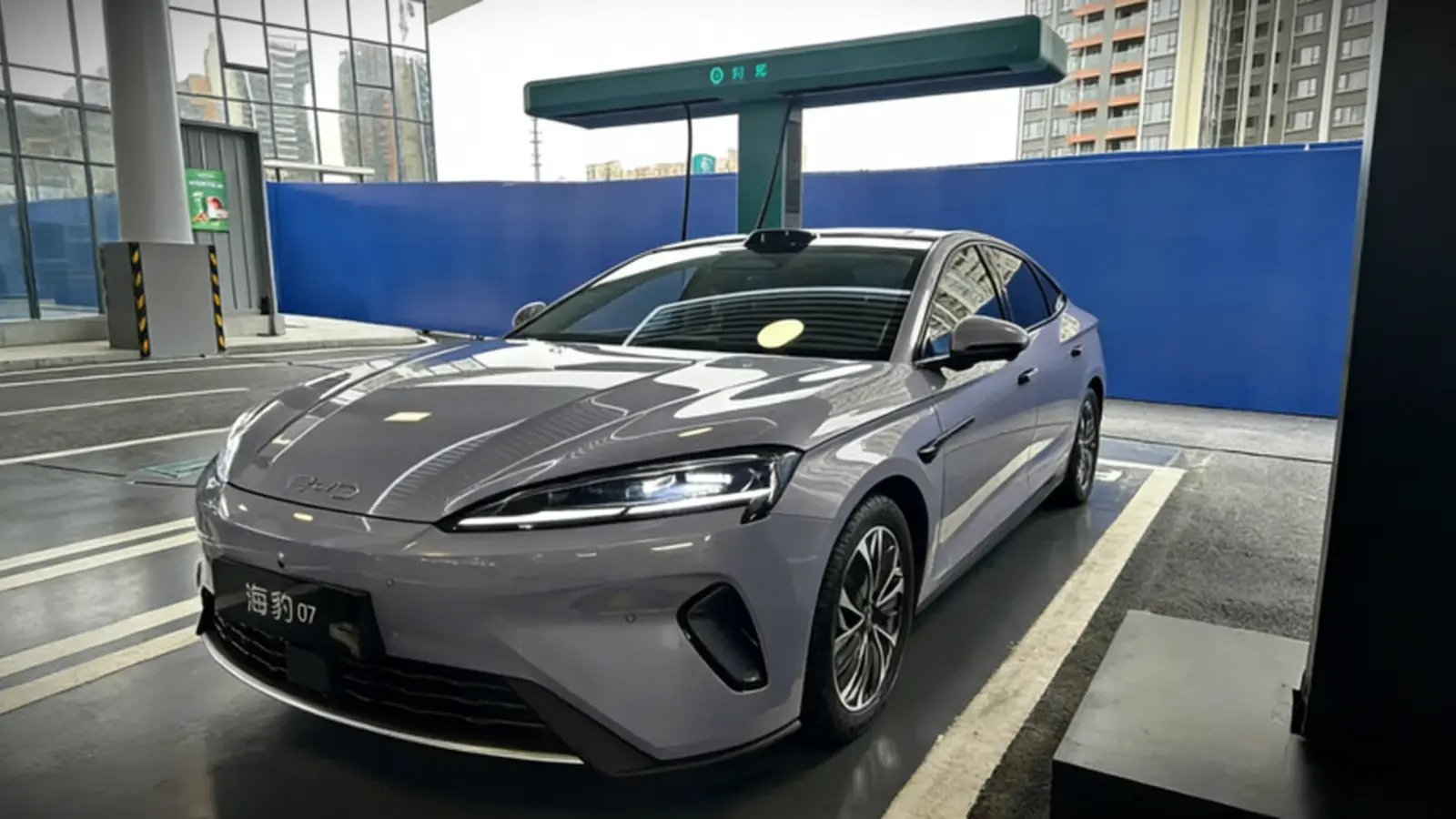
Five minutes. That’s all the time BYD now claims it takes to breathe serious range back into an electric car. In an industry where convenience decides winners, that number lands like a thunderclap.
Just days after unveiling the second‑generation Blade Battery on March 5, the Chinese automaker revealed something even more ambitious: a nationwide fast‑charging offensive. During a media briefing in Shenzhen, BYD branding chief Li Yunfei confirmed the company plans to install 20,000 megawatt‑level charging stations across China by the end of 2026.
The announcement immediately reframed a debate that has shaped China’s EV infrastructure for years. Battery swapping—pioneered by Nio—has long promised the fastest way to get drivers back on the road. But if a plug can deliver comparable speed, the entire equation begins to shift.
Li himself struck a diplomatic tone online, describing swapping and flash charging as “different paths to the same destination.” Both, he suggested, exist to accelerate electric mobility. Yet the sheer scale of BYD’s charging rollout hints at something more strategic: a push to make ultra‑fast charging the dominant way EV drivers refuel.
The moment charging caught up
For years, battery swapping held one unbeatable advantage: speed. Pull into a station, swap the battery, leave in roughly three minutes.
BYD’s latest technology narrows that gap dramatically. Its Megawatt Flash Charge 2.0 system, working alongside the new Blade Battery, can take a vehicle from 10% to 70% state of charge in about five minutes. On paper, that turns what used to be a decisive advantage for swapping into a marginal difference.
The company is also targeting one of the swap model’s quiet weaknesses: extreme weather. In northern China, frigid winters can reduce battery performance and slow operations. BYD says its updated thermal management system allows charging from 20% to 97% in roughly 12 minutes even at temperatures as low as −30°C.
Safety remains central to the pitch. During internal testing, Blade Battery 2.0 reportedly survived simultaneous flash charging and a nail‑penetration test without triggering thermal runaway—even after 500 high‑power cycles.
An infrastructure race quietly unfolding
China’s swap ecosystem has gradually consolidated around a handful of major players. Nio leads the field, supported by companies such as CATL and Aulton New Energy. Together, they’ve built thousands of swap stations nationwide.
But BYD’s charging strategy aims to move faster than that entire network combined.
- BYD currently operates more than 4,200 megawatt flash‑charging stations and targets 20,000 by 2026.
- Nio runs around 3,790 battery swap stations, with a goal of roughly 4,800.
- CATL and Aulton are expanding their own swap networks but remain far smaller in scale.
If BYD hits its target, the company expects 90% of urban China to sit within a five‑kilometer radius of a 1,500‑kW charging point.
And it plans to build them cheaply.
Instead of relying on massive grid upgrades—often the biggest obstacle to high‑power charging—BYD’s stations incorporate internal LFP battery storage. These act like energy buffers. The station slowly draws about 100 kW from the grid, stores it, and then releases up to 1,500 kW during a rapid charge.
The company claims this architecture cuts installation costs by as much as 60% compared with traditional megawatt charging setups that require dedicated substations.
Premium symbol vs mass‑market access
Nio’s swap network still carries a certain prestige. For the brand’s roughly 1.05 million cumulative owners, the stations symbolize a premium ecosystem—an EV experience designed around convenience and exclusivity.
BYD, by contrast, is chasing scale.
The second‑generation Blade battery will initially appear in high‑end models such as the Yangwang U7 and Denza Z9GT in early 2026. Soon after, the technology is expected to trickle down into the brand’s mainstream lineup, including the Song and Qin series, followed later by entry models like the Dolphin and Seagull.
If that rollout unfolds as planned, ultra‑fast charging won’t be a luxury perk. It will be a mass‑market feature.
And in that world, the question facing China’s EV infrastructure becomes simple: if charging takes only a few minutes, how much advantage does swapping really have left?

“Cars are evolving faster than ever. I cover electric vehicles, smart mobility, and the future of transportation worldwide.”

Discussion
Leave a Comment