
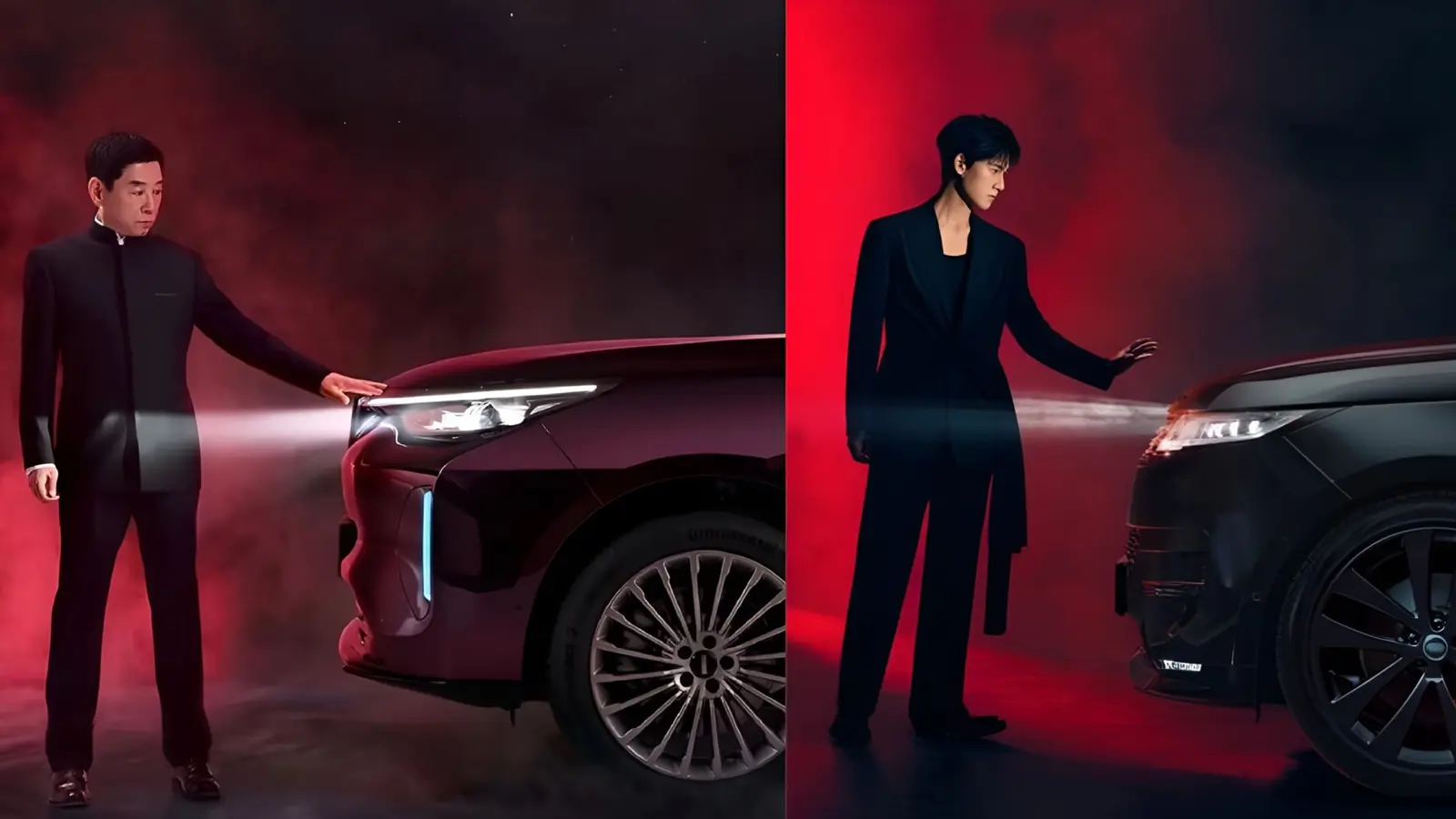
Scroll through enough car ads and you start to notice patterns—dramatic lighting, a confident driver, a sleek SUV posed like it owns the night. But every once in a while, an image pops up that feels a little too familiar. That’s exactly what happened when Great Wall Motor unveiled a promotional poster for its new Wey V9X.
Within hours, the internet had done what the internet does best: side‑by‑side comparisons. The newly released Wey campaign looked strikingly similar to a Range Rover Sport advertisement Land Rover had published the year before. Not just similar in mood. Similar in composition. Similar in posture. Similar almost frame for frame.
And once people saw it, they couldn’t unsee it.
The original Range Rover image features a sharply dressed Asian man standing beside a black Range Rover Sport. He stretches a hand toward the hood as red lighting bleeds through clouds of drifting smoke behind him. It’s theatrical, almost cinematic, the kind of marketing image designed to suggest quiet power and confidence.
Now swap the Range Rover for a Wey V9X and you essentially get the second poster released by Great Wall Motor. The angle of the vehicle? Nearly identical. The pose of the man in black? The same extended arm toward the hood. Even the smoky red backdrop returns, creating an atmosphere that feels less like homage and more like duplication.
Look closer and the resemblance becomes even harder to defend. The Wey’s headlights illuminate the man in a way that mirrors the lighting effect in the original Range Rover image. The staging, the framing, the mood—it all lines up with uncanny precision.

When "Inspiration" Crosses the Line
China’s automotive industry has spent years shaking off an old reputation: the idea that local brands borrowed a little too heavily from Western designs. In fairness, the landscape has changed dramatically. Companies like BYD, NIO, Geely, and even Great Wall itself now produce vehicles with distinct design languages and serious global ambitions.
Which is why this incident caught so many observers off guard.
Rather than quietly ignoring the criticism, Great Wall Motor chairman Wei Jianjun addressed the issue directly on Chinese social media. His response was unusually candid for a corporate controversy.
After reviewing the situation internally, he acknowledged that the poster had indeed been plagiarized.
According to a translation reported by IT-Home, Wei stated that there was "no justification" for the copied imagery. He issued a public apology not only to Land Rover but also to the designer responsible for the original advertisement and to followers who expect better from the company.
He also made it clear that Great Wall Motor is prepared to accept full legal and financial responsibility if necessary.
That level of accountability is rare in the automotive world, where marketing disputes are often brushed aside as coincidence or "creative overlap." In this case, however, the visual parallels were simply too obvious to ignore.
For now, Land Rover has not announced whether it plans to pursue legal action. But with Great Wall already acknowledging the mistake publicly, the ball may ultimately be in the British brand’s court.
Either way, the episode serves as a reminder that in today’s hyperconnected car culture, nothing slips by unnoticed. A single image can travel across the globe in minutes—and when two campaigns look nearly identical, someone will always spot it.
Especially when one of them already belonged to a Range Rover.

“I cover automotive innovation, electric vehicles, and the future of mobility — where technology meets sustainability.”

Discussion
Leave a Comment