
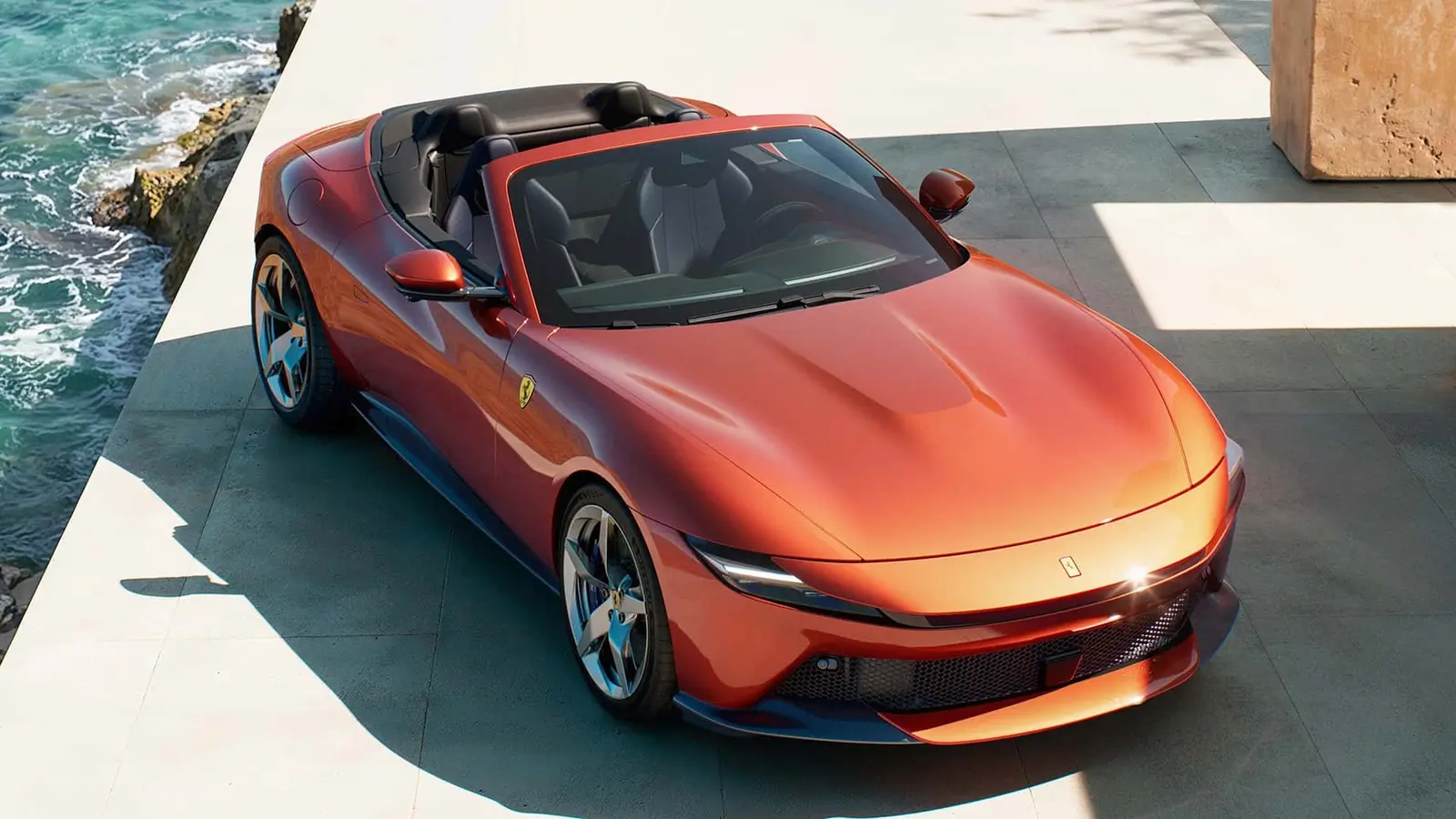
Take the roof off a Ferrari and something changes. Not just the sound—though the roar of a twin‑turbo V8 suddenly feels closer, rawer—but the entire character of the car. The newly revealed Ferrari Amalfi Spider leans fully into that idea. Same heart as the coupe. Same dramatic performance. Just one big difference: open sky.
This new 2+ convertible arrives as the latest chapter in Ferrari’s long love affair with open‑top grand tourers. Cars like these have always carried a certain romance in Maranello’s lineup—machines built not only for speed, but for the kind of drives where scenery and sound matter as much as lap times.
The Amalfi Spider keeps the coupe’s elegant proportions yet reshapes the experience entirely. Raise the roof and it still looks tight, sculpted, unmistakably Ferrari. Drop it, and the car stretches visually, the body lines becoming more expressive as airflow and light carve across the surfaces.

Soft Top Engineering Meets Italian Design
Ferrari didn’t just remove the coupe’s fixed roof and call it a day. The Spider uses a carefully engineered fully automatic soft top built from five layers of fabric with varying thicknesses. The layered construction—arranged in a technical "sandwich" structure—helps reduce road and wind noise, keeping the cabin surprisingly calm even at speed.
An integrated rear glass window improves visibility and insulation, while the fabric roof itself comes in four tailored colors along with two technical‑material finishes. One of the new options, called Tecnico Ottanio, adds a modern, almost architectural texture that blends neatly with the bodywork.

Ferrari’s designers made sure the car looks intentional whether the roof is up or folded away. Even the weave pattern can extend onto the tonneau cover and surrounding surfaces, creating visual continuity across the rear deck.
Aerodynamics remain a major part of the story. At the back sits an integrated active rear wing with three operating positions. In its High Downforce setting, it can generate up to 243 pounds of downforce at 155 mph, helping the Spider stay planted when the road—and the driver—demand more.

A Cabin Built for Open‑Air Driving
Driving a convertible is thrilling. Wind buffeting, less so. Ferrari tackled that with a clever wind deflector integrated into the rear seat backrests. At the press of a button it deploys to calm turbulence in the cabin. Push it back down and it disappears neatly into its housing.
Inside, the Amalfi Spider mixes sportiness with understated luxury. A suspended aluminum bridge forms the center tunnel, giving the cockpit a floating, technical feel. Door panels carry subtle nautical influences—an elegant nod to the kind of coastal drives this car practically demands.

The dashboard is built around a monolithic cockpit structure that houses the main instrument display and air vents in one cohesive piece. Two additional screens handle infotainment duties and the passenger display, keeping both occupants engaged.
There are practical considerations too. With the roof raised, luggage capacity sits at about 9.0 cubic feet. Lower the top and the folded fabric stack—roughly 220 millimeters thick—reduces space to around 6.1 cubic feet. Enough for a weekend getaway, which honestly feels like the point.

Twin‑Turbo V8 Power and Ferrari Tech
At the core of the Amalfi Spider lies Ferrari’s celebrated 3.9‑liter twin‑turbocharged V8 from the F154 engine family. In this application it produces 631 horsepower, delivering an impressive 163 horsepower per liter. Even with the added structural reinforcements typical of convertibles, curb weight lands around 3,430 pounds—about 176 pounds heavier than the coupe.
Ferrari refined the engine with several technical updates, including a revised turbocharging system, lightweight camshafts that save nearly three pounds, and a redesigned engine block with precision machining aimed at better thermal management.
Power flows through an eight‑speed wet‑clutch dual‑clutch gearbox—the same transmission used in the SF90 Stradale. Braking and dynamic control systems borrow technology from other modern Ferraris as well, including the ABS Evo system first seen in the 296 GTB.

The car’s electronic brain ties everything together through Side Slip Control 6.1. Steering response, torque distribution, suspension behavior, and traction management all communicate constantly, maximizing grip and stability without dulling the driving experience.
Drivers can tailor the mood using Ferrari’s familiar Manettino switch, choosing between Wet, Comfort, Sport, Race, and ESC‑Off modes. Each setting alters the intervention level of systems like F1‑Trac traction control, adaptive suspension damping, and the electronic differential.
Even a machine this focused on performance comes with modern safety tech. The Amalfi Spider includes adaptive cruise control, automatic emergency braking, blind‑spot monitoring, lane‑keeping assistance, traffic‑sign recognition, and driver attention monitoring. Optional upgrades add surround‑view cameras and rear cross‑traffic alert.
The Ferrari Amalfi Spider starts at around €270,000 in Europe, and the first customer deliveries are expected in early 2027.
For some buyers, that price buys speed. For others, it buys a Ferrari soundtrack with nothing but open air above it—which may be the real reason cars like this exist in the first place.

“Cars are evolving faster than ever. I cover electric vehicles, smart mobility, and the future of transportation worldwide.”

Discussion
Leave a Comment