
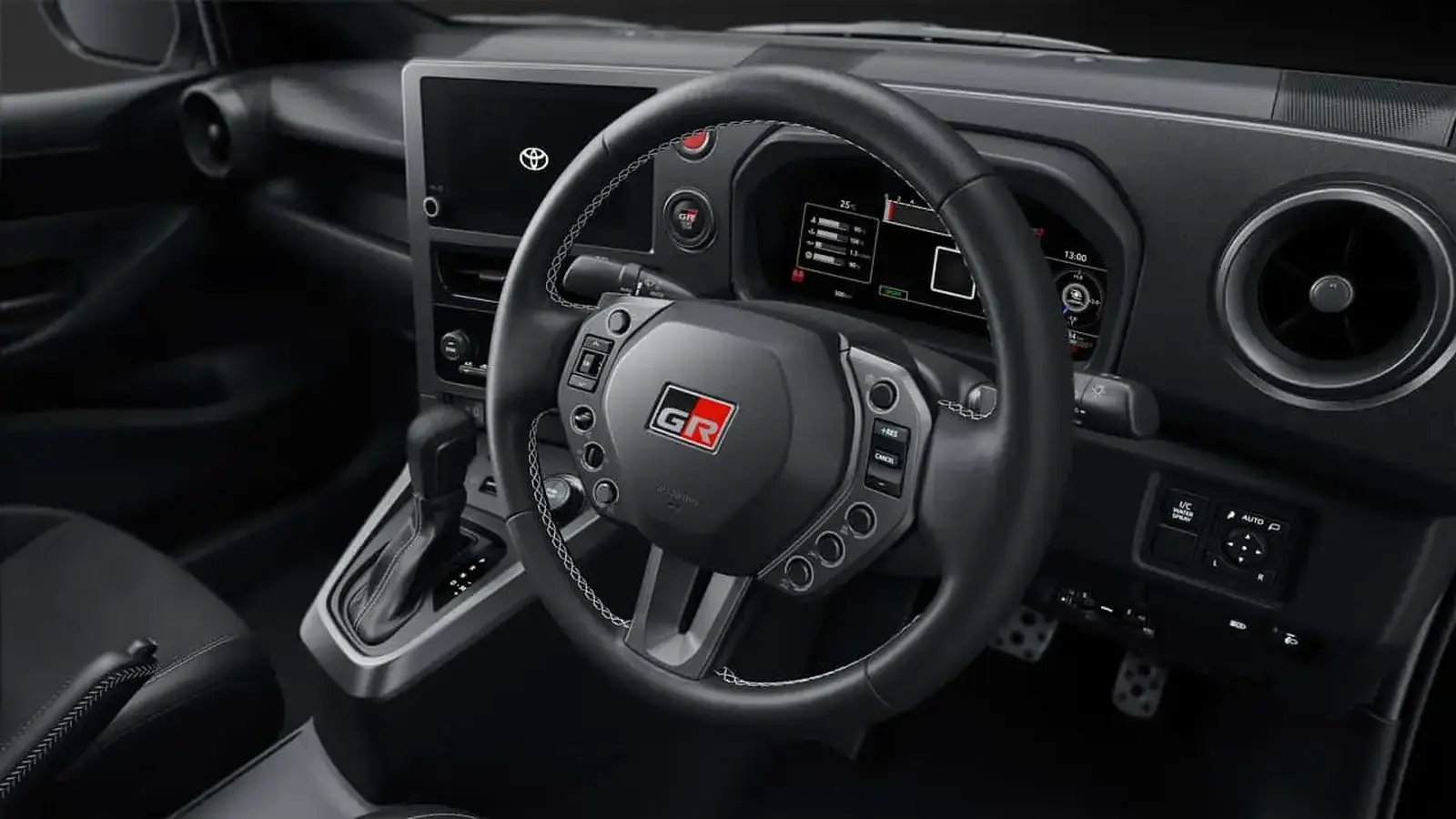
Some problems only reveal themselves once a car meets the real world. The Toyota GR Yaris, a pocket-sized rally-bred hot hatch adored by enthusiasts, has spent nearly six years proving just how special it is. Yet even cult favorites have quirks. One of them lived right in the driver's hands.
Owners loved the car’s razor-sharp chassis and punchy three-cylinder turbo engine. What they didn’t love? The steering wheel. Not the feel of it, but the way its buttons crowded the rim, occasionally triggering functions when drivers simply wanted to grip the wheel and focus on the road.
Toyota listened. And for the 2026 GR Yaris, the solution arrives in the form of a completely redesigned steering wheel—one shaped as much by feedback from everyday owners as by input from professional racing drivers.
A Small Detail That Matters at Speed
The issue sounded minor on paper: the buttons were positioned too close to the outer rim. In spirited driving, that proximity meant drivers sometimes brushed the controls unintentionally. It wasn’t a safety crisis, but it interrupted the rhythm of driving a car designed for precision.
Toyota’s Gazoo Racing engineers approached the fix the same way they treat performance upgrades—by going to the track. Prototype steering wheels were molded from clay and tested in real driving conditions before the design was finalized. The result is subtle but meaningful.
The controls now sit closer to the center, grouped around the airbag housing. That small shift moves them further away from where drivers naturally place their hands. The grip area has also been expanded, giving palms more room during aggressive cornering.
There’s another tweak drivers will feel immediately: the steering wheel diameter is slightly smaller. That change may sound minor, but it sharpens steering inputs and enhances the sense of connection between driver and car—exactly the kind of refinement enthusiasts appreciate.
Visually, the update brings a small but symbolic change as well. The familiar Toyota emblem has been replaced by the GR badge, reinforcing the identity of Gazoo Racing as Toyota’s dedicated performance arm.
The updated wheel also introduces illuminated rings around the switches on both sides, making them easier to locate in low-light conditions. And for drivers who want the full rally-inspired setup, Toyota now allows the heated steering wheel to be paired with the vertical handbrake option—something many fans had been hoping for.

More Than Just a Steering Wheel Update
The 2026 GR Yaris doesn’t stop with interior tweaks. Toyota has quietly refined several mechanical components to keep the hot hatch sharp in a segment where driver engagement still matters.
New Bridgestone Potenza Race tires are part of the update. These aren’t simply a different tread pattern. The tires feature a revised rubber compound and internal structure designed to deliver stronger grip during aggressive cornering while also reducing road noise during everyday driving.
Suspension tuning has also been revisited. Engineers adjusted damper settings at all four corners to better complement the new tires and maintain the car’s balance between track-ready precision and daily usability.
Meanwhile, the electric power steering system has received further calibration updates for 2026. The goal: sharper feedback and more natural weighting as speeds increase.
None of these changes dramatically alter the character of the GR Yaris. Instead, they refine it—like polishing an already well-honed tool.
And that might be the most impressive part of the story. Many automakers move on quickly once a car launches, shifting resources to the next model cycle. Toyota, however, continues to evolve the GR Yaris years after its debut, treating it less like a disposable product and more like a living performance platform.
The updates also hint that this generation of the GR Yaris isn’t going anywhere just yet. Enthusiast-focused cars often have short lifespans, especially in a market increasingly dominated by SUVs and electrification. Yet Toyota’s steady stream of refinements suggests the rally-inspired hatch still has time left on the road.
Of course, not every enthusiast gets to experience it. The GR Yaris was never sold in the United States, leaving American drivers to admire it from afar. Instead, Toyota offers the larger GR Corolla, which shares the same fiery three-cylinder engine and performance philosophy.
Looking further ahead, Toyota’s performance division appears far from finished. The company has already teased the possibility of bringing back the Celica nameplate, and engineers are reportedly developing a new turbocharged 2.0-liter four-cylinder engine that could eventually power future Gazoo Racing models.
If that happens, today’s GR Yaris may one day be remembered as a turning point—the car that proved Toyota still understands what driving enthusiasts want. Sometimes, that means big things like rally-inspired all-wheel drive and turbocharged power. Other times, it’s something as simple as getting the steering wheel exactly right.

“Cars are evolving faster than ever. I cover electric vehicles, smart mobility, and the future of transportation worldwide.”

Discussion
Leave a Comment