
The race in China’s electric sedan market just got louder. Xiaomi is preparing to relaunch its SU7 with sharper hardware, faster charging, and a stack of sensors that signals the company isn’t playing cautiously anymore.
According to reports from Autohome, the refreshed SU7 is scheduled for an official debut in March, with customer deliveries expected to begin almost immediately after the reveal. Production is already ramping up, and Xiaomi is reportedly targeting around 16,000 units in March alone—an aggressive start that hints at serious demand.
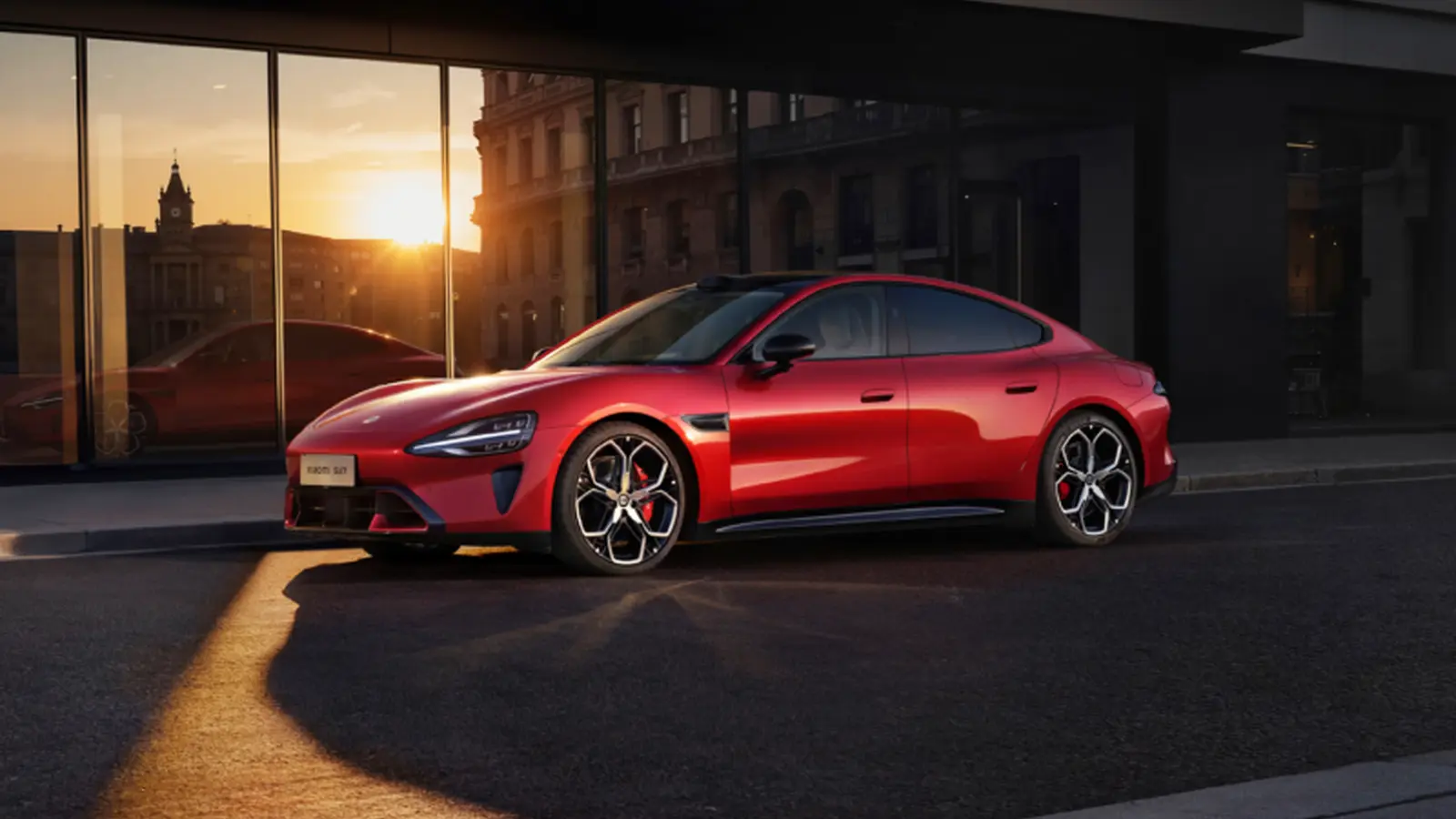
At first glance, the design stays familiar. The sleek fastback silhouette remains intact, keeping the sporty proportions that made the original car instantly recognizable. Look closer, though, and the details begin to shift. A newly styled front grille now integrates millimeter‑wave radar, while the brand’s distinctive “droplet” headlights stay in place but gain a stronger high‑beam reach—up to 400 meters.
Two fresh paint options, Capri Blue and Chixia Red, join the color palette. Beneath the body sits a more performance‑focused setup: 20‑inch wheels, red brake calipers, and staggered tires measuring 245 mm at the front and 265 mm at the rear. Four‑piston fixed calipers come standard, emphasizing the sedan’s sporty intent. Semi‑hidden door handles and black mirror caps carry over, maintaining Xiaomi’s evolving design language.
The rear keeps its dramatic halo‑style taillight signature along with an active spoiler that subtly adjusts for aerodynamics. Inside the cabin, the changes are quieter but noticeable—darker interior themes, a redesigned secondary dashboard, an updated steering wheel, and refreshed stitching patterns across the seats and doors.
A Sensor Suite That Signals Xiaomi’s Ambition
The bigger story sits beneath the sheet metal. Xiaomi has made lidar standard across all trims, pairing it with a 4D millimeter‑wave radar system and a computing platform rated at 700 TOPS. In practical terms, the system is designed to keep tracking objects even in low‑visibility situations—fog, darkness, or partial obstructions.
Safety hardware has also expanded. The SU7 now carries nine airbags instead of seven, including additional rear side protection. Structural upgrades include door beams made from 2,200 MPa hot‑formed steel and an integrated roll‑cage style reinforcement designed to improve crash resilience.
Three Versions, One Focus on Range and Charging
Xiaomi plans to offer three variants: Standard, Pro, and Max. The entry and mid‑level models rely on a 752‑volt electrical architecture, while the flagship Max version jumps to an 897‑volt platform designed for ultra‑fast charging.
All models use Xiaomi’s V6s‑Plus motors, with official CLTC range figures stretching from 720 km in the Standard model to an impressive 902 km in the Pro version. The Max, despite prioritizing performance, still reaches a claimed 835 km.
Where the Max really stands out is charging speed. With high‑voltage fast charging, Xiaomi says the car can recover up to 670 kilometers of range in just 15 minutes under optimal conditions. Both the Pro and Max variants also add dual‑chamber air suspension paired with CDC adaptive dampers, giving the sedan more flexibility between comfort and performance.
All of this places the SU7 squarely against some of the most recognizable electric sedans in China’s premium mid‑size segment. Tesla’s Model 3 and the Nio ET5 are the obvious rivals—cars that have built their reputations around range, software capability, and increasingly advanced driver‑assistance hardware.
But Xiaomi’s timing is interesting. China’s EV market is currently locked in a fierce price war, while automakers simultaneously push toward higher‑voltage architectures and increasingly complex sensor stacks. Standardizing lidar across the lineup is a bold move in that environment, signaling how quickly hardware expectations are rising.
Behind the scenes, another pressure point is emerging: semiconductor supply. Memory chip constraints have begun affecting advanced driver‑assistance systems more than battery costs in some cases, slowing progress toward Level 3 autonomous driving across the industry.
The SU7’s update arrives right in the middle of that turbulence. Add rising AI hardware costs—already forcing price adjustments from competitors like the Zeekr 007 GT—and it becomes clear that modern EV development is turning into a balancing act between cutting‑edge technology and keeping cars affordable.
Xiaomi appears ready to take that gamble.

“Cars are evolving faster than ever. I cover electric vehicles, smart mobility, and the future of transportation worldwide.”

Discussion
Leave a Comment