
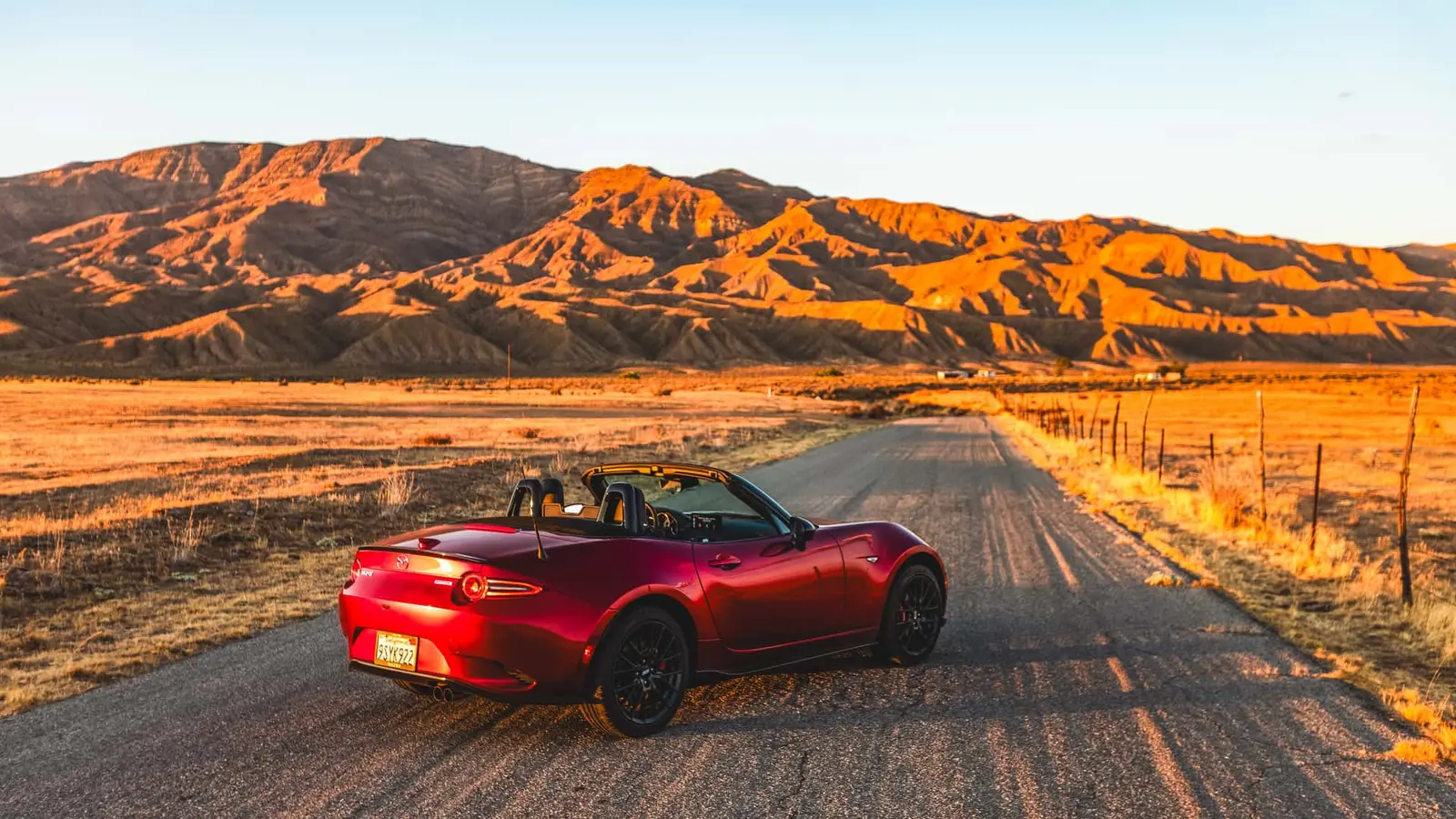
The number sounds almost unreal in today’s world of bloated curb weights and battery-heavy platforms: under one ton. That’s the line Mazda refuses to cross with the next-generation MX-5, and it’s not just engineering ambition—it’s philosophy.
Long before a single prototype has been spotted on public roads, Mazda is already drawing a clear boundary around what the future Miata can and cannot become. And for once, the message isn’t about power, screens, or electrification. It’s about restraint.
Manabu Osuga, Mazda’s Global Sales and Marketing chief, recently hinted at the company’s internal target: keep the next Miata below 1,000 kilograms (2,204 pounds). That would make it even lighter than today’s ND3, a car already celebrated for its simplicity and balance.
This obsession with grams isn’t new. Mazda calls it its “gram strategy,” a quiet discipline that shapes everything from materials to packaging. Every component is questioned. Every gram must justify its existence. In an era where most sports cars are gaining weight with every update, the Miata is moving in the opposite direction.
Why electrification is (still) off the table
There’s an elephant in the room, of course: electrification. While the rest of the industry races toward hybrid and fully electric performance, Mazda is deliberately holding back—at least for this car.
Osuga didn’t dismiss hybrids outright, but his reasoning was blunt. Current systems are simply too heavy. Add them to a lightweight roadster, and the entire character shifts. Balance changes. Agility fades. The very thing that defines the MX-5 gets diluted.
That doesn’t mean the door is closed forever. If hybrid tech becomes lighter and more compact, Mazda is willing to reconsider. But for now, the internal combustion engine remains the heart of the Miata experience.
It’s a bold stance, especially as emissions rules tighten globally. In Europe, the 2.0-liter engine has already disappeared from the lineup due to compliance issues, leaving the smaller 1.5-liter as the sole option. That reality makes the next chapter even more intriguing.
One possible answer lies in Mazda’s upcoming Skyactiv-Z engine family. Expected to debut around 2027, this new 2.5-liter unit is being engineered to meet strict Euro 7 regulations. If it delivers on both efficiency and performance, it could give the next Miata a rare combination: more power without sacrificing its lightweight ethos.
And yes, the manual gearbox is staying. In a shrinking field of driver-focused sports cars, that alone feels like a small victory.
The competition isn’t exactly fierce anymore, either. BMW’s Z4 is nearing the end of its run, and the Toyota GR86/Subaru BRZ twins remain coupes, not open-top rivals. The Miata, once part of a crowded segment, now stands largely alone.
If Mazda pulls this off—sub-2,200 pounds, manual transmission, and possibly more power—it won’t just preserve the Miata formula. It will sharpen it.
And in a market obsessed with bigger numbers, that might be the most radical move of all.

“I cover automotive innovation, electric vehicles, and the future of mobility — where technology meets sustainability.”

Discussion
Leave a Comment