
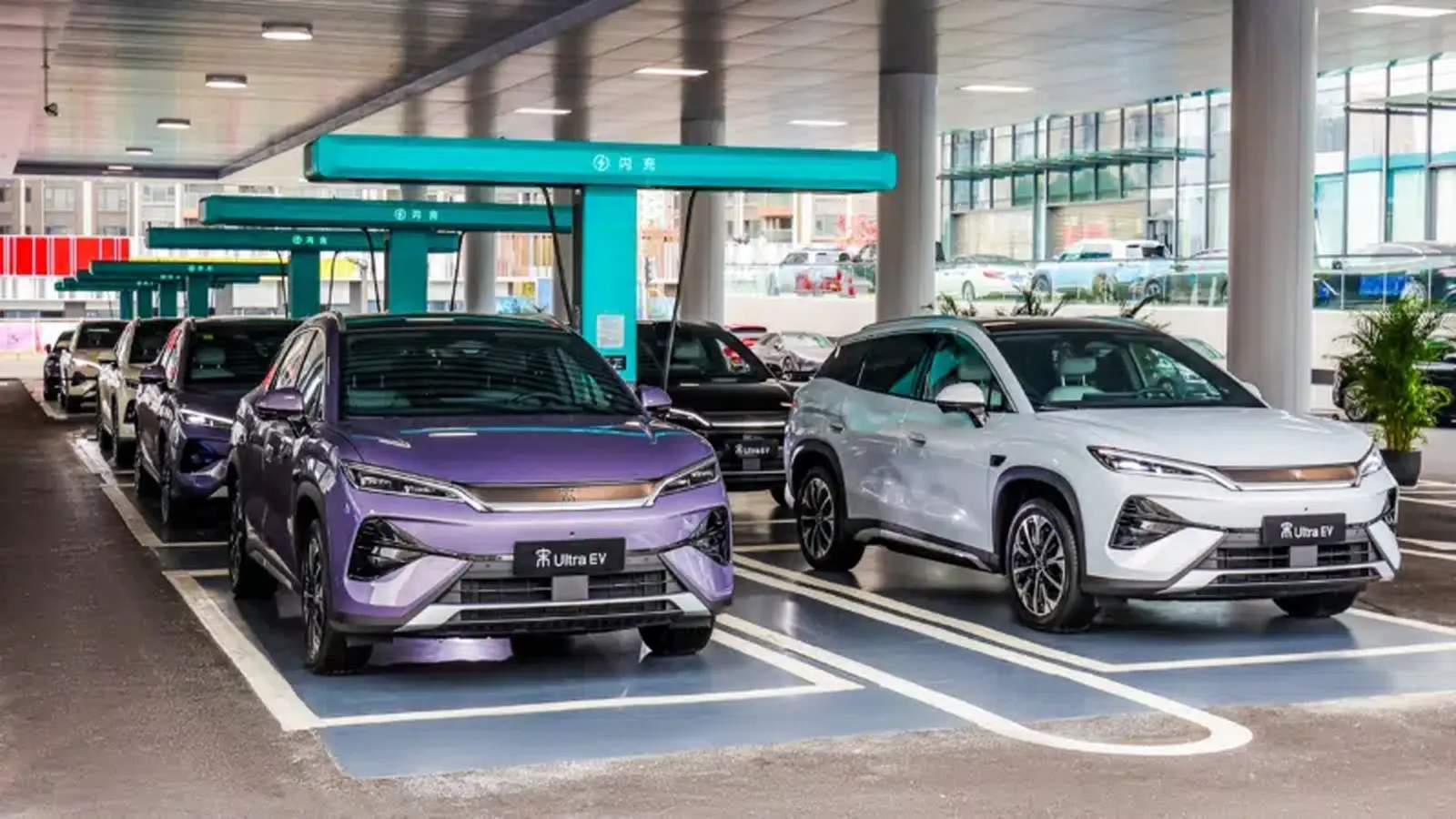
Three days. That’s all it took for the BYD Song Ultra EV to start crowding showrooms across China. Walk into a dealership right now and you’ll likely find a steady stream of curious buyers—many of them already halfway to signing.
Early figures suggest around 15 orders per store within just 72 hours of launch. That’s not just healthy demand—it’s momentum. And it’s pushing foot traffic up by roughly 40%, a signal that BYD may have struck a nerve in the mid-size electric SUV space.
The pricing helps. Starting at 151,900 yuan (about $21,980), the Song Ultra EV undercuts several rivals while offering specs that feel anything but budget. But the real hook? Charging. BYD claims the battery can jump from 10% to 97% in just nine minutes under ideal conditions. That’s the kind of number that makes even seasoned EV drivers pause.
Who’s actually buying it?
This isn’t a youth-driven hype car. Buyers largely fall between 35 and 45 years old practical, informed, and often upgrading from an existing vehicle. Around 70% are trading in, which says a lot about how the Song Ultra EV is positioned: not as a gamble, but as a logical next step.
Interestingly, women account for nearly a third of early orders, a notable share in a segment that often skews male. Color choices reflect that broader appeal too, with beige, purple, and white emerging as the top picks.
Buyers aren’t holding back on tech either. Nearly half are opting for BYD’s DiPilot 300 driver-assistance package, which adds LiDAR and a 254 TOPS computing platform for 9,900 yuan ($1,430). That’s a strong uptake for a paid upgrade—and a sign that advanced driver assistance is quickly becoming an expectation, not a luxury.
Then there’s range. About 70% of customers are choosing the long-range version, rated at 710 km (CLTC). Range anxiety may be fading, but clearly, more is still better.

Competition some of it from within
Here’s where things get interesting. Roughly half of potential buyers are cross-shopping the Song Ultra EV with BYD’s own Sealion 06 EV. That’s right—its biggest rival might be sitting in the same showroom.
It’s a double-edged sword. On one hand, it shows how deep and competitive BYD’s lineup has become. On the other, it raises questions about overlap and internal cannibalization.
Outside the brand, the usual suspects appear: Tesla Model Y, Xpeng G6, Leapmotor C11, and Deepal S7. All strong contenders—but BYD’s pricing and charging advantage could tilt the balance.
Under the skin, the Song Ultra EV rides on BYD’s e-Platform 3.0 Evo with an 800V architecture. Power comes from a rear-mounted motor producing between 240 kW and 270 kW, pushing the SUV to a top speed of 210 km/h. Two LFP battery options are available—75.6 kWh for 620 km or 82.7 kWh for 710 km—both supporting the brand’s fast-charging tech.
Inside, it’s familiar BYD: a large 15.6-inch rotating display dominates the cabin, paired with a 10.25-inch digital instrument cluster. The gear selector sits on the steering column, freeing up space and giving the interior a cleaner feel.
Nothing about the Song Ultra EV feels experimental. That may be exactly why it’s selling.

“Cars are evolving faster than ever. I cover electric vehicles, smart mobility, and the future of transportation worldwide.”

Discussion
Leave a Comment