
5 Minutes
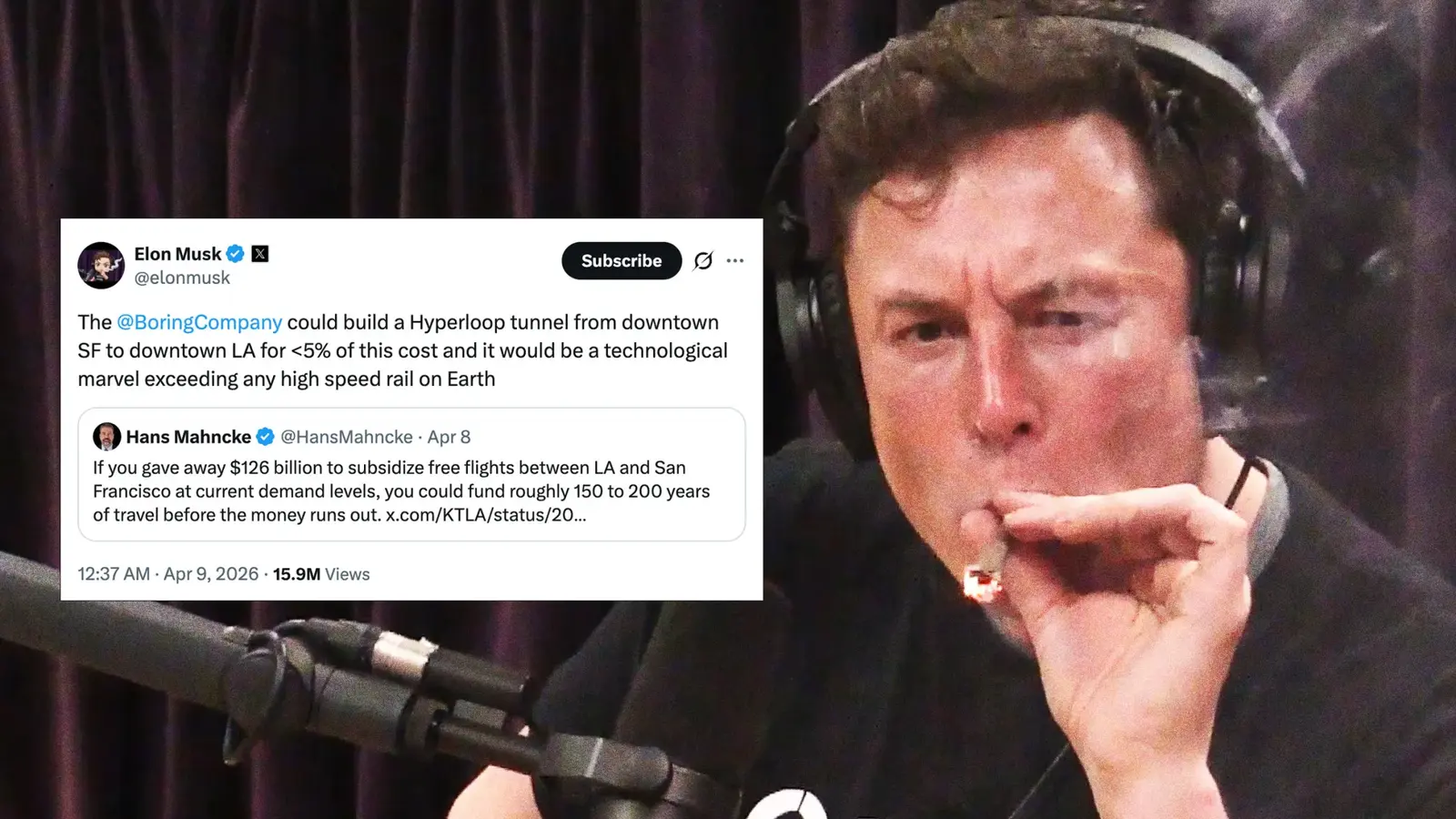
Elon Musk has never been shy about making a bold claim, but this one landed with particular force. On Thursday, after fresh reports that California’s long-delayed high-speed rail line could end up costing $126 billion, Musk jumped into the debate on X with a familiar mix of swagger and provocation.
When one user suggested the money might be better spent subsidizing free flights between Los Angeles and San Francisco for decades, Musk went even further. He said The Boring Company could build a Hyperloop tunnel between downtown San Francisco and downtown Los Angeles for less than 5 percent of that price, calling it a technological marvel that would outclass any high-speed rail system on Earth.
The idea sounds grand. The problem is that it exists mostly in Musk’s imagination.
Hyperloop, the vacuum-tube transit concept that once inspired Silicon Valley hype, has long been criticized by engineers and transportation experts as impractical, expensive, and potentially unsafe. Yet when asked why The Boring Company had not already delivered something close to that vision, Musk pointed not to technical barriers, but to one of his favorite targets: bureaucracy.
According to Musk, California’s rail project is less about moving people and more about channeling money through consultants, unions, and public agencies. That accusation is dramatic, and in some cases not entirely disconnected from the real frustrations surrounding major infrastructure projects in the United States. California’s high-speed rail line has been delayed for years, with costs climbing far beyond original estimates and progress moving at a glacial pace.
Still, Musk’s comparison with China is where the conversation becomes hard to ignore. Since California approved its Los Angeles to San Francisco rail line in 2008, only about 80 miles of track have been laid. In the same period, China has built more than 23,500 miles of high-speed rail, creating one of the world’s most advanced and expansive networks. Its trains routinely reach speeds above 210 miles per hour. That is not marketing fluff. That is serious engineering.
And yet, Musk insists his company could do better.
The trouble is that The Boring Company’s actual record does not support that kind of confidence. Musk promised in 2022 that a working Hyperloop would be built in the coming years, but no such project has broken ground. The company’s most visible effort remains the Vegas Loop, a tunnel system that moves passengers in Tesla vehicles through a limited underground network beneath Las Vegas.
Even that project has modest numbers by global transit standards. The Boring Company has reportedly completed just 2.1 miles of finished tunnel, and 2.4 miles in total. Its claimed fixed cost stands at $47 million, or roughly $22 million per mile. On paper, that may sound efficient. In practice, it is a small-scale system moving cars through narrow tunnels at limited speeds, not a mass-transit network transforming how millions of people travel.
The comparison with China’s high-speed rail only sharpens the contrast. The Economist reported in 2017 that China spent about $360 billion to build 13,670 miles of rail, or around $26 million per mile. That figure is in the same broad range as the Vegas Loop’s tunnel costs, but the output is wildly different. China got a national rail network carrying enormous passenger volumes at bullet-train speeds. The Boring Company got a niche underground shuttle service with Teslas that still do not fully drive themselves.
That last point matters. Despite years of hype around autonomy, the vehicles in ongoing tests apparently struggle even on guideway-like routes that should make the job easier. So when Musk talks about building a system that would eclipse every high-speed rail line on the planet, skepticism is the most natural response.
Big promises are part of Musk’s brand. Sometimes they arrive as rockets, electric cars, or satellite networks. Sometimes they arrive as tunnel dreams that sound more like a challenge thrown across a bar than a workable transportation plan. For now, the evidence suggests that China’s rail engineers have already done the heavy lifting, while The Boring Company is still trying to prove it can do more than drill a few miles of tunnel and make headlines.
Source: futurism


Comments
bioNix
Vegas Loop is tiny, Teslas not fully autonomous yet. Bold claim, but China did the heavy lifting. Musk needs proof not tweets, imo
mechbyte
Wait, less than 5% of $126B? sounds like Musk math. Is The Boring Co actually capable or just hype again? feels like vaporware, tbh

Leave a Comment