
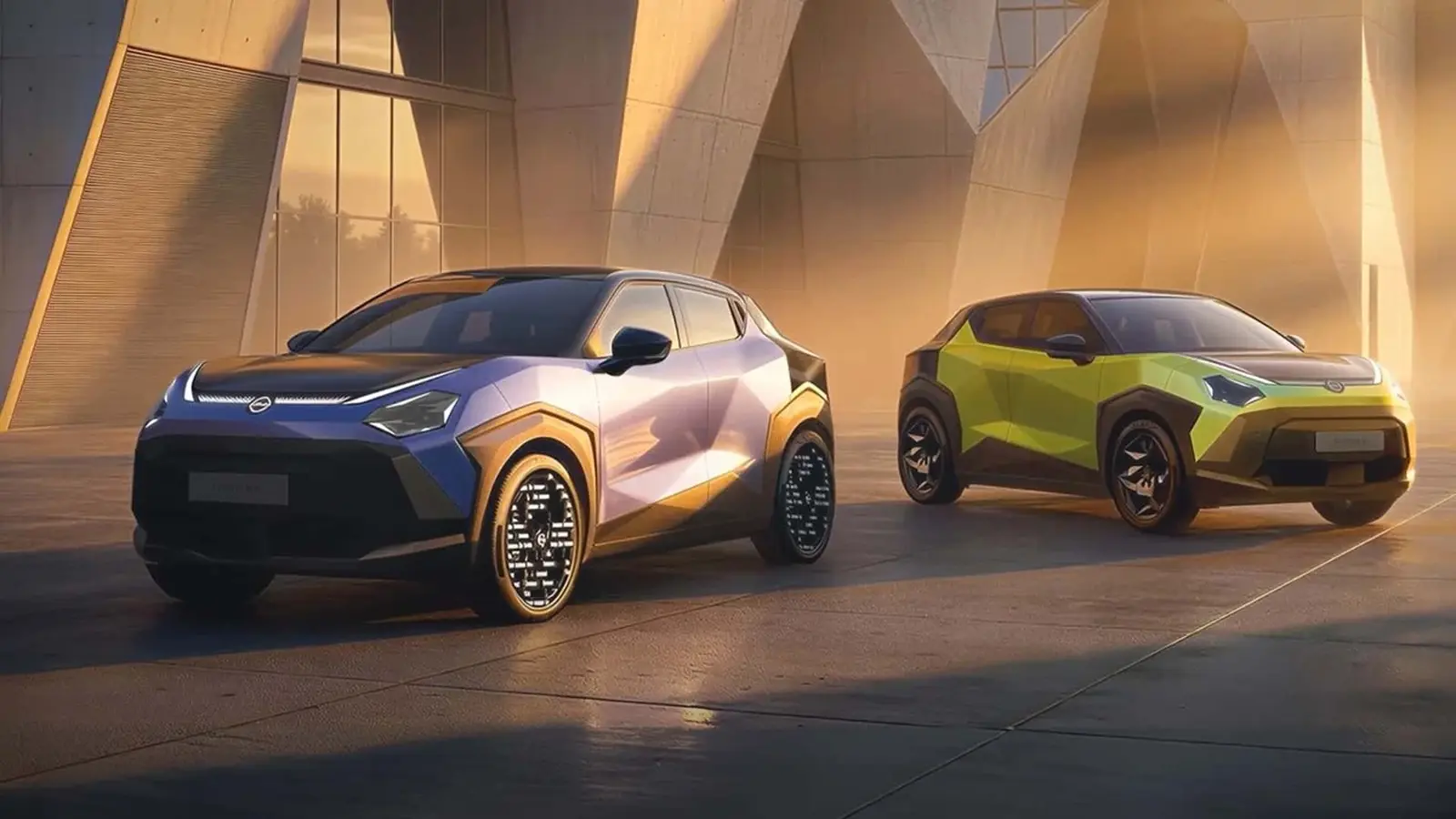
The Nissan Juke has always played by its own rules, and the next chapter looks even bolder. After more than a decade of standing out in a sea of sensible small crossovers, Nissan is readying a third-generation Juke that leans hard into the weird, the angular and the unmistakably electric.
At first glance, this is no gentle evolution. The new Juke looks as if someone took a concept car and decided to make it real. The surfaces are full of sharp creases, the stance is taut, and even the wheel designs have a futuristic, almost pixel-like feel. It is the kind of styling that will split opinion in seconds. That is exactly the point.
One of the cleverest Juke trademarks survives, too. The rear door handles are still tucked into the pillars, preserving that coupe-like silhouette the model has long used to disguise its practicality. And while the new car looks like it belongs in a design studio rather than a supermarket car park, it actually shares its CMF-EV platform with the more conventional Nissan Leaf.

Electric only, but not quite yet
The biggest change is hidden beneath the skin. The next Juke will be fully electric, marking a major shift for one of Nissan’s most recognizable nameplates. Even so, the current second-generation model is not disappearing immediately. Nissan plans to keep the existing hybrid version on sale for now, a sensible move in a market where not every buyer is ready to make the jump to a battery-powered crossover.

Both generations will be built at Nissan’s Sunderland plant in the UK, with the all-new electric Juke expected to arrive in Europe next spring. For a model that has always relied on personality to win over buyers, the move to EV power seems designed to sharpen its identity rather than soften it.
For now, Nissan is keeping the cabin and technical details under wraps, but the Leaf offers a useful clue. In Europe, the electric hatchback is available with 52 kWh and 75 kWh battery packs, delivering a WLTP driving range of up to 271 miles and 375 miles respectively. If the Juke follows a similar formula, expect a front-wheel-drive setup with a single motor.

The Leaf’s entry-level version produces 174 hp and 255 lb-ft of torque, while the stronger model develops 215 hp and 262 lb-ft, enough for a 0 to 62 mph sprint in 7.6 seconds. Whether the Juke matches those figures remains to be seen, but the recipe is already taking shape: compact, electric and anything but ordinary.
And that may be the real story here. In a segment packed with soft curves and safe choices, Nissan is doubling down on character. Again.

“Cars are evolving faster than ever. I cover electric vehicles, smart mobility, and the future of transportation worldwide.”

Discussion
Leave a Comment