
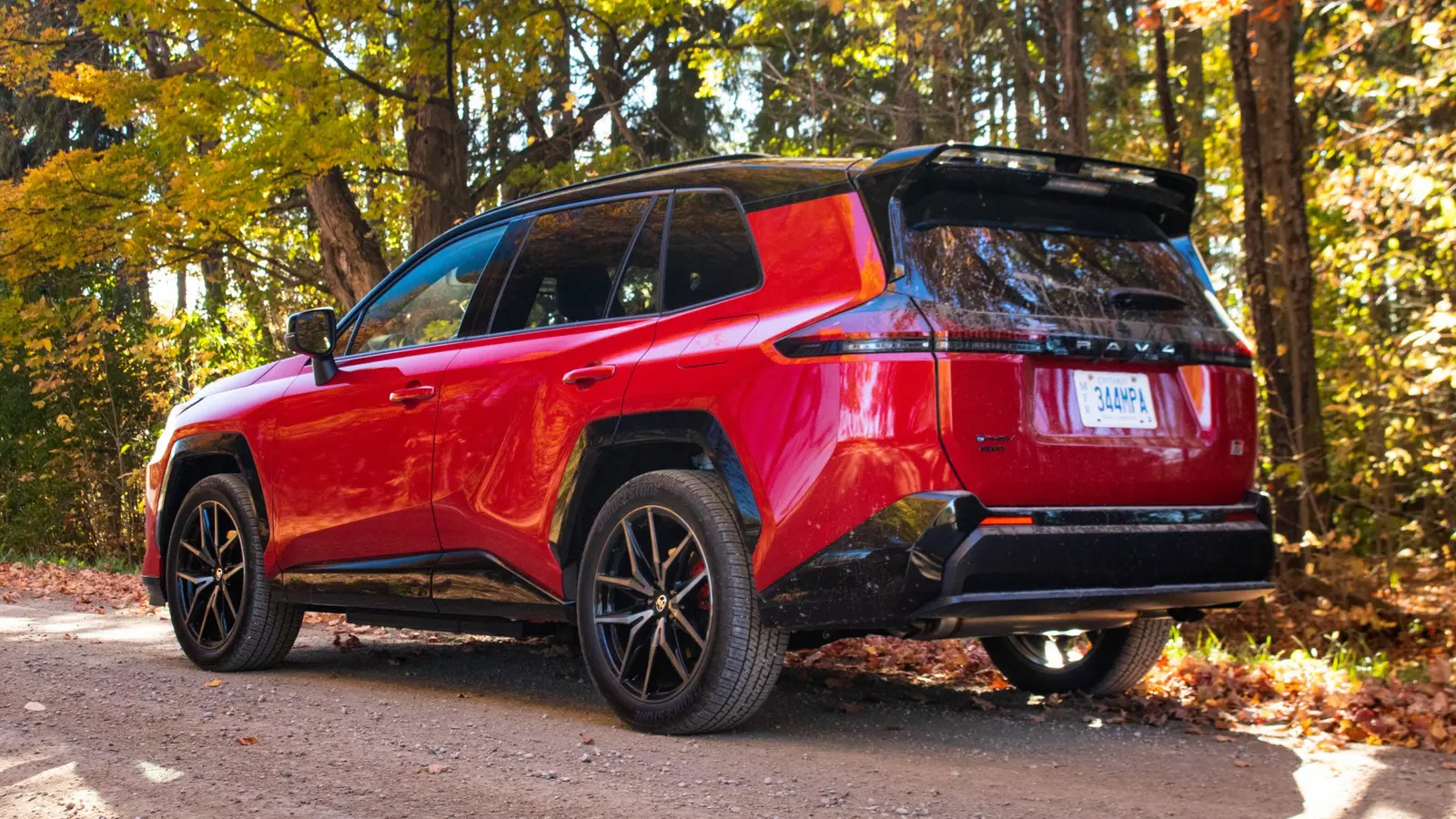
For three decades the Toyota RAV4 has been a sensible family choice. Comfortable, efficient, reliable, practical. What it rarely delivered was genuine driver appeal. The sixth generation changes that narrative. The RAV4 GR Sport is a plug-in hybrid with class-leading system output, a lower and firmer GR-tuned chassis, bigger brakes, focused steering, and a cabin that still works for everyday life. We spent time with an early GR Sport to understand not just the spec sheet, but how it feels to live with and where it stands among rivals.
Quick highlights
Powertrain: 2.5-liter Dynamic Force four-cylinder paired with three electric motors
System output: up to 324 hp, electronic all-wheel drive standard
Transmission: eCVT with simulated steps via paddles
Battery: 22.7 kWh, claimed electric range 48–52 miles depending on trim
AC charging: 7 kW onboard charger on GR Sport. DC fast charging available on some other trims in certain markets, not on GR Sport
Performance: 0 to 60 mph measured at 5.47 s in an early test with a passenger, likely near 5.0 s in ideal conditions
EV-only 0 to 60 mph: about 8.9 s
EPA references: 41 mpg city and 34 mpg highway indicated for similar configurations. WLTP figures in Europe can differ
Ground clearance and stance: GR Sport sits 15 mm lower, still around 190 mm of clearance
Brakes: larger rotors on PHEV variants, 12.9 in front and 12.0 in back
Cargo: 33.6 cu ft seats up, 63.6 cu ft seats folded, temporary spare under floor
Towing: GR Sport is not rated to tow. Other PHEV trims in some markets are
Note on pricing and availability: final pricing has not been announced at the time of writing. Regular hybrid models are expected first, with PHEV including GR Sport targeted for early 2026 depending on market.
.avif)
Exterior and proportions
The GR Sport is not shy about its mission. Up front you get a larger honeycomb grille with GR badging, functional openings for cooling, and a more assertive lower splitter. Premium projector LED headlamps with LED DRL and indicators are standard on this trim. The visual signature borrows from recent GR models but remains recognizably RAV4.
The stance is key. Toyota lowers the car by 15 mm, trims the wheel offsets, and fits 20-inch wheels with 235/50 tires. They are genuine summer performance tires, which brings precision on warm dry tarmac and asks for a dedicated winter or all-season set where climates demand it. Overall length is 182.9 in on a 105.9 in wheelbase, but with longer bumpers the GR Sport is the longest of the new lineup.
At the rear the stacked roof spoiler is the boldest cue we have seen on a RAV4, claimed to add measurable downforce. Full LED taillamps keep a clean, darkened look. The exhaust tips are tucked out of sight which cleans up the design even if it reduces the visual drama. Two deliberate choices round out the exterior brief: no roof rails and no sunroof on this trim. The intent is weight discipline and a lower center of gravity rather than a feature count flex.
Chassis, steering, and brakes
The hardware changes go beyond looks. GR-specific dampers, the lower ride height, and sharper steering calibration reduce body motion and tighten response around center. The RAV4 still sits tall because it is an SUV, so roll is not eliminated, but the contrast to softer trims is immediate.
Brakes are upsized across PHEV variants to 12.9 in front and 12.0 in back, with red-painted calipers on GR Sport. The single-piston floating design is fine for daily driving and mountain descents when combined with regenerative braking. If you are chasing repeated high-energy stops, a multi-piston setup would deliver more bite, but that is outside the GR Sport’s real-world brief.
Tires matter. The Dunlop SP Sport Maxx summer compound on 20s gives grip and crisp turn-in. In heavy rain or cold climates, owners will want high quality all-season or dedicated winter rubber. With the right tires, the electric rear axle and traction logic make the GR Sport a calm and secure all-weather partner.
.avif)
Powertrain and performance
Under the hood is Toyota’s strongest mainstream plug-in hybrid to date. The 2.5-liter naturally aspirated four-cyl teams up with three electric motors. Two assist at the front. A dedicated rear motor brings true on-demand all-wheel drive without a prop shaft. Total system output is rated at up to 324 hp.
The eCVT remains a planetary-split hybrid transmission. Paddle shifters simulate steps if you want a familiar rhythm on a winding road, but they do not convert the unit into a conventional stepped automatic. Use them to hold revs and control regen feel rather than to expect crisp gear changes.
The 22.7 kWh pack is the other headline. It is big for the class, enabling a claimed 48–52 miles of EV range depending on trim and tires. More importantly, the pack can deliver enough power that the GR Sport will stay in EV even with the accelerator pinned in certain conditions. That transforms urban driving, short highway hops, and early morning commutes into quietly quick progress.
Performance is where the GR Sport makes good on the badge. We recorded 5.47 seconds to 60 mph with a passenger at moderate elevation on an early loop. Solo at sea level and in cooler air, expect something closer to the five-second mark. EV-only 0 to 60 mph took about 8.9 seconds. Passing punch in hybrid mode is strong because the electric torque fills instantly while the engine contributes sustained power.
Engine sound stays subdued. There is no pops and bangs theater here. If you want exhaust drama this is not that car. What you get is thrust and composure, which suits the GR Sport’s mission of real-world speed.
Efficiency and range
EPA-style references of 41 mpg city and 34 mpg highway for related specs are an indicator rather than a guarantee. WLTP test cycles tend to differ. The bigger truth for a PHEV is usage. Plug in nightly and a 22.7 kWh pack covers many daily routines on electricity alone. Run long highway days without charging and the car becomes a very efficient hybrid.
Total range with a full pack and full tank is easily long-trip capable. The lack of DC fast charging on the GR Sport is a conscious choice and matters most for people who rely on opportunistic fast top-ups during multi-stop days. For the majority who charge at home or work, the 7 kW AC charger is the feature that truly shapes ownership.
.avif)
Interior, ergonomics, and tech
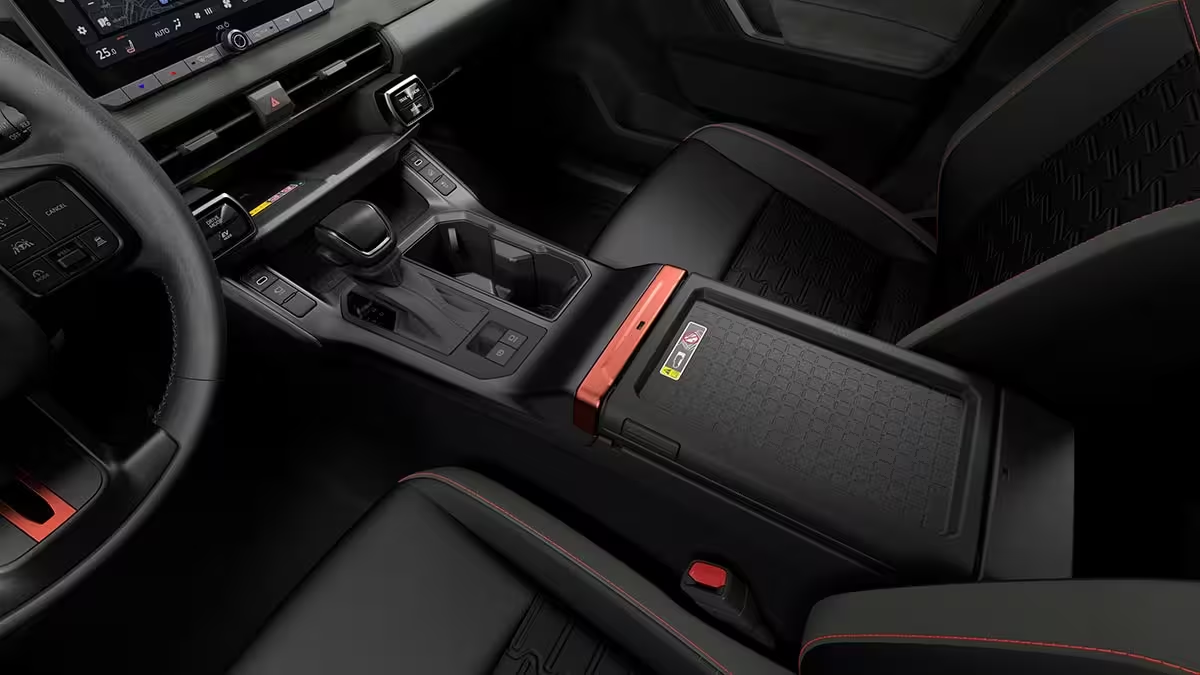
Inside, the GR Sport trades bright trims for purpose. The cabin is black with red contrast stitching. Seats mix SoftTex with a suede-like Brin Naub insert and add more lateral support than the XSE. Power adjustment for the driver is common. The front passenger often remains manual depending on market. Three-stage heating is present. Ventilation and memory vary by package and region.
Materials land where they matter. Touch zones are soft and padded, while upper dash areas can remain hard. The win is that glossy piano black is largely avoided on high-contact surfaces. Toyota also fits GR alloy pedals which add a little sparkle to the otherwise restrained space. The absence of any sunroof leaves generous headroom.
.avif)
Infotainment and driver display
Toyota’s 12.9-inch Audio Multimedia 2.0 system is responsive and clear. Wireless Apple CarPlay and Android Auto connect quickly. The built-in cloud navigation is competent, but phone maps will remain the default for many. The 360-degree camera suite is one of the biggest functional upgrades, with higher resolution, a free-rotate perimeter scan, and a transparent ground view that genuinely helps curb-side parking.
The driver display offers several layouts: dual dials, single dial, minimalist digital speed, assistance view, energy flow, and even map integration. Drive modes include Normal, Eco, Sport, and Custom. EV and HV selections sit alongside Trail and Snow modes so you can tailor behavior to conditions. The climate control retains physical knobs and buttons, which is the right call for winter gloves and muscle memory.
.avif)
Second row and cargo
Rear passengers get adjustable backrests, dedicated air vents, and two USB-C ports. Foot space is decent and two adults will be comfortable. A third fits for shorter trips. Cargo volume is generous for a PHEV because the battery pack is packaged under the floor midsection. Floors are slightly higher than a non-plug-in, but you still get an almost flat load area with the seats folded and, crucially, a temporary spare under the floor.
.avif)
Safety and driver assistance
Toyota Safety Sense is standard and brings the expected suite: adaptive cruise control, lane keeping with lane centering, automatic emergency braking with pedestrian and cyclist detection, blind spot monitoring, and rear cross traffic alert with braking. A digital rearview mirror is not guaranteed on this trim. The 360 camera and parking sensors, though, make urban maneuvering easy. Euro NCAP ratings will be published when the European-spec cars are tested. Historically the RAV4 has performed well in structural and active safety tests.
Charging and ownership
The GR Sport’s onboard 7 kW AC charger refills the pack from low to full in roughly three and a half hours on a typical home wallbox. That is the ownership pivot. If you can plug in at home or work, you will use the car in EV for most local miles and operate in hybrid mode on longer trips without anxiety. If you cannot plug in regularly, you will still enjoy strong performance and hybrid efficiency, but you will miss the core advantage of a PHEV.
Practical notes for owners
Install a dedicated 32 A circuit and a quality 7.4 or 11 kW wallbox.
Precondition the cabin while plugged in on very hot or cold days to preserve EV range.
Avoid storing the car for long periods at 100 percent or near zero percent state of charge.
Rotate the 20-inch tires regularly and maintain proper alignment to control wear and cabin noise.
If you face harsh winters, buy a dedicated winter set rather than relying on all-seasons.
.avif)
Trims and what sets GR Sport apart
Depending on market, the RAV4 PHEV family includes SE, XSE, Woodland, and GR Sport. Key differences:
SE PHEV: value focused, similar power, simpler chassis tune, AC 7 kW and in some markets DC up to 50 kW
XSE PHEV: more equipment and comfort options available, some packages include DC fast charging
Woodland PHEV: raised ride height and rough-road flavor where offered
GR Sport PHEV: GR dampers, 15 mm lower ride height, sharper steering, larger brakes, summer performance tires, no sunroof, no roof rails, AC 7 kW only
If you want the most comfort and panoramic feel, XSE is a better fit. If you want a RAV4 that finally drives with intent on your favorite back road while remaining a pragmatic family car, the GR Sport is the one.
On-road impressions
Urban driving is where the big battery and electric torque make the first impression. Takeoff is smooth and quiet, gaps in traffic are closed with confidence, and the car slips through city speeds in EV mode without fuss. On the highway the hybrid system blends power seamlessly. The eCVT keeps the engine in its efficient band. Under heavy throttle the engine can be heard, but noise levels are lower than before and short bursts feel clean rather than strained.
On a twisty road the heavier steering and firmer damping make themselves known. The nose follows inputs faithfully and mid-corner composure is improved. You still feel vertical motion over broken pavement, especially on 20-inch wheels, but the tune stops short of harshness. The brake pedal is predictable in everyday use, and the strong regenerative capability helps manage speed on long descents without cooking the friction brakes.
What stands out is the breadth of ability. The GR Sport is not a track SUV and does not pretend to be. It is a family crossover that can be quick, composed, and efficient. That is a more useful type of performance for most people, most of the time.
Rivals and market context
Direct plug-in hybrid competitors vary by region, but the shopping list often includes:
Honda CR-V e:PHEV
Hyundai Tucson Plug-in Hybrid
Kia Sportage Plug-in Hybrid
Volkswagen Tiguan eHybrid of the new generation
Mazda CX-5 and CX-50 Turbo as non-PHEV performance-leaning alternatives
Volvo XC40 and EX40 if you are ready to go fully electric
Why choose the GR Sport over these
Highest system output among mainstream PHEV crossovers in its size class at the time of writing
True electric rear axle for AWD feel and winter confidence
Big battery for real EV use in daily life
GR chassis changes that you can actually feel
RAV4 practicality, resale strength, and brand reputation
Where rivals may appeal
Some offer panoramic roofs, power passenger seats, or richer interior materials
Certain trims include DC fast charging
Dedicated performance variants from premium brands deliver stronger braking systems and more theatrical soundtracks
.avif)
Ownership costs and practicalities
Insurance: performance and newness tend to push premiums higher, while safety tech and driver profile can bring them down
Maintenance: Toyota hybrid hardware is well proven. PHEV components often carry extended warranties depending on market
Tires: 20-inch rubber is not cheap. A dedicated winter set is wise in cold climates
Energy: home AC charging overnight is far cheaper per mile than gasoline in most regions
Resale: RAV4 values are historically strong. GR branding could further support demand if supply is modest
Pros and cons
Pros
Strongest mainstream Toyota PHEV powertrain with genuine pace
GR-tuned chassis brings real gains in steering feel and body control
Big battery supports meaningful EV commuting
Excellent 360 camera suite and modernized infotainment
Practical interior with spare tire and generous cargo area
Cons
No sunroof and no roof rails on GR Sport
Not rated to tow
Paddles simulate steps rather than deliver real shifts
Summer performance tires require a second set for winter
Some hard plastics remain on upper dash areas
.avif)
Key specifications
Engine and motors: 2.5-liter inline-four with direct injection plus three electric motors
System output: up to 324 hp
Drivetrain: eAWD with dedicated rear electric motor
Transmission: eCVT with simulated steps
Battery: 22.7 kWh
EV range: 48–52 miles claimed depending on trim and conditions
0 to 60 mph: about 5.0 to 5.5 seconds depending on conditions
0 to 60 mph EV-only: about 8.9 seconds
Brakes: 12.9 in front, 12.0 in rear rotors on PHEV
Wheels and tires: 20 in, 235/50
Ground clearance: around 190 mm with GR’s 15 mm drop
Cargo volume: 33.6 cu ft seats up, 63.6 cu ft seats folded
Towing: not rated on GR Sport
Figures can vary with market specification and final certification.
.avif)
Verdict
The 2026 Toyota RAV4 GR Sport does what many enthusiasts have wanted from a RAV4 for years. It keeps the model’s family-friendly core and layers on real pace, sharper responses, and a longer electric stride. It is not a premium performance SUV and does not chase exhaust theatrics. It is a faster, more focused RAV4 that remains quiet, efficient, and useful the other 95 percent of the time.
If you want a plug-in hybrid SUV that feels alert on a back road yet behaves like a Toyota in school-run duty, the GR Sport belongs at the top of your list. If you absolutely must have a panoramic roof, DC fast charging, or towing, consider another trim or rival. For everyone else, this is the RAV4 that proves sensible can also be sincerely enjoyable.

“Cars are evolving faster than ever. I cover electric vehicles, smart mobility, and the future of transportation worldwide.”

Discussion
Leave a Comment