
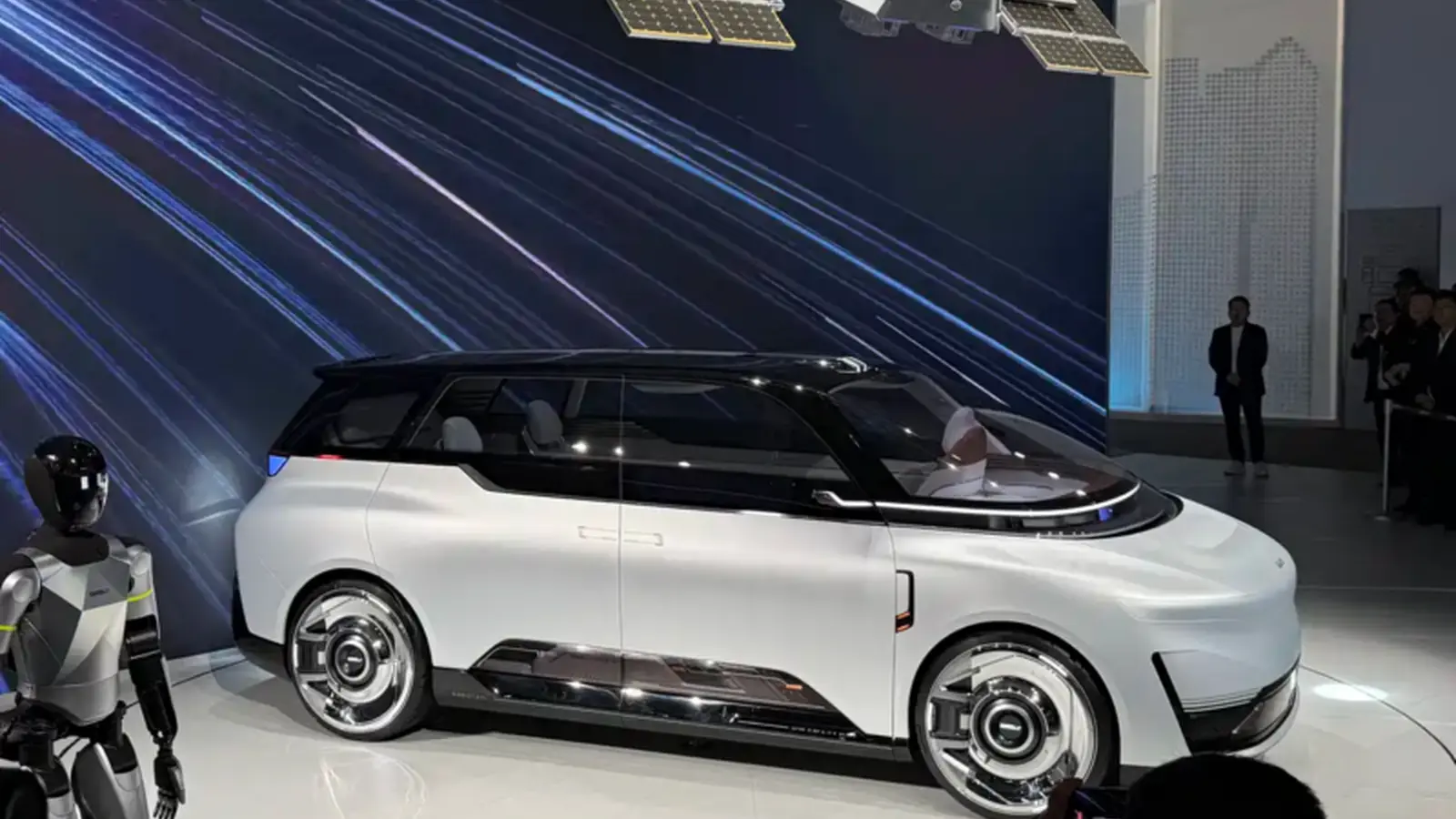
Geely just pulled the covers off something that could change the mood around autonomous mobility in China. At the 2026 Beijing Auto Show, the company unveiled the Eva Cab, described as China’s first native robotaxi prototype, and it arrives with a clear message: this is not a concept built for show, but a serious shot at commercial self-driving transport.
The headline numbers are hard to ignore. Under the skin, the Eva Cab runs on a 196-billion-parameter Step 3.5 large model paired with Geely’s H9 high-level computing solution, which delivers 1,400 TOPS of processing power. Geely says the system can infer at 350 TPS, making decisions up to three times faster than a human driver. In practical terms, the company claims it can handle 99% of everyday driving situations, from squeezing through manual toll booths to mapping a way forward on rural roads with no lane markings at all.
A robotaxi built to think, not just react
At the center of the package is Geely’s World Action Model, or WAM. Instead of relying on the usual perception to decision chain, WAM is designed as a closed loop that combines macro planning with micro-level deduction. That sounds technical, but the idea is simple enough. The vehicle is supposed to behave less like a machine following instructions and more like an experienced driver reading the road, the traffic, and the messy little negotiations that happen in real life.
That ambition is backed by serious sensor hardware. The prototype uses 43 perception components, including lidar and high-definition cameras, creating what Geely describes as a triple 360-degree blind-spot-free detection network. The system scans the surroundings continuously, identifying pedestrians, vehicles, and obstacles before they become a problem. Geely says the setup has already shown strong results in complex scenarios, including a 95% success rate in multi-turn U-turn maneuvers. For a robotaxi, that matters. A lot.

Then there is the design, which makes its own statement. The Eva Cab ditches the steering wheel and the familiar control layout entirely. That is not just a styling decision. It is a signal of intent. Geely is building for a future where passengers may not need to touch anything at all, because the vehicle does the thinking, the steering, and the risk management on its own.
The company also says the car uses its AI digital chassis technology, with a response time of just 4 milliseconds. In extreme conditions, Geely claims this system can deliver automatic risk avoidance and help keep the vehicle stable without driver intervention. The promise is bold: active risk avoidance, never losing control.
For now, the Eva Cab remains a prototype, but the business plan behind it is already taking shape. Geely says a deeply customized version developed with Caocao Mobility is scheduled for mass production in 2027, when commercial operations are expected to begin. If that timeline holds, the brand could move unmanned driving from auto-show theater into actual daily transport services.
There is also a wider industry angle here. Earlier reports suggested that Geely’s Zeekr brand and Waymo were working together on a robotaxi based on the Zeekr Mix, but that path appears to have stumbled. Sales of the Zeekr Mix in China have reportedly fallen to almost nothing this year, which only adds more intrigue to Geely’s push with the Eva Cab. One project may have lost momentum, but the company clearly is not backing away from the robotaxi race.
And that is the real story. China’s autonomous vehicle race is no longer about distant promises. It is about who can turn the software, sensors, and safety systems into something that works in the real world. Geely’s Eva Cab is now firmly in that conversation.

“I cover automotive innovation, electric vehicles, and the future of mobility — where technology meets sustainability.”

Discussion
Leave a Comment