
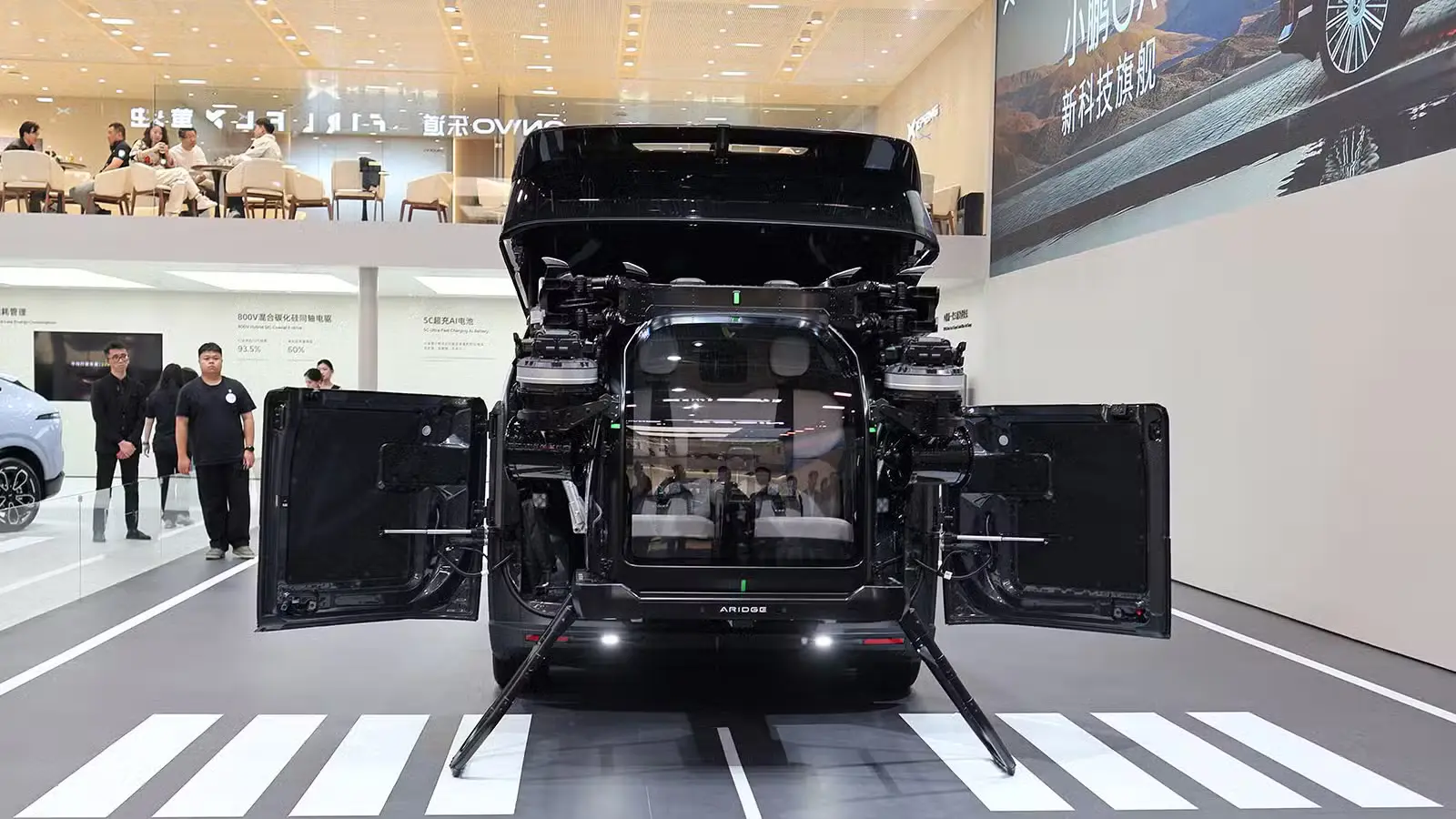
The queue around Xpeng’s stand in Beijing told its own story. People were not just stopping for photos. They were climbing into virtual reality flight demos, watching the aircraft detach from its ground vehicle, and asking the question every futuristic concept car dreams of hearing: when can I get one?
For Aridge, Xpeng’s flying car division, the answer is getting closer. Its modular flying car, called the Land Aircraft Carrier, took more than 90 orders in a single day at the 2026 Beijing Auto Show, according to Xpeng chairman and CEO He Xiaopeng. The figure was shared on Weibo on Sunday, the third day of the show, and it adds fresh momentum to a project that has already collected more than 7,000 pre-orders.
That is not a casual number for a machine that still sounds like science fiction to many buyers. The Land Aircraft Carrier is not a sleek little drone with a steering wheel bolted on. It is a two-part mobility system: a road-going parent vehicle and a two-seat aircraft that can separate when flight is needed.
A car, an aircraft, and a very public test of trust
The concept is clever because it avoids one of the biggest problems facing flying cars: trying to make one machine do everything. On the road, the parent vehicle behaves more like a large new-energy vehicle. It uses an 800-volt high-voltage extended-range platform and is said to offer a combined driving range of more than 1,000 kilometers.
When the aircraft needs power, the ground vehicle can recharge it either while parked or on the move. Aridge says that setup can support five to six flights. In China, owners would only need a standard Class C driving licence to use the parent vehicle on public roads, although aviation permissions and local flight rules will still shape how and where the aircraft can actually be flown.

The price target is almost as important as the engineering. Aridge has previously said the Land Aircraft Carrier will be priced below roughly €240,000, placing it far above mainstream EV territory but potentially within reach of wealthy early adopters, business users, emergency service operators, tourism companies and private mobility fleets.
Mass production has not started yet, but Aridge is no longer behaving like a company with a design study in a corner of an exhibition hall. It is taking customer orders, promoting real-world use cases and pushing toward production and deliveries within 2026.
The company’s Guangzhou facility is central to that plan. A pilot production batch rolled off the line in November 2025, and the factory has been set up with processes that look far closer to automotive assembly than boutique aircraft building. At full capacity, Aridge says the line can produce one aircraft every 30 minutes. Ambitious? Absolutely. But that is the kind of figure meant to signal that this is being treated as an industrial product, not a hand-built novelty.
China first, but not China only
He Xiaopeng also made it clear at the Beijing show that Aridge is looking beyond its home market. The company is in talks with potential markets including the Middle East, Indonesia and Malaysia, regions where low-altitude mobility could appeal to private operators, resort destinations, island communities and public agencies looking for faster point-to-point transport.
Europe and the United States are also on the radar, though those markets bring tougher certification questions, denser regulatory frameworks and more complicated public acceptance challenges. Aridge is already working on a second-generation mass-producible flying car, which He said is being developed with overseas requirements in mind as well as demand in China.
That matters. A flying car can dazzle an auto show crowd in minutes, but selling it globally is a different game. Noise rules, airspace management, pilot training, crash safety, insurance, charging infrastructure and maintenance networks all become part of the product. In other words, the machine is only half the battle.
Still, Aridge has money and momentum. The company, formerly known as Xpeng Aeroht before its October 2025 rebrand, completed a new equity financing round worth nearly €187 million last month. Previous media reports have also said it is preparing for a Hong Kong initial public offering.
For Xpeng, the flying car project does more than generate spectacle. It gives the brand a claim on the next frontier of electric mobility at a time when China’s EV market is brutally competitive and increasingly global. Whether the Land Aircraft Carrier becomes a practical transport tool or remains an expensive early-adopter toy will depend on execution, regulation and public confidence.
But at the Beijing Auto Show, one thing was hard to miss: the crowd was not laughing. It was lining up.

“I cover automotive innovation, electric vehicles, and the future of mobility — where technology meets sustainability.”

Discussion
Leave a Comment