
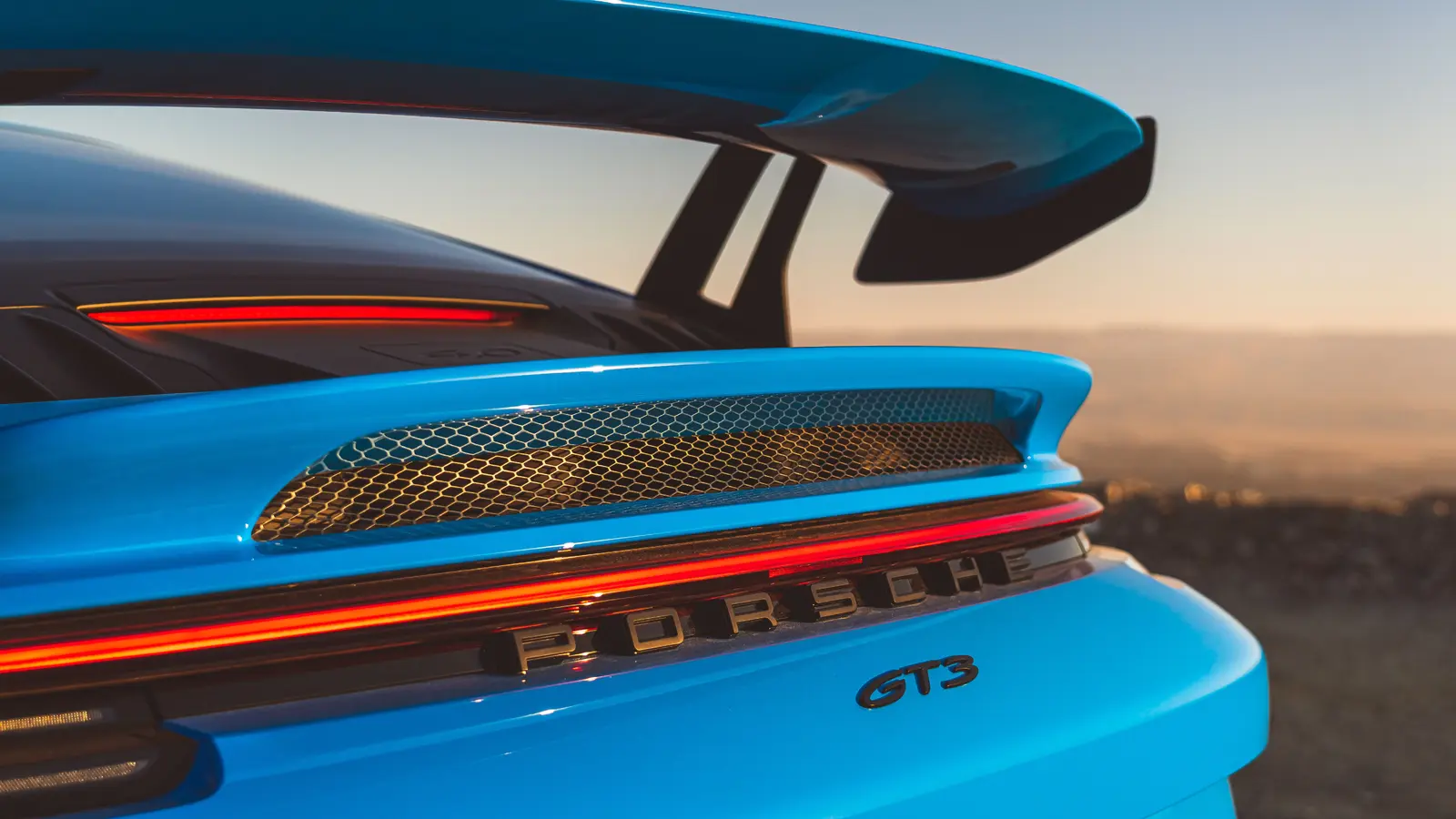
The Porsche 911 GT3 has always sounded like a dare. No turbo whistle, no electric crutch, no softened edges. Just a high-revving flat-six behind the driver, breathing on its own and screaming toward the redline as if emissions rules, market shifts, and common sense were somebody else's problem.
That may not last much longer.
Since the first 996-generation 911 GT3 arrived in 1999, Porsche has treated the model as something close to sacred ground. The formula was brutally simple: lightweight thinking, motorsport hardware, razor-sharp steering, and a naturally aspirated flat-six that made the car feel less like a product and more like a mechanical ritual. Six generations later, the GT3 has survived noise restrictions, particulate filters, tougher fuel economy targets, and the slow tightening of European regulation. But the current 992.2 Porsche 911 GT3 could be the final one to carry that free-breathing 4.0-liter engine in anything like its present form.
The flat-six is running out of road
Andreas Preuninger, the man in charge of Porsche's GT division, has now hinted that the beloved engine's future is becoming increasingly difficult to defend. Speaking briefly to Car and Driver, Preuninger was asked how long the naturally aspirated 4.0-liter flat-six could continue without help from turbocharging or hybrid assistance. His answer was not exactly comforting for purists.
In the United States, he suggested, the engine might survive for quite some time. Europe is another story. There, he said, it may only have a few years left unless Porsche makes substantial changes.
Then came the question every GT3 fan has probably feared: could turbocharging become the way forward? Preuninger's answer was short, careful, and loaded with meaning: "It might be."
That does not confirm a turbocharged Porsche 911 GT3. Not yet. Porsche's GT team is famously protective of the car's character, and nobody in Weissach will casually throw away a recipe that has made the GT3 one of the most respected driver's cars on the planet. Still, the message is clear enough. The old solution of squeezing a little more efficiency from the same naturally aspirated layout is getting harder.

The problem is not really America. It is Europe. The European Union's 2030 climate targets aim for a 55 percent reduction in vehicle greenhouse gas emissions compared with 1990 levels, and performance cars have very little room to hide. A screaming, high-compression six-cylinder that thrives at 9,000 rpm is glorious. It is also increasingly awkward in a regulatory world obsessed with fleet averages and carbon output.
Porsche could theoretically build different GT3 variants for different regions, keeping a naturally aspirated version for markets with looser rules and a modified version for Europe. In reality, that sounds expensive, messy, and unlikely. Separate powertrains would mean separate development programs, homologation work, emissions certification, durability testing, and production complexity. For a relatively low-volume car, the math gets ugly fast.
So the next GT3 will probably be engineered around the toughest major market rather than the easiest one. That means Europe will have a loud voice in deciding what the world's future GT3 looks, drives, and sounds like.
A turbocharged GT3 would be a seismic change, but not necessarily a disaster. Porsche knows forced induction better than almost anyone. The 911 Turbo has been a benchmark for decades, and the GT2 RS has shown how ferocious a turbocharged rear-engined Porsche can be when the gloves come off. The challenge is subtler than power. A GT3 is not loved because it is merely fast. It is loved because of how it responds.
Throttle response. Engine texture. The climb through the rev range. The sense that every input goes straight through the car's nervous system. Add turbochargers, and Porsche would need to preserve that immediacy while gaining the efficiency and emissions advantages forced induction can bring. Small turbos, electric assist, clever anti-lag strategies, or some form of hybridized boost could all be part of the discussion, though Porsche has not laid out a technical roadmap.
There is another complication. If the GT3 gets turbos, what happens to the rest of the GT family?
The GT2 has traditionally stood apart because it is the wild turbocharged sibling: more power, more torque, more aggression, and usually a much sharper edge. If the GT3 also moves to forced induction, Porsche would need to redraw the boundaries. The GT2 might become even more extreme, perhaps with hybrid assistance or a very different performance brief. Or Porsche could lean harder into chassis philosophy, keeping the GT3 as the precision tool and the GT2 as the brute-force weapon.
The 718 lineup adds another wrinkle. The next generation is widely expected to mix electric and combustion possibilities in some form, which leaves the future GT4 powertrain open to speculation. If Porsche is already rethinking what makes a GT car authentic, the Cayman and Boxster side of the family will not be immune.
For now, the 992.2 GT3 stands as a reminder of a fading era: naturally aspirated, track-honed, and defiantly old-school in the best possible way. If it really is the last of its kind, history will treat it kindly. But Porsche has faced this kind of crossroads before. The company has a habit of changing the recipe while somehow keeping the flavor.
The next 911 GT3 may whistle instead of howl. The real question is whether it can still raise the hairs on your neck when the road opens up.

“Cars are evolving faster than ever. I cover electric vehicles, smart mobility, and the future of transportation worldwide.”

Discussion
Leave a Comment