
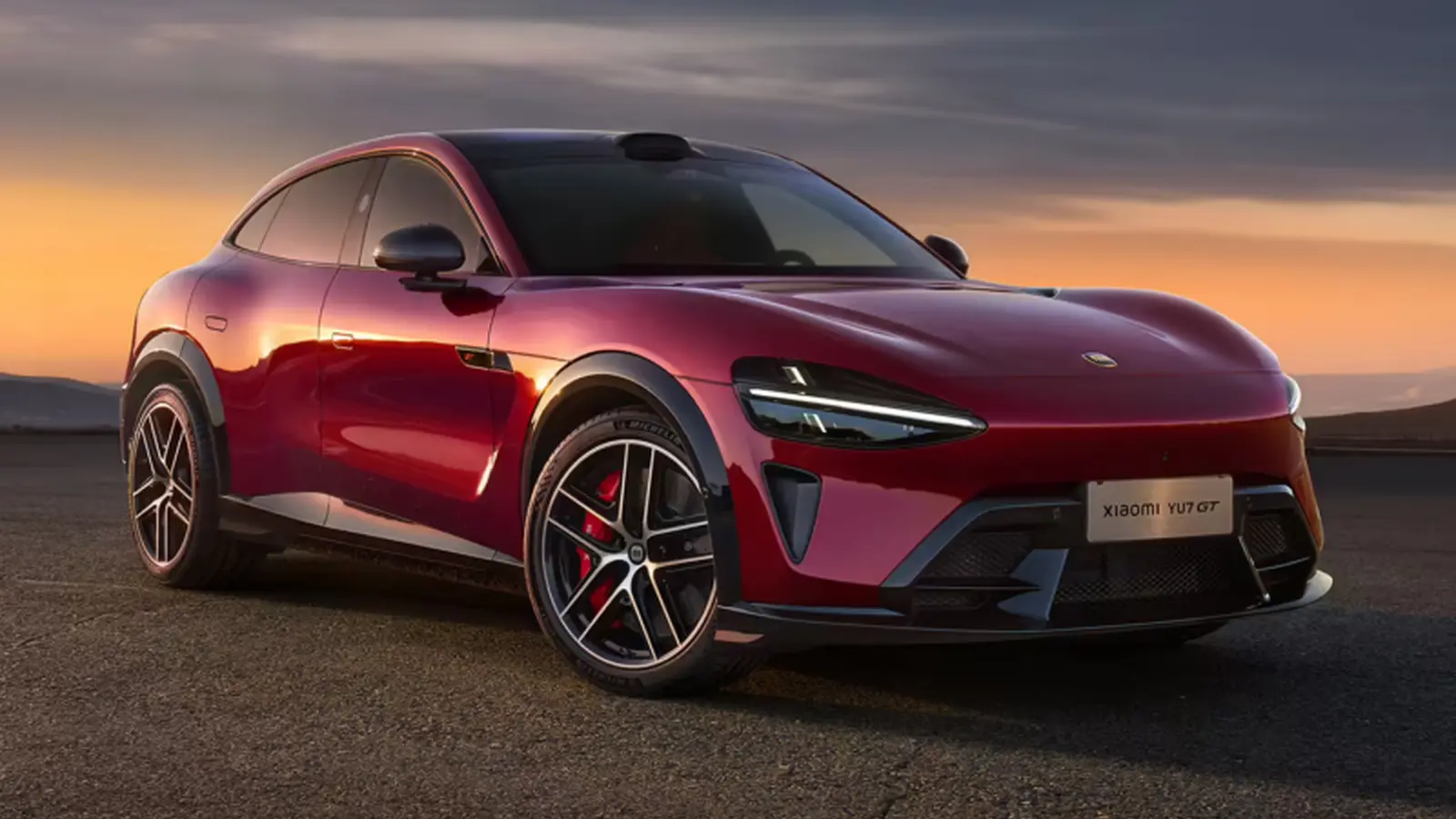
Burgundy crossovers are starting to crowd Xiaomi’s factory floors, and they are not there by accident. The company is clearly getting ready for the late May arrival of the Xiaomi YU7 GT, a high performance electric SUV that brings 990 hp to the table and claims a top speed of 300 km/h.
That alone would be enough to grab attention. But the more interesting part is how Xiaomi wants this car to be understood. Despite the numbers, the YU7 GT is not being pitched as an all out track monster in the mould of the SU7 Ultra. Xiaomi says the difference comes down to purpose. Ultra is reserved for its most extreme, circuit focused machines. GT, by contrast, is meant to signal something faster, richer, and more usable over long distances.
In other words, this is not Xiaomi chasing lap records for the sake of a headline. It is trying to build what it describes as a sports car level SUV for travel. That means serious pace, yes, but also comfort, luxury, and enough battery capacity to make the performance feel practical rather than theatrical.
The numbers support that positioning. The YU7 GT uses a dual motor setup with a 288 kW front motor and a 450 kW rear motor, delivering a combined 738 kW, or 990 hp. Energy comes from a 101.7 kWh battery, and Xiaomi quotes a CLTC range of up to 705 km. The official 0 to 100 km/h time has not been released yet, which only adds a little suspense ahead of the launch.
Not an Ultra, and that seems to be the point
Xiaomi’s explanation is fairly straightforward. The SU7 Ultra sits at the sharpest end of its performance strategy, built with track use in mind. The company has been eager to underline that image, pointing to the sedan’s Nürburgring credentials. Xiaomi says the SU7 Ultra became the third fastest car at the Nürburgring, helped by a staggering 1,138 kW, or 1,526 hp, a 0 to 100 km/h sprint of 1.98 seconds, and a top speed of 359 km/h.
The YU7 GT takes a different road. It still has huge power, but it is aimed at buyers who want supercar energy in a five seat crossover they can actually live with. That is where the GT badge makes sense. Grand tourers have always been about covering distance quickly without beating up the people inside. Xiaomi appears to be translating that old idea into the EV era.
And yes, it still looks the part. Test cars seen at the Nürburgring Nordschleife wore aggressive bodywork, including a pronounced front splitter, rear diffuser, and larger brake calipers. The SUV rides on 21 inch wheels and features 10 through air channels, details that suggest Xiaomi has put just as much thought into cooling and aero efficiency as it has into straight line speed.
There is more underneath. Air suspension, rear axle torque vectoring, and Brembo carbon ceramic brakes all point to a crossover that is meant to feel sharper and more composed than its size might suggest. Xiaomi is not trying to hide the YU7 GT’s performance intent. It is simply framing that intent in a more rounded, road focused way.
Factory photos circulating online suggest the first batch is finished in a deep burgundy shade. That could mean these vehicles are earmarked for showroom duty, likely headed to Xiaomi Auto stores across China soon after the reveal. If so, the company is leaning into presentation as much as specification, which makes sense for a model expected to pull fresh attention toward its expanding EV lineup.
Size matters here too. The Xiaomi YU7 GT measures 5,015 mm long, 2,007 mm wide, and 1,597 mm tall, with a 3,000 mm wheelbase. That makes it 42 mm longer, 21 mm narrower, and 8 mm taller than the Ferrari Purosangue. Not a comparison Xiaomi will mind people making.
The wider business picture is also starting to come into focus. According to China EV DataTracker, Xiaomi delivered 80,856 vehicles in the first quarter of 2026, up 6.6 percent year on year, giving it a 1.9 percent market share. Lei Jun has already set a full year delivery target of 550,000 vehicles for 2026, and halo products like the YU7 GT will matter. Cars like this do more than add volume. They shape image, bring footfall into stores, and tell buyers Xiaomi is serious about competing beyond the mainstream.
That is why the YU7 GT matters. Not because it is the wildest thing Xiaomi can build, but because it may be the clearest sign yet that the company understands performance is not one thing. Sometimes it is about setting records. Sometimes it is about making a fast electric SUV feel desirable enough that people want to drive it across a continent.

“Cars are evolving faster than ever. I cover electric vehicles, smart mobility, and the future of transportation worldwide.”

Discussion
Leave a Comment