
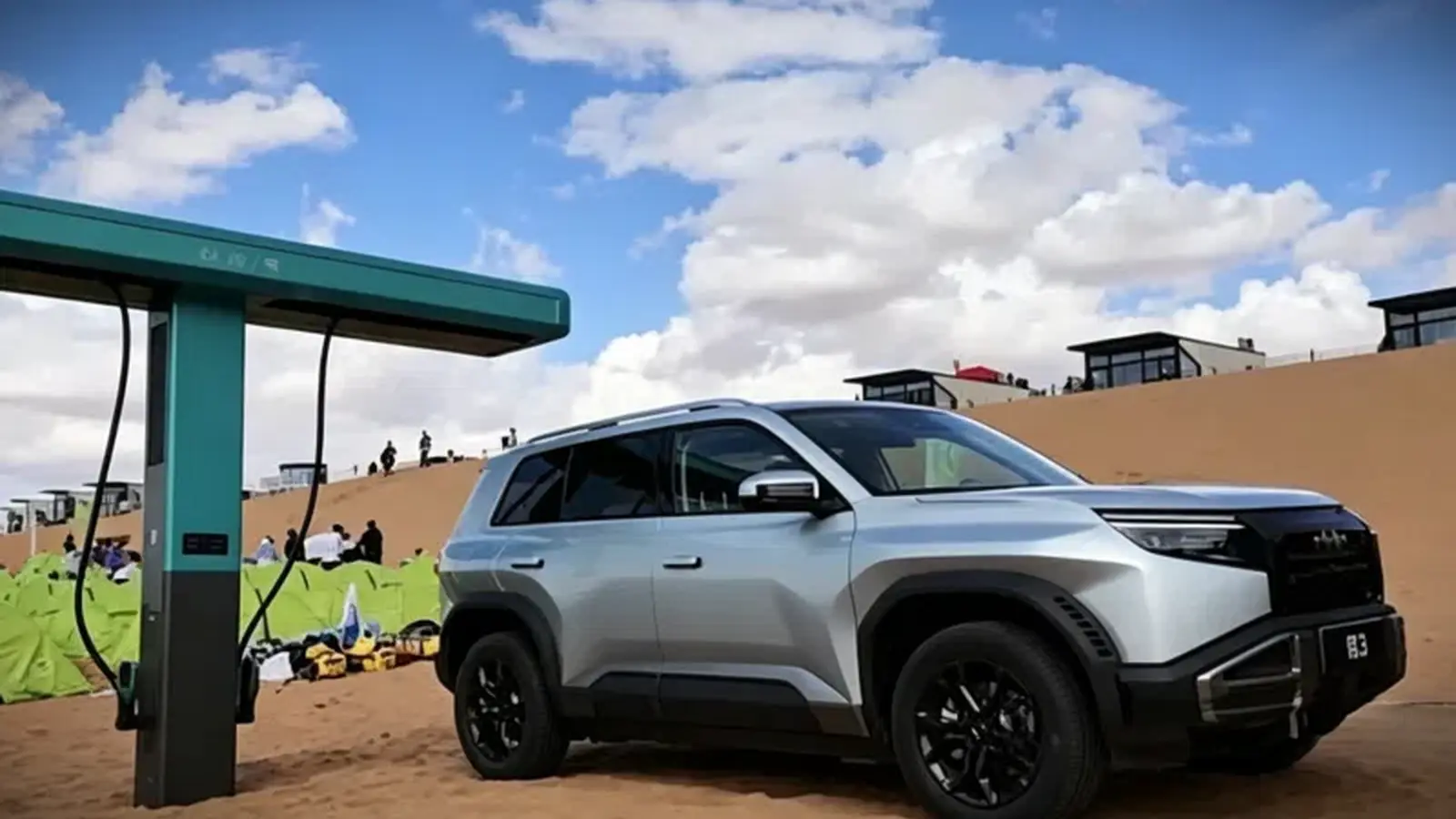
Sand, wind, isolation, and still the charger worked. That is the point BYD wanted to make in Inner Mongolia, where the company staged a flash charging test deep in the Tengger Desert at the remote Sha15 endpoint. Instead of a polished city forecourt or a busy expressway service area, BYD took its ultra fast charging story somewhere far less forgiving and far more revealing.
On site, the brand used an FCB Tai 3 to show what its system could do under rough desert conditions. According to reports from Autohome, staff said the vehicle gained a rapid charge in just five minutes and reached a full charge in nine. Those are headline grabbing numbers, of course, but the location may be the bigger story. A charger in a major city proves convenience. A charger in the desert proves intent.
The Tengger Desert is not the kind of place that flatters infrastructure. Sand gets everywhere. Wind punishes exposed equipment. Logistics are harder, maintenance is harder, and the usual assumptions about grid access and service support become shaky. That is why this installation matters. It suggests BYD is not only chasing scale on paper, but also testing how flexible its charging network can be when the environment turns hostile.
Not just bigger, but bolder
The desert demonstration arrives as BYD keeps accelerating its charging rollout across China. In early April 2026, the company said it had already hit 5,000 flash charging stations only 27 days after launching the program. During the May holiday travel period, that figure climbed again, reaching 5,715 stations nationwide.
That is a serious footprint in a very short time. It also gives BYD a stronger answer to one of the oldest questions in the electric car market: what happens when drivers leave the obvious routes behind? Urban charging is one thing. Motorway charging is another. Remote charging is where confidence is won or lost.
BYD has also signalled that its ambitions stretch well beyond China. The company says it plans to install 6,000 flash chargers overseas, a move that fits neatly with its broader global push. Europe is part of that picture, especially as the Denza brand prepares to expand with models including the Z9 GT and D9.
There is, naturally, some context behind the charging claims. BYD has not published a full breakdown of the standardised testing conditions used in the desert run, and real world charging speeds always depend on the usual variables: battery temperature, state of charge, charger output, and vehicle compatibility. In other words, the five minute and nine minute figures are impressive, but they should not be treated as a guaranteed result for every driver in every situation.
Even so, the symbolism is hard to miss. Extreme environment testing gives BYD another layer of credibility as competition in high power EV charging intensifies. Carmakers and charging operators across China are pouring money into faster networks, trying to reduce the gap between refuelling a petrol car and recharging an EV. BYD appears determined to compete on both fronts at once, raw network size and deployment versatility.
The timing is interesting for another reason. According to China EV DataTracker, BYD sold 314,100 electric vehicles globally in April 2026. That represented a 6.2 percent rise from March, but also a 15.7 percent drop compared with the same month a year earlier. The company has now posted year on year declines for eight straight months, even as overseas deliveries continue to grow.
That creates an unusual backdrop. On one side, BYD is expanding aggressively, building chargers at speed, testing them in punishing locations, and pushing its brands into new markets. On the other, the sales trend shows that scale alone does not guarantee momentum forever. The pressure is still there.
Maybe that is why this desert test feels more significant than a simple tech demo. It is a statement about resilience, ambition, and the kind of infrastructure battle that may shape the next phase of the EV market. Anyone can build where it is easy. The real message lands when you build where almost nobody expects you to.

“Cars are evolving faster than ever. I cover electric vehicles, smart mobility, and the future of transportation worldwide.”

Discussion
Leave a Comment