
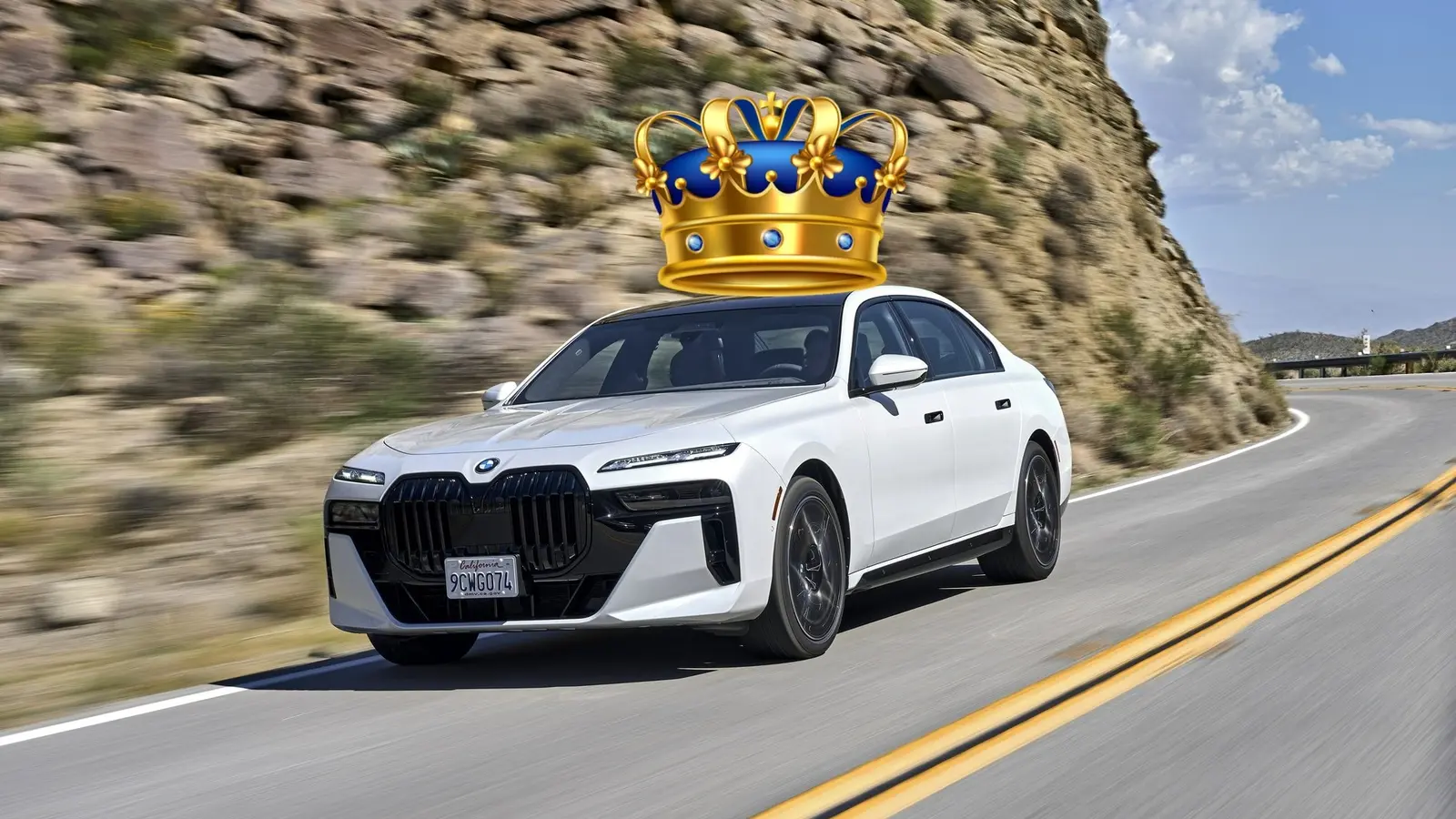
Here is the strange part of today’s EV market: a used BMW i7 can now cost less than a new Tesla Model 3 Performance. Read that again. One is a full-size luxury flagship built to pamper its passengers in near silence. The other is a compact performance sedan. That gap says everything about where the premium electric market stands in 2026.
The BMW i7 never really became the must-have electric limousine many expected. Some buyers were put off by its bold styling, others by its weight, and plenty simply were not ready to trust a large EV for long-distance travel. For the traditional 7 Series crowd, the idea of planning charging stops on a business trip still feels like an unnecessary headache, especially in regions where fast-charging infrastructure remains patchy.
That weak demand is now creating a genuine opportunity in the used market. If you can charge at home or at work, the i7 starts to look less like a risky indulgence and more like one of the most tempting five-figure EV bargains on sale.
The depreciation story nobody can ignore
Early examples of the BMW i7 xDrive60 are already appearing at prices that would have sounded absurd not long ago. One 2023 car with around 37,000 kilometers on the clock, finished in Oxide Grey and equipped with the M Sport package, Shadowline trim and a Bowers and Wilkins audio system, was originally priced at more than €120,000. Today, cars in that territory are surfacing for roughly €48,700.
That is the hook. This is not some stripped-out experiment with a premium badge. It is a 7 Series. You still get the lounge-like cabin, the big-road presence, the whisper-quiet drivetrain and the kind of comfort that makes many newer EVs feel thin and ordinary by comparison.
Range, of course, is where reality enters the room. In ideal conditions, an i7 xDrive60 can manage about 483 kilometers. Use the battery more conservatively and charge to around 80 percent for day-to-day longevity, and that number falls closer to 402 kilometers. In harsh winter weather, it can drop much further. That sounds dramatic until you remember how many luxury sedans spend most of their lives doing airport runs, school trips, commuting and short motorway hops. For that kind of use, the i7 still makes a lot of sense.
If your daily routine is modest and you have access to AC charging, you may only need to plug in once or twice a week. Suddenly the i7 stops looking compromised and starts looking deeply convenient.

Big car, small-money logic
Several used examples now sit in the same rough price window. Higher-mileage cars can be found from about €47,800, while better-specified or more distinctive versions climb into the mid-€50,000 range. That puts the i7 in a fascinating position. It is no longer competing with six-figure luxury EVs. It is drifting into the territory of mainstream new electric saloons and crossovers.
And that changes the conversation completely.
Because once you stop comparing the i7 to a new Mercedes EQS or a brand-new high-end EV, and start comparing it to what €50,000 to €55,000 actually buys today, the BMW becomes unusually persuasive. You get flagship comfort, serious road presence, effortless pace and one of the best cabins in the segment for the price of a far more ordinary new EV.
It also helps that the i7 does not scream EV in the way some rivals do. Unlike the EQS, which leans heavily into its own aerodynamic identity, the BMW looks like a 7 Series first and an electric car second. For many buyers, that matters. They want electric power without feeling like they are making a visual statement every time they leave the driveway.
There are caveats. This is still a heavy luxury EV, and tyre wear is not a fantasy. Public charging on long journeys can still test your patience. And if your life regularly involves last-minute cross-country travel with no time to think about charging strategy, a diesel or plug-in hybrid executive saloon may still fit better.
But for the right buyer, the numbers are becoming hard to dismiss. Electricity is often cheaper than petrol, especially if you can charge overnight on an off-peak tariff. Running costs can look surprisingly reasonable for something this large and this plush. The badge helps too. There is still a quiet satisfaction in driving a BMW flagship, even if it happens to run on electrons.
The facelifted i7 has not dramatically reset the formula, and that may be the best news of all for used buyers. As newer examples begin to appear, earlier pre-facelift cars should continue to soften in price. That means the sweet spot may not even be here yet.
So yes, it sounds a little counterintuitive. A depreciated electric limousine from BMW is not the obvious answer in today’s car market. But that is exactly why it is interesting. Ignore the noise around EV tribalism for a moment, look at the classifieds with a clear head, and the used BMW i7 starts to look like one of the smartest luxury EV buys available right now.

“Cars are evolving faster than ever. I cover electric vehicles, smart mobility, and the future of transportation worldwide.”

Discussion
Leave a Comment