
.webp)
For decades, the global car industry had a familiar shape. Germany built engineering prestige. Japan perfected reliability and scale. The United States exported power, size and mass-market aspiration. These countries did not simply manufacture vehicles; they built entire economic identities around them. Detroit, Wolfsburg, Stuttgart, Toyota City and Turin were not just names on a map. They were symbols of industrial confidence.
That confidence is now being tested in a way few executives in the traditional car world expected so quickly.
In less than a decade, the center of gravity in the automotive industry has begun to shift away from the combustion-engine empires of the 20th century and toward a new ecosystem built around batteries, software, vertical integration and state-backed industrial ambition. At the heart of this shift stands BYD, a Chinese company that began not as a carmaker, but as a modest battery workshop in Shenzhen.
The scale of BYD’s rise is difficult to overstate. Once dismissed by rivals, analysts and even Elon Musk, the company has become one of the most important forces in electric mobility. Its cars are now sold across China, Europe, Latin America, Southeast Asia and beyond. Its battery technology has reshaped cost expectations. Its plug-in hybrids have reached buyers who were not ready for full electric vehicles. Its manufacturing model has placed immense pressure on automakers that once seemed untouchable.
Yet BYD’s story is not a simple tale of innovation conquering old industry. It is also a story about subsidies, debt, brutal price wars, aggressive expansion and the risks that appear when growth becomes too fast to control. BYD may be the clearest example yet of the new automotive age: technically impressive, commercially ruthless, geopolitically charged and increasingly difficult for Western rivals to understand, let alone defeat.
The End of the Old Automotive Certainty
For most of the last century, automotive power was concentrated in a handful of regions. Germany, Japan and the United States set the standards. Their manufacturers controlled the technologies, the brands, the supplier networks and the emotional language of car ownership.
The internal combustion engine was central to that dominance. It was complicated, expensive to master and deeply tied to decades of engineering know-how. Building a world-class engine, transmission and chassis required long institutional memory. That complexity protected the established players. It created a barrier that newcomers struggled to cross.
Electric cars changed the equation.
An EV is not simple, but it shifts the source of value. The battery pack, power electronics, software systems, charging capability, cost control and supply chain access now matter as much as engine refinement once did. In this new environment, a company that understands batteries can become a serious carmaker faster than a traditional carmaker can become a serious battery company.
That is where BYD found its opening.
The pressure on legacy automakers is already visible. German brands that once dominated the premium market are facing shrinking margins. Porsche, Mercedes-Benz and Volkswagen have all had to confront a market where prestige alone is no longer enough. Stellantis has been forced into deep restructuring. Volkswagen’s job cuts show how severe the transformation has become for Europe’s industrial base.
This is not just a cyclical downturn. It is a structural challenge. The companies that built their empires around combustion technology now face competitors that do not carry the same legacy costs, supplier dependencies or cultural hesitation.
BYD is the most important of those competitors because it did not merely join the electric car race. It changed the economics of the race.

The Battery Engineer Who Saw Cars Differently
The story begins with Wang Chuanfu, BYD’s founder and one of the most consequential figures in the modern car industry.
In 1995, Wang was a 29-year-old battery engineer. He founded BYD in Shenzhen with a small loan from a relative and began producing rechargeable batteries in a rented workshop. At the time, the company had none of the glamour associated with global automaking. It was not building sleek sedans, performance cars or luxury SUVs. It was competing in the unromantic world of batteries, cost discipline and manufacturing efficiency.
That background shaped everything BYD later became.
Traditional car executives looked at a vehicle as a mechanical object first: an engine, a platform, a suspension system, a driving experience. Wang approached the car from another direction. To him, the future automobile was essentially a battery system on wheels. That view now seems obvious, but two decades ago it was far from mainstream.
BYD grew rapidly as a battery supplier. It became a major producer for electronics companies at a time when mobile phones were spreading across the world. By the early 2000s, the company had already proved it could manufacture complex products at scale and at extremely competitive prices.
Then, in 2003, Wang made a move that many investors saw as reckless. BYD bought Qinchuan Auto, a struggling state-owned carmaker. The market reaction was brutal. Investors doubted that a battery company could become an automaker. Wang did not even have a driver’s license at the time, a detail that became almost symbolic of the skepticism surrounding the deal.
But Wang was not trying to build a conventional car company. He was trying to build a manufacturing system.
Vertical Integration as a Weapon
One of BYD’s defining decisions was its commitment to vertical integration. In simple terms, the company wanted to control as much of the production chain as possible.
That meant not only assembling vehicles, but producing batteries, electric motors, power electronics, semiconductors, software components and other critical parts internally. While most global automakers built their operations around vast networks of outside suppliers, BYD tried to own more of the process.
For years, this looked old-fashioned. The global car industry had spent decades perfecting outsourcing. Automakers focused on design, engineering, branding, assembly and platform strategy, while suppliers handled thousands of components. This model created flexibility and allowed manufacturers to spread cost and risk across the supply chain.
But it also created vulnerability.
The chip shortage that followed the pandemic exposed that vulnerability in dramatic fashion. Automakers around the world were forced to halt production because they could not secure enough semiconductors. Cars sat unfinished. Assembly plants slowed or stopped. Waiting lists grew.
BYD, by contrast, was far less exposed. Because it had developed internal capability in key components, it could keep production moving more effectively than many of its rivals. What once seemed inefficient suddenly looked resilient.
This is one of the reasons BYD has become so difficult to compete with. It does not need to negotiate with the same number of suppliers, each adding its own margin and facing its own bottlenecks. It can compress costs across the value chain and move faster when market conditions shift.
In the EV era, that matters enormously. Batteries remain the most expensive part of an electric car. If a manufacturer can reduce battery cost, secure materials, produce cells at scale and integrate them efficiently into vehicles, it gains an advantage that touches every model it sells.
BYD built that advantage before many Western automakers fully understood how serious the battery race would become.
The Blade Battery and the Cost of Confidence
The technical symbol of BYD’s rise is the Blade Battery.
Introduced in 2020, the Blade Battery is based on lithium iron phosphate chemistry, commonly known as LFP. For years, LFP batteries were seen as safe and relatively affordable, but less energy-dense than nickel-cobalt-based alternatives. That meant they were often associated with lower range or less premium applications.
BYD changed the conversation by redesigning the cell format and pack structure. The long, thin blade-like cells allowed more efficient use of space inside the battery pack. The result was a battery that was safer, cheaper and still capable of delivering competitive range.
Safety became a central part of BYD’s message. The company heavily promoted the Blade Battery’s resistance to thermal runaway, the chain reaction that can lead to battery fires. At a time when EV buyers were still concerned about battery durability and safety, this gave BYD a powerful marketing advantage.
Cost was even more important.
A cheaper battery allows a carmaker to reduce vehicle prices without destroying margins. It also makes it possible to offer EVs and plug-in hybrids to buyers who would never consider a premium-priced Tesla or European electric SUV.
This is where BYD’s strategy became especially dangerous for rivals. The company was not only building advanced technology; it was making that technology affordable. In a market where price is often the deciding factor, that combination is devastating.

Why Plug-In Hybrids Became BYD’s Masterstroke
While Tesla pushed the world toward pure electric cars, BYD took a broader view.
The company invested heavily in plug-in hybrids, and that decision proved crucial. In many markets, buyers like the idea of electric driving but remain anxious about charging infrastructure, long-distance travel and battery range. This is especially true outside wealthy urban centers, where public chargers may be unreliable, slow or simply unavailable.
BYD understood this gap.
A plug-in hybrid gives buyers a compromise: electric driving for daily use, with a gasoline engine available for longer trips. For millions of consumers, especially in China, Southeast Asia and Latin America, that is not a temporary weakness. It is the practical answer to real infrastructure limits.
Western automakers and regulators often treated hybrids as a transitional technology. BYD treated them as a mass-market weapon.
This helped the company reach customers that pure EV brands could not easily capture. It also gave BYD scale. The more vehicles it produced, the more it could reduce costs, refine components and pressure competitors on price.
By the time many global automakers began to reconsider hybrids, BYD had already built a strong position.
The Role of the Chinese State
No serious analysis of BYD can ignore the role of Chinese industrial policy.
BYD is a private company, but it grew inside a system that identified electric vehicles as a national priority. China’s government wanted to reduce dependence on imported oil, cut urban pollution, move up the manufacturing value chain and become a global leader in future technologies. EVs were a perfect target.
The support came in many forms: consumer incentives, manufacturing subsidies, favorable loans, land access, procurement programs and policy protection. Cities electrified bus and taxi fleets. Local governments competed to attract production. State-backed finance helped companies scale faster than normal market conditions would allow.
BYD benefited from this environment.
Supporters argue that China simply made a strategic bet earlier and more aggressively than the West. Critics argue that the result is an uneven playing field where foreign rivals are forced to compete against companies strengthened by years of state support.
Both arguments contain truth.
Western governments also support their industries, including through tax incentives, loans, infrastructure funding and research programs. But the scale and coordination of China’s EV policy created a different kind of industrial ecosystem. It did not just help BYD sell cars. It helped create an entire supply chain around batteries, minerals, components and manufacturing capacity.
That ecosystem is now one of China’s greatest advantages.
For European automakers, this is deeply uncomfortable. They are not merely competing with BYD as a brand. They are competing with a network of suppliers, battery producers, mineral processors, logistics systems and policy structures that took years to build.

The Price War That Changed Everything
BYD’s rise has also triggered one of the most intense price wars in modern automotive history.
In China, the EV market has become brutally competitive. Dozens of brands are fighting for survival. Discounts are frequent. Model cycles are shorter. Consumers expect more technology at lower prices. Profit margins are under pressure across the sector.
BYD has been one of the main forces driving this dynamic. Its ability to lower prices has put pressure on both domestic rivals and foreign automakers. Tesla has had to respond with price cuts. Volkswagen, Toyota, Honda, Nissan and others have struggled to defend market share in China, once one of their most profitable markets.
For consumers, lower prices are attractive. For the industry, they can be destabilizing.
A price war rewards scale, cost control and access to capital. It punishes companies with high fixed costs, weaker supply chains or slower product development. BYD’s integrated model gives it a strong hand in this environment, but even BYD is not immune to the dangers of selling too aggressively.
At some point, price cuts begin to raise questions. Are sales growing because demand is healthy, or because companies are sacrificing profitability? Are production numbers reflecting real customer demand, or pressure to maintain growth? Can suppliers survive if payment terms stretch too far?
These questions are now becoming central to the BYD story.
The Cracks Behind the Growth
The more spectacular a company’s rise, the more closely the market examines its foundations. BYD is no exception.
Concerns have emerged about debt, supplier financing and the true strength of its cash position. Analysts have questioned whether the company’s official debt levels fully reflect the obligations embedded in its supply chain. Long payment cycles to suppliers have become a particular point of concern.
In any manufacturing industry, suppliers are the hidden skeleton of growth. If a carmaker delays payments for months, it can make its own cash position look stronger while pushing stress onto smaller companies. That may work during rapid expansion, but it becomes dangerous if sales slow or financing conditions tighten.
This is why some observers have compared parts of China’s industrial expansion to the property sector before the Evergrande collapse. The comparison is not perfect, but the warning is clear: fast growth can hide financial fragility until confidence starts to weaken.
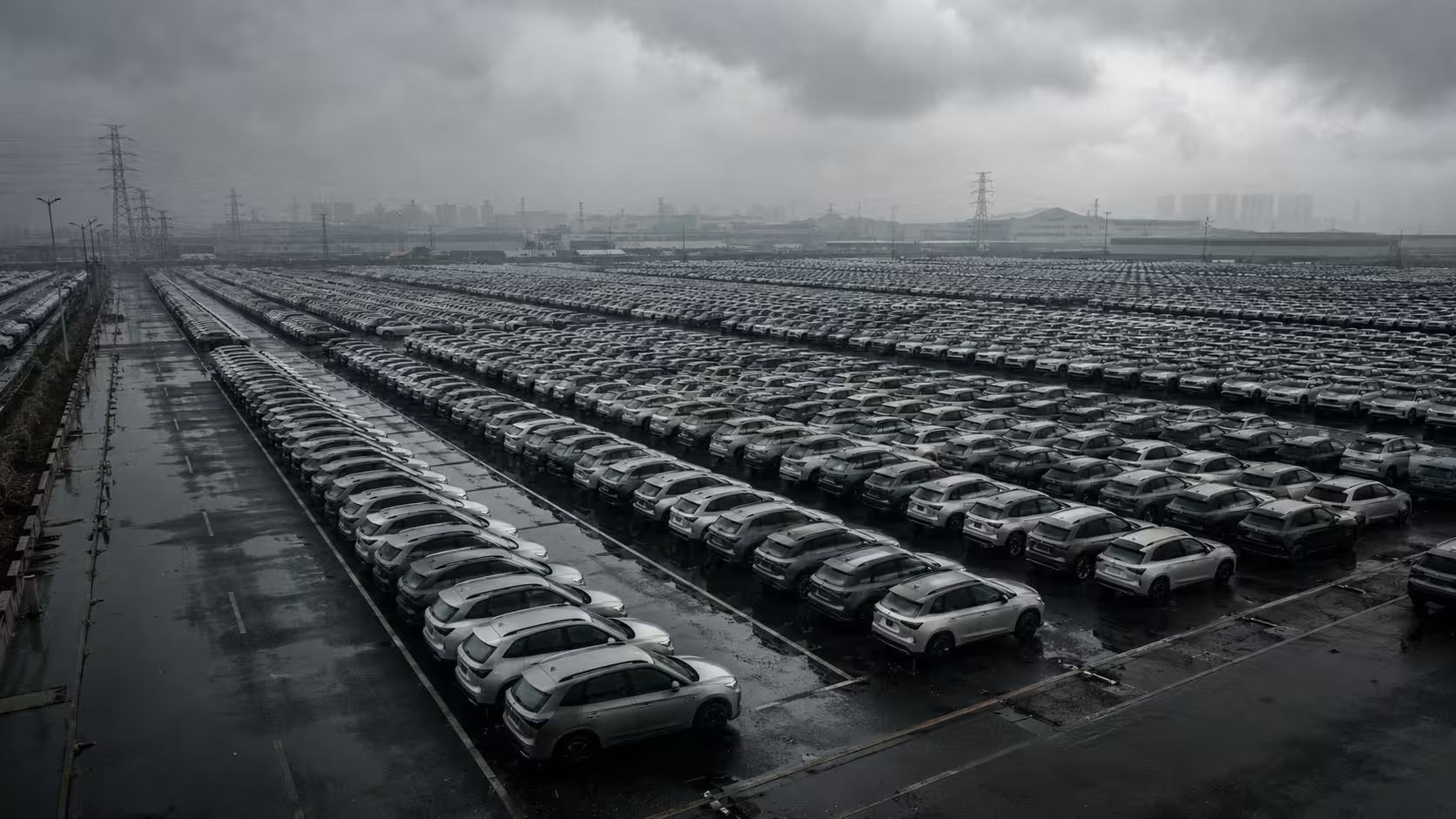
There have also been allegations and reports about “zero-mileage used cars” in China, a practice in which vehicles are registered as sold but later appear on the used market with little or no real customer use. If widespread, this can distort sales figures and create a false impression of demand.
For a company like BYD, whose reputation rests partly on massive sales volume, such concerns matter. The difference between genuine retail demand and inventory pushed through the system is not a technical detail. It is the difference between sustainable leadership and inflated momentum.
Quality Pressure and the Cost of Scaling Fast
Rapid growth creates another problem: quality control.
No automaker can expand at extreme speed without stress. New factories, new workers, new suppliers, new models and new markets all increase complexity. Even companies with strong engineering cultures struggle when the pace becomes too aggressive.
BYD has faced complaints and recalls, including concerns around electronic systems, vehicle reliability and specific safety issues. Some owners have reported software glitches, infotainment problems and inconsistent build quality. In a modern EV, where software and electronics define much of the ownership experience, such issues can damage trust quickly.
This is especially important as BYD moves into export markets. A buyer in China may evaluate the company differently from a buyer in Germany, the United Kingdom, Australia or Brazil. In many markets, BYD must prove not only that its cars are affordable and technologically competitive, but also that its service network, parts supply, warranty support and long-term durability can match established brands.
That is a much harder task than selling cars at home.
The challenge is not unique to BYD. Hyundai, Kia, Toyota and Honda all went through periods where they had to earn trust outside their domestic markets. The difference is that BYD is trying to do it at remarkable speed, in a more politically sensitive era, and with far more scrutiny.
The Human Cost of Industrial Speed
The darker side of BYD’s expansion has also drawn attention.
Reports from Brazil about labor conditions at a BYD-linked factory construction site raised serious concerns. Authorities described conditions for some Chinese workers as deeply troubling, with allegations involving long working hours, poor living conditions and restrictions on personal documents.
Such reports are damaging not only because they raise ethical questions, but because they challenge the clean, futuristic image that electric vehicle companies often try to present. EVs are marketed as symbols of progress. But the supply chains and construction projects behind them can still involve harsh labor practices, environmental trade-offs and cost pressures that are anything but futuristic.
For global consumers, especially in Europe, this matters. Buyers increasingly expect automakers to meet standards not only on emissions and technology, but also on labor, transparency and corporate responsibility.
BYD’s international expansion will therefore require more than competitive cars. It will require trust.
Why Legacy Automakers Are Struggling to Respond
The easy explanation for BYD’s success is that it makes cheaper electric cars. But that misses the deeper issue.
Legacy automakers are struggling because their organizations were built for a different age. They have dealer networks, union agreements, engine plants, legacy platforms, complex supplier contracts and brand expectations formed over decades. These can be strengths, but they can also slow adaptation.
A German premium brand cannot suddenly cut prices to BYD levels without damaging its image and margins. A Japanese automaker cannot rebuild its battery supply chain overnight. An American manufacturer cannot easily abandon the profit structure of large combustion vehicles while EV demand remains uneven.
BYD does not face the same constraints. It was built around the technologies now shaping the market.
This is why the disruption feels so severe. It is not just that BYD has good products. It is that BYD’s entire structure fits the moment better than many traditional automakers’ structures do.
Europe’s Dilemma
Europe faces the most difficult version of this problem.
The European Union wants to accelerate the shift to cleaner vehicles, but its automakers are under pressure from cheaper Chinese EVs. If Europe protects its market too aggressively, consumers may face higher prices and slower EV adoption. If it does nothing, domestic manufacturers may lose ground in one of the most important industrial transitions of the century.
Tariffs can slow the advance of Chinese brands, but they cannot solve the underlying competitiveness gap. European automakers still need cheaper batteries, faster development cycles, better software and more flexible manufacturing.
The political stakes are high. The car industry supports hundreds of thousands of jobs across Europe. In Germany especially, automotive manufacturing is tied to national economic identity. A major loss of competitiveness would not simply affect shareholders. It would affect workers, suppliers, regions and governments.
BYD has made that possibility feel real.

Is BYD the Next Toyota or the Next Warning Sign?
There are two competing ways to see BYD.
The first is that BYD is becoming the Toyota of the electric age: disciplined, vertically integrated, cost-conscious and globally ambitious. Under this view, the company has built the right technology at the right time and is now forcing the world to accept a new automotive reality.
The second view is more cautious. It sees BYD as a company growing too fast, supported by a distorted market, carrying hidden financial risks and vulnerable to quality problems, political resistance and overcapacity.
Both views may be true at the same time.
BYD can be a brilliant industrial success and still face serious risks. It can have genuine technological advantages while also benefiting from state support. It can disrupt the global industry while also exposing the dangers of overproduction and price-war economics.
That complexity is what makes BYD so important.
The New Rules of the Automotive Game
The BYD story is bigger than one company. It shows how the global car industry has changed.
The old rules rewarded engine expertise, brand heritage, supplier management and incremental improvement. The new rules reward battery control, software capability, cost speed, mineral access, manufacturing integration and political alignment.
This does not mean legacy automakers are finished. Toyota, Volkswagen, Hyundai, Mercedes-Benz, BMW, Ford and General Motors still have enormous resources, engineering talent and brand power. But they no longer control the pace of change.
BYD has helped prove that the future of the car industry may be shaped less by the countries that perfected the combustion engine and more by the companies that control the battery supply chain.
That is the real disruption.
Whether BYD becomes a permanent global champion or eventually struggles under the weight of its own expansion, it has already changed the industry. It has forced every major automaker to rethink costs, speed, sourcing and technology. It has turned batteries into the core battlefield of automotive power. It has shown that a company once laughed at by the industry can become the company everyone has to answer.
The question now is no longer whether BYD belongs in the global conversation. It does.
The harder question is whether the rest of the automotive world can adapt quickly enough to survive the conversation BYD has started.

“Cars are evolving faster than ever. I cover electric vehicles, smart mobility, and the future of transportation worldwide.”

Discussion
Leave a Comment