
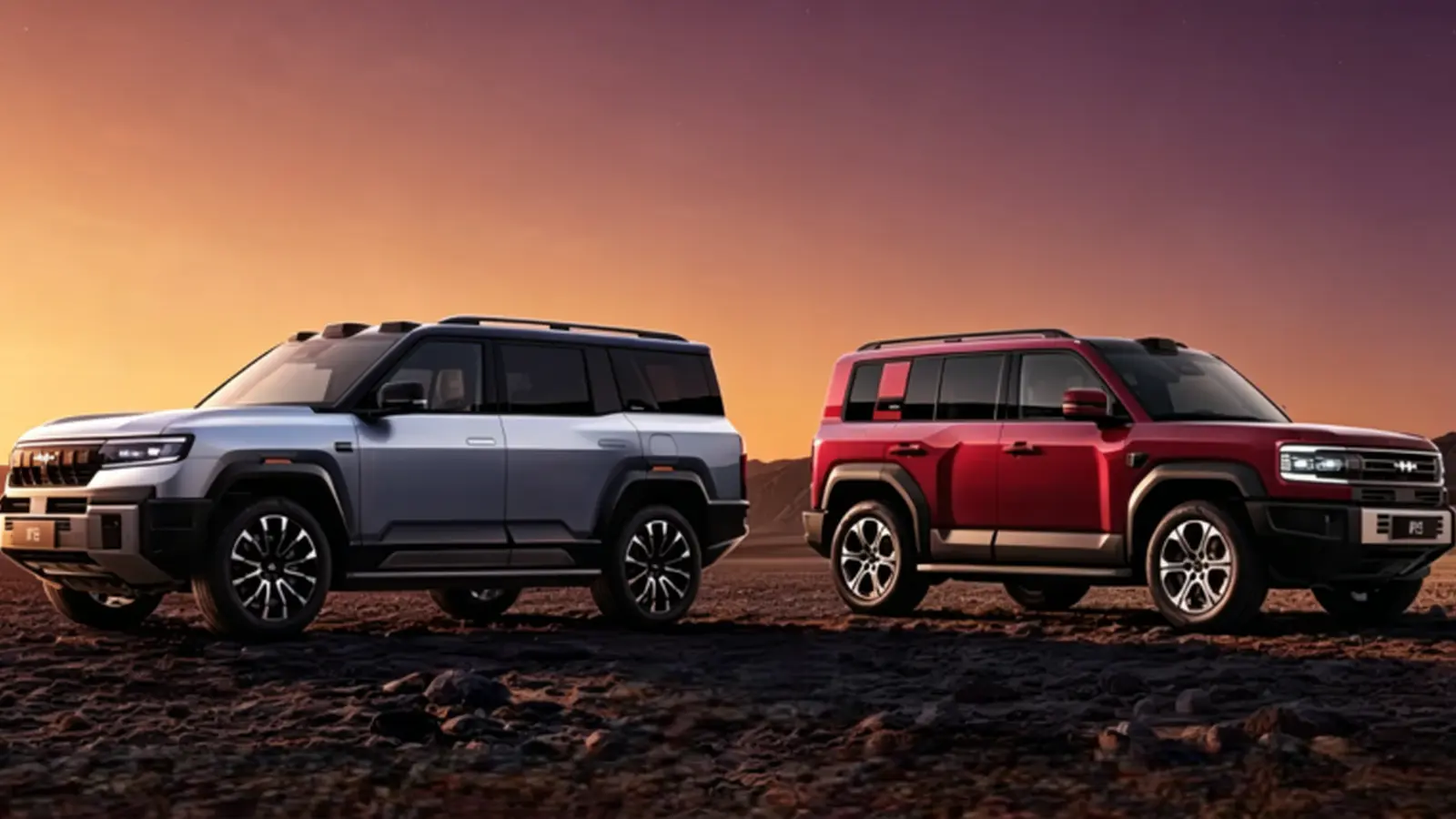
BYD has gone after a very specific kind of buyer here: the driver who wants an SUV that can crawl over rocks, soak up broken roads, sprint like a performance car, and still plug in at night. That is the pitch behind the newly launched Denza B5 and Denza B8 Flash Charge Editions, introduced in China under BYD’s Fang Cheng Bao brand with a much more advanced suspension setup and updated plug in hybrid hardware.
Outside China, these two models are known as the Denza B5 and Denza B8. This latest update matters because it is not just a trim shuffle or a software patch. The headline change is BYD’s second generation YunNian P Ultra intelligent hydraulic body control system, a more sophisticated suspension package designed to give both SUVs extra composure on tarmac and far more trickery when the road disappears altogether.
The pricing puts them squarely in the premium electrified SUV conversation. The Denza B5 Flash Charge Edition starts at about €39,100, with a temporary launch price of roughly €38,400. BYD also added a Denza B5 210 km Tianshen Max variant at around €33,300, falling to about €32,500 with the current discount. The larger Denza B8 Flash Charge Edition opens at approximately €53,700, with an introductory price close to €52,400.
What really changed underneath
The most important development sits below the bodywork. BYD says the new YunNian P Ultra system swaps the previous single valve damping arrangement for a dual valve layout, while also bringing three level stiffness adjustment and road preview capability. In plain English, the vehicle is meant to react faster and more intelligently, reading what is ahead and adjusting before the cabin gets jolted around.
The figures are attention grabbing. BYD claims each wheel can be lifted independently by as much as 300 mm. Suspension travel adjustment reaches up to 200 mm. There is even support for three wheel driving mode, the sort of feature that sounds theatrical until you remember these SUVs are being sold with genuine off road ambitions. The hydraulic system’s maximum lifting force is rated at 9 tonnes.

For the B5, this is a particularly meaningful jump. Earlier versions used a simpler YunNian P setup with only two levels of stiffness adjustment and no road preview function, so this facelift is more than incremental. It changes the way the vehicle presents itself in a crowded plug in SUV market.
The Denza B5 keeps its midsize proportions, measuring 4,880 mm long, 1,970 mm wide and 1,920 mm tall, with a 2,800 mm wheelbase. It uses a 1.5 litre turbocharged plug in hybrid system paired with two electric motors. Combined output stands at 505 kW and 760 Nm, with 200 kW from the front motor and 285 kW from the rear. A 46.7 kWh battery supports a claimed total range of 1,310 km.
BYD also fits the B5 with its God’s Eye B driver assistance suite, which bundles one lidar unit, three millimetre wave radars, 12 ultrasonic radars and 11 cameras. The feature list includes city navigation assist, highway navigation assist and automated parking, underscoring how Chinese carmakers increasingly blend rugged image, electrified performance and high level assisted driving into one package.
The Denza B8 plays in a bigger, more expensive league. It stays on BYD’s DMO plug in hybrid platform and uses a 2.0 litre turbo engine with front and rear electric motors. Total system output climbs to 550 kW, while torque remains at 760 Nm. BYD quotes a 0 to 100 km/h time of 4.8 seconds, which is properly quick for a large family SUV with off road pretensions.
It shares the same 46.7 kWh battery size as the B5, but stretches the claimed combined range to 1,380 km. Size wise, the B8 measures 5,195 mm in length, 1,994 mm in width and 1,905 mm in height, riding on a 2,920 mm wheelbase. Buyers can choose five, six or seven seats, giving it broader appeal in markets where large electrified SUVs are replacing traditional body on frame family haulers.
There is another notable difference. The B8 Flash Charge Edition comes standard with Huawei ADS 4 driver assistance technology, plus dual lidar sensors, three millimetre wave radars, 12 ultrasonic radars and 11 cameras. Earlier this year, it also secured a five star ANCAP crash rating, which gives BYD a useful safety talking point as it pushes Denza further into export territory.
Why this launch matters beyond the spec sheet
BYD is not only refining products. It is building momentum. Fang Cheng Bao posted domestic sales of 21,138 vehicles in April 2026, up 110.6 percent from a year earlier. That followed 21,120 units in March and 14,491 in February, a sign that the brand is moving well beyond niche status in China’s brutally competitive new energy vehicle market.
During the launch event, the company also confirmed that BYD’s Shark pickup line will be folded into the Fang Cheng Bao portfolio in China. That says a lot about where this sub brand is headed. Think less urban crossover, more adventure focused performance label with plug in muscle and heavy use of software, sensors and chassis tech.
The Denza B5 and B8 Flash Charge Editions feel like a statement of intent. They are big, fast, packed with hardware and unapologetically tech heavy. More importantly, they show how quickly the definition of an off road SUV is changing in the EV era. It is no longer just about locking differentials and ground clearance. Now it is also about lidar, hydraulic body control, electric torque, and the ability to cover huge distances without giving up daily usability.

“Cars are evolving faster than ever. I cover electric vehicles, smart mobility, and the future of transportation worldwide.”

Discussion
Leave a Comment