
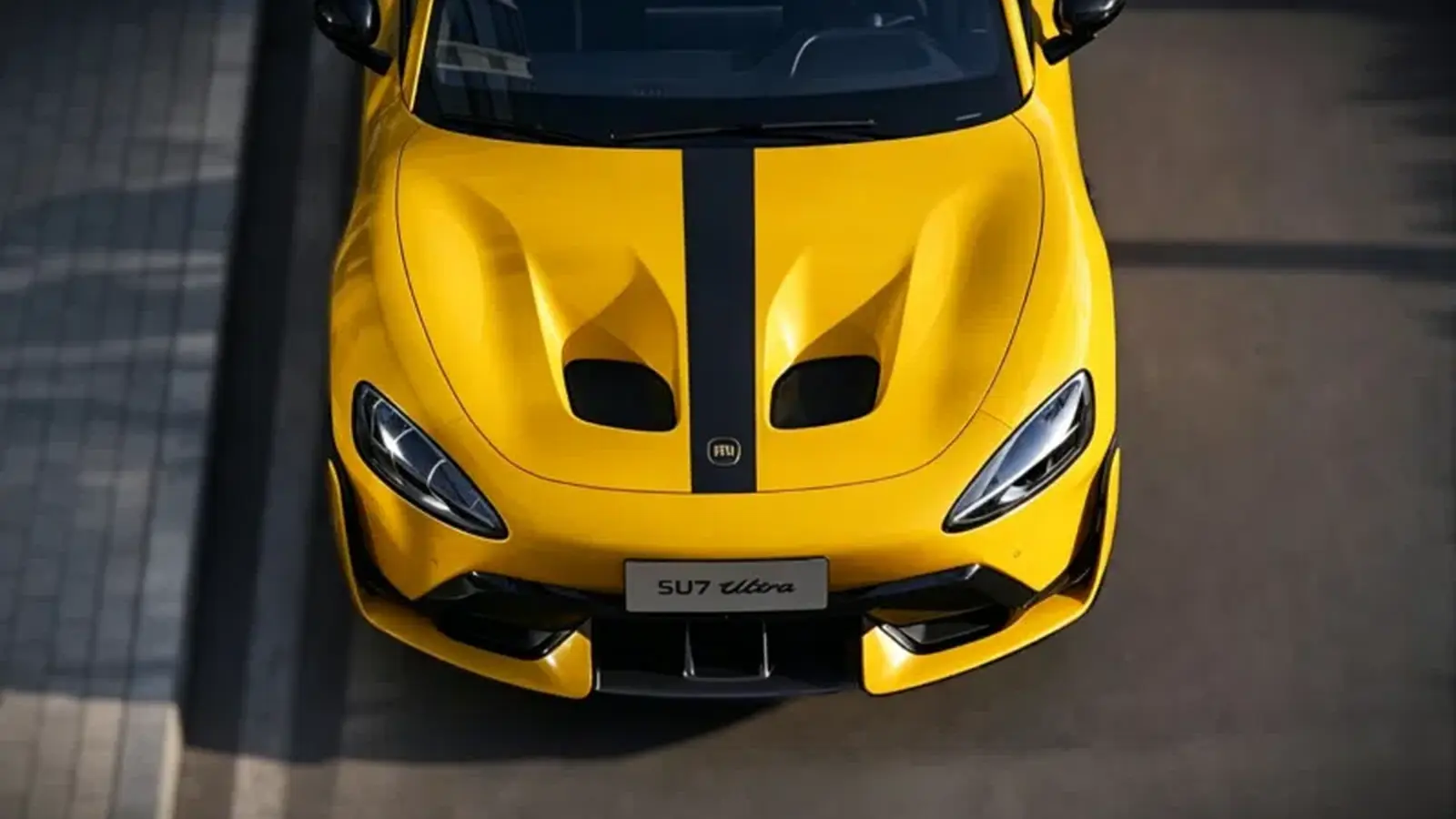
What looked like a niche argument over a performance hood has turned into one of the first real courtroom tests of how Xiaomi sells its cars. A court in China has now ruled on the much-discussed Xiaomi SU7 Ultra ducted hood dispute, and the message is clear: the marketing went too far, but not far enough to count as fraud.
The case was heard by the People’s Court of Licheng District in Jinan, in eastern China’s Shandong province. According to local reports, the lawsuit was brought by an SU7 Ultra buyer against Xiaomi Auto and its regional sales arm. In the first-instance ruling issued on May 13, the court found that Xiaomi’s promotional material around the carbon-fibre dual-duct front hood included exaggerated claims and breached the principle of good faith.
That said, the court stopped short of calling the conduct deceptive in a legal sense. Judges concluded that Xiaomi had not fabricated facts and had not deliberately hidden the truth from buyers. For that reason, the plaintiff’s demand for triple compensation and repayment of the deposit at double value was rejected.
The practical outcome is narrower, but still significant. The vehicle purchase agreement signed on March 7, 2025 will be terminated on July 4, 2025. Xiaomi has been ordered to return the buyer’s 20,000 yuan deposit, roughly €2,550 at current exchange rates, within ten days after the ruling takes legal effect. The court also held Xiaomi jointly liable for that refund. Claims for further compensation linked to the optional carbon-fibre hood package were dismissed.
Where the controversy really began
At the heart of the dispute is Xiaomi’s optional dual-air-duct hood for the SU7 Ultra, a feature presented as both visually dramatic and functionally meaningful. The issue is that some owners and online testers began questioning whether those openings actually delivered the aerodynamic and cooling benefits many assumed they would.
That skepticism spread quickly. In enthusiast circles, details like airflow extraction, downforce and brake cooling are not cosmetic footnotes. They are the whole point. Once informal tests started appearing online, the hood became more than a styling talking point. It became a credibility problem.
In court, Xiaomi argued that founder Lei Jun had already made it clear during the October 2024 launch event that the production version differed substantially from the prototype. The company said descriptions suggesting a replica design referred to appearance, not to a one-for-one carryover of internal engineering or full track-grade functionality.
Xiaomi also pushed back against the online testing itself. The automaker said the SU7 Ultra uses an AGS active intake grille system that closes automatically when the vehicle is stationary, meaning some garage-style airflow tests did not reflect real operating conditions. To support its case, Xiaomi submitted a wind tunnel report from the China Automotive Technology and Research Centre. That report reportedly showed the hood could provide modest downforce benefits, limited airflow extraction and some auxiliary brake cooling.
In other words, Xiaomi’s position was not that the hood did nothing, but that expectations had outrun reality.
The court appears to have landed somewhere in the middle. It accepted that the marketing language was overstated, yet it did not find evidence of outright fraud. That distinction matters, especially for a young carmaker trying to protect its credibility while scaling at speed in China’s brutally competitive EV market.
Xiaomi had already started to soften the fallout before this ruling arrived. After consumer complaints surfaced, the company revised parts of its promotional wording, issued an apology and introduced remedies for affected customers. Buyers of undelivered cars were offered free replacement standard hoods, while existing owners were given compensation points. Earlier this year, Xiaomi also launched a free aerodynamic upgrade program for SU7 Ultra owners fitted with the ducted hood.
This latest decision follows an earlier legal win of a more procedural kind for Xiaomi in another case tied to the same hood controversy. So while the company avoided the heavier reputational damage that a fraud ruling might have brought, the court’s criticism still lands as a warning shot. In the performance EV space, where buyers are paying close attention to every claimed technical advantage, flashy language can come back hard if the hardware does not quite match the story.
The broader sales picture shows why this matters. Data from China EV DataTracker indicates domestic Xiaomi SU7 sales reached 26,826 units in April 2026, a huge 240.3 percent jump from the previous month, though still 6.2 percent lower than a year earlier. The SU7 accounted for 73.1 percent of Xiaomi’s brand sales during the month. Earlier in 2026, the model posted 7,882 units in March and 1,133 in January.
So no, this is not just a dispute about vents in a carbon-fibre panel. It is about the growing pains of a new automotive brand learning that in the car business, especially in the performance segment, enthusiasts listen closely, buyers remember the promise, and courts can end up parsing the fine print.

“I cover automotive innovation, electric vehicles, and the future of mobility — where technology meets sustainability.”

Discussion
Leave a Comment