
Picture an SUV lifting one wheel clean off the ground, then calmly rolling on as if nothing happened. That is no stunt built for social media clips alone. In China’s fast-moving premium SUV market, it has become the latest proof point in a growing chassis technology battle led by BYD, Huawei-backed Aito, and Li Auto.
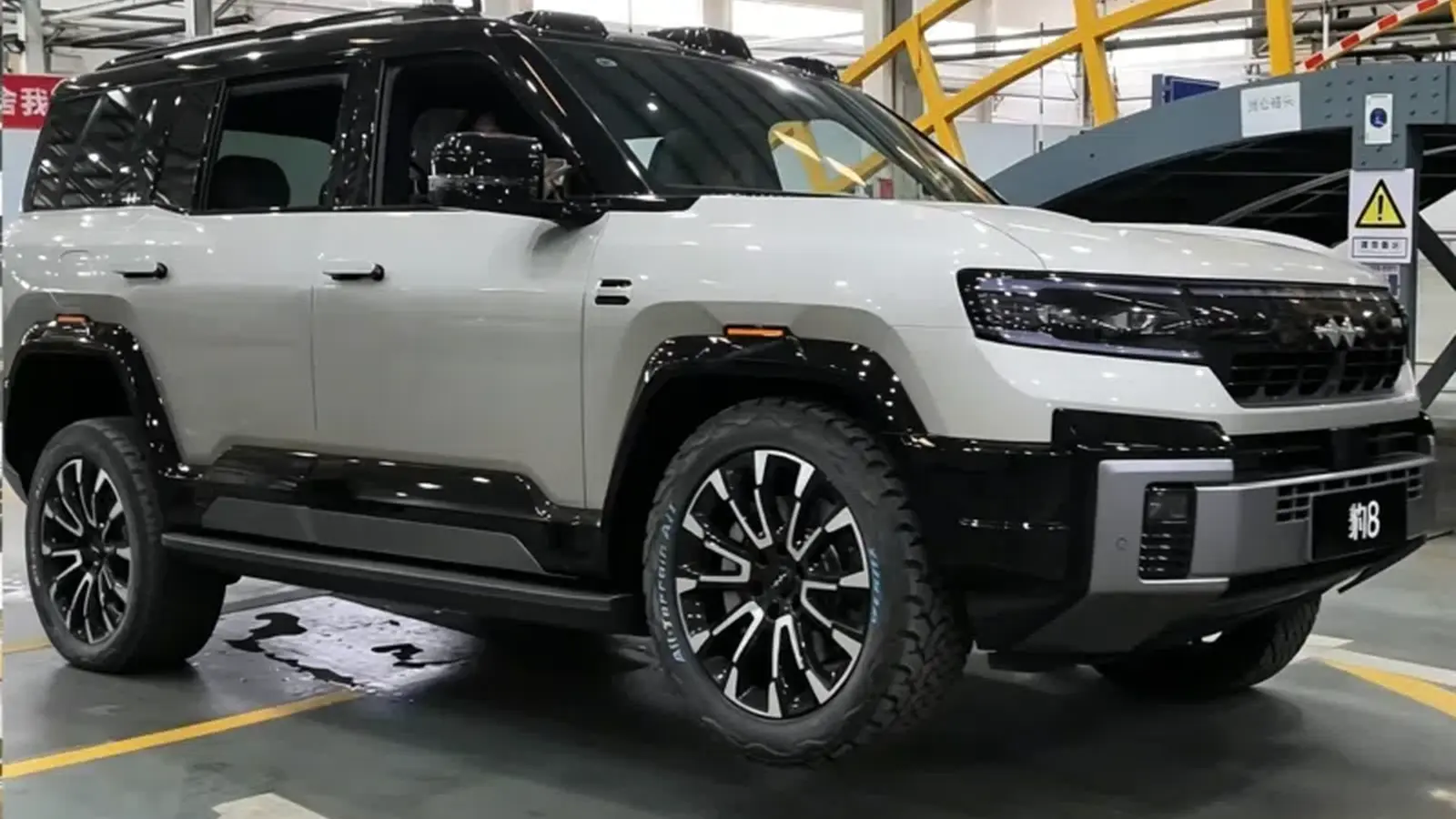
BYD has thrown the freshest punch with the Denza B8 Flash Charge Edition, also known in China as the Fang Cheng Bao Bao 8. At a media event on the company’s off-road test ground, the SUV showed off its new Yunnian-P Ultra suspension by raising a wheel fully into the air and continuing forward at low speed on the other three. It looked dramatic, yes, but the message was practical: this is being positioned as a real-world emergency and recovery tool, not just a party trick.
The system brings three headline functions. One is wheel-lift recovery, designed to help the vehicle free itself when traction disappears. Another is wheel-lift tyre replacement, which lets the suspension raise one corner of the SUV without the driver needing a traditional jack. Then there is the three-wheel driving mode itself, intended for crawling through obstacles or getting the car to safety after a problem.

BYD says the suspension can generate up to 9 tonnes of lifting force. In the tyre-change demo, the wheel was raised in under a minute, and a full replacement shown to media took 1 minute 56 seconds. That alone hints at where this technology is heading. Carmakers are no longer talking only about comfort or handling. They are turning the suspension into an active rescue system.
There was another demonstration that made the point even more clearly. BYD deliberately buried the vehicle in deep sand, then used suspension height adjustments to shift load, recover traction, and climb back out. On uneven bridge-style obstacles, the Denza B8 also lifted individual wheels to avoid scraping the underside. It is a clever blend of off-road theatre and serious chassis control.
The Denza B8 Flash Charge Edition is not only about suspension hardware. BYD says it adds roughly 200 km of CLTC pure electric range, along with the updated DiLink 5.0 in-car software. In Europe money, the Denza B8 Flash Charge Edition starts at about €53,700, while the Denza B5 Flash Charge Edition comes in at roughly €39,100.
Not just BYD anymore
Huawei-backed Aito is moving in the same direction. Early previews of the new Aito M9 have shown the large SUV lifting a front wheel while maintaining stable low-speed movement on the remaining three. Videos shared by Chinese bloggers quickly spread online, and for good reason. A feature like this instantly translates into brand prestige in a market obsessed with visible technology.
Huawei says the M9’s fully active intelligent chassis can adjust suspension settings proactively according to road conditions. That matters, because systems like these only work convincingly when the software, sensors, and mechanical hardware move in perfect sync. The updated Aito M9 is now open for pre-order in China at around €63,900. Huawei executive Yu Chengdong has also said the new-generation M9 brings more than 140 technology upgrades, underlining just how central innovation has become to the model’s pitch.
Li Auto is in the fight too, with the new Li Auto L9 Livis. Its 800V fully active hydraulic suspension supports many of the same crowd-catching abilities: single-wheel lifting, tyre replacement, and off-road recovery. The company says the setup reacts within milliseconds and can control all four wheels independently, without relying on a traditional anti-roll bar.

That sounds impressive, though the sales backdrop is more complicated. China EV DataTracker figures show domestic Li Auto L9 sales reached 452 units in April 2026, down 88.1 percent year on year and 70.8 percent from March. Total sales from January to April 2026 stood at 4,131 units. So while the hardware is getting more advanced, the commercial battle is clearly still brutal.
What makes this trend so interesting is that each manufacturer is taking a slightly different engineering route. Li Auto and Aito are leaning on fully active hydraulic systems. BYD, meanwhile, is pushing several approaches across its brands, including the hydraulic Yunnian-P Ultra seen here and the electromagnetic Yunnian-Z used in the Yangwang U7, which controls suspension movement directly without hydraulic oil.
The bigger story is not really about one SUV balancing on three wheels. It is about how active suspension is being reinvented as a defining feature in high-end Chinese SUVs and off-roaders. Ride comfort used to be the headline. Then came body control. Now the suspension is expected to level the car, lift a wheel, help replace a tyre, recover from sand or ruts, and keep the chassis clear of obstacles. In other words, it is becoming one of the smartest systems on the whole vehicle.
And that may be the real takeaway from China’s current SUV tech war. Horsepower still matters. Screens still sell. But increasingly, the battle for attention is happening underneath the body, where software-driven chassis systems are turning heavy family SUVs into machines that can limp home on three wheels and make it look easy.

“I cover automotive innovation, electric vehicles, and the future of mobility — where technology meets sustainability.”

Discussion
Leave a Comment