
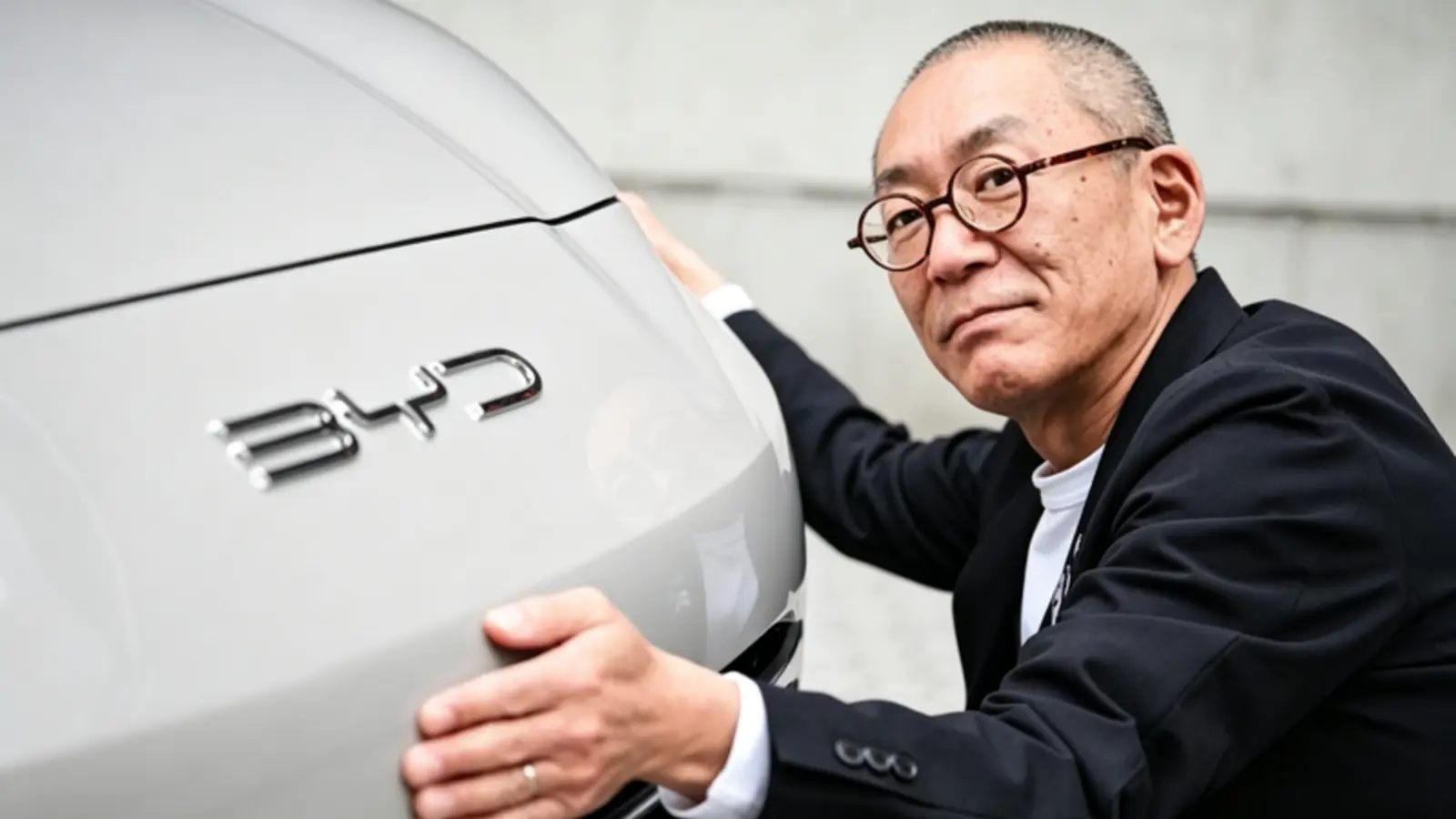
Cracking Japan’s kei car market is not something an outsider does by accident. That is why BYD’s latest move matters. Ahead of the summer debut of its new Racco EV, the Chinese carmaker has reportedly brought in Hirohide Tagawa, a longtime Nissan engineer with deep roots in the country’s small car programs, according to Nikkei.
For anyone watching Japan’s electric car race, that detail says a lot. The Racco is not just another imported compact EV with a few local tweaks. It has been conceived specifically for Japan’s kei car class, a category shaped by tight rules on size, power output, and tax treatment. Those limits may sound restrictive, but they are exactly what made kei cars a backbone of Japanese urban mobility. In crowded cities, where narrow lanes and tiny parking spaces are part of daily life, these vehicles make perfect sense.
Tagawa knows that world better than most. He spent roughly 25 to 30 years at Nissan after joining in the 1990s, building a reputation around kei car planning and development. Inside the company, he was widely associated with projects that helped define Nissan’s approach to lightweight city cars across several generations. His name has been linked to models such as the Nissan Dayz and the all electric Nissan Sakura, the latter becoming one of the most visible examples of how Japan’s domestic brands translated kei car logic into the EV era.
The Sakura, launched in 2022, was more than a niche experiment. It showed that electric kei cars could move beyond compliance and become viable mainstream products for city users. The Dayz, meanwhile, remained one of Nissan’s core kei platforms, giving Tagawa years of experience in the kind of packaging, cost control, and regulatory balancing act that defines this segment.
That background now appears to be feeding directly into BYD Auto Japan’s strategy. Industry reports suggest Tagawa became involved in EV development projects for the Japanese market after leaving Nissan, and the timing lines up neatly with BYD’s push to do something many foreign brands have struggled to pull off: build a vehicle that genuinely fits local expectations rather than forcing a global model into a very Japanese mold.

Why the Racco could be a bigger deal than it looks
On paper, the BYD Racco sounds modest. In reality, modest is exactly the point.
The car is said to use a 20 kWh lithium iron phosphate battery, offer around 180 km of WLTC range, and support DC fast charging at up to 100 kW. It is also expected to come with L2+ driver assistance systems as standard. More importantly for everyday use, the Racco reportedly features sliding rear doors and a tall body design, two details that matter enormously in Japanese cities where access, visibility, and maneuverability can make or break a car’s appeal.
Engineering a proper kei EV is a highly specialized job. Every millimeter counts. Every cost decision counts too. Buyers in this class are value conscious, but they also expect practical cabin space, easy entry, low running costs, and a vehicle that feels effortless to live with. This is where hiring someone like Tagawa looks less like a symbolic recruitment and more like a calculated play.
BYD is entering a segment where local brands still hold the upper hand. Nissan and Suzuki, in particular, understand the rhythms of this market in ways most global manufacturers do not. That makes the Racco one of BYD’s most interesting tests outside China. It is not simply selling an EV in Japan. It is trying to speak Japan’s native automotive language.
Earlier reports placed the Racco’s starting price at about 2.5 million yen, which converts to roughly €14,700 at current exchange rates. That would put it right in the heart of Japan’s mainstream kei EV territory, close enough to established rivals to make comparison inevitable. And that, perhaps, is where the real battle begins. If BYD can match domestic players on usability and value, not just battery specs, it could force a serious rethink in a category long treated as home turf by Japanese brands.
The Racco also broadens BYD’s small EV portfolio beyond the Seagull, currently its smallest passenger car in China. The timing is notable. Data from China Ev DataTracker shows Seagull deliveries fell to 9,864 units in April 2026, down 71.0 percent year on year and 31.5 percent from March. March deliveries reached 14,409 units, while January and February combined came to 11,185 units. Those numbers do not define the Racco, but they do underline why new regional plays matter for BYD as it sharpens its global EV strategy.
Japan’s kei segment has never been easy to enter. It is too specific, too mature, and too demanding for shortcuts. But if BYD really wants a place in the country’s electric future, hiring one of Nissan’s kei car veterans might be the smartest signal it could have sent.

“I cover automotive innovation, electric vehicles, and the future of mobility — where technology meets sustainability.”

Discussion
Leave a Comment