
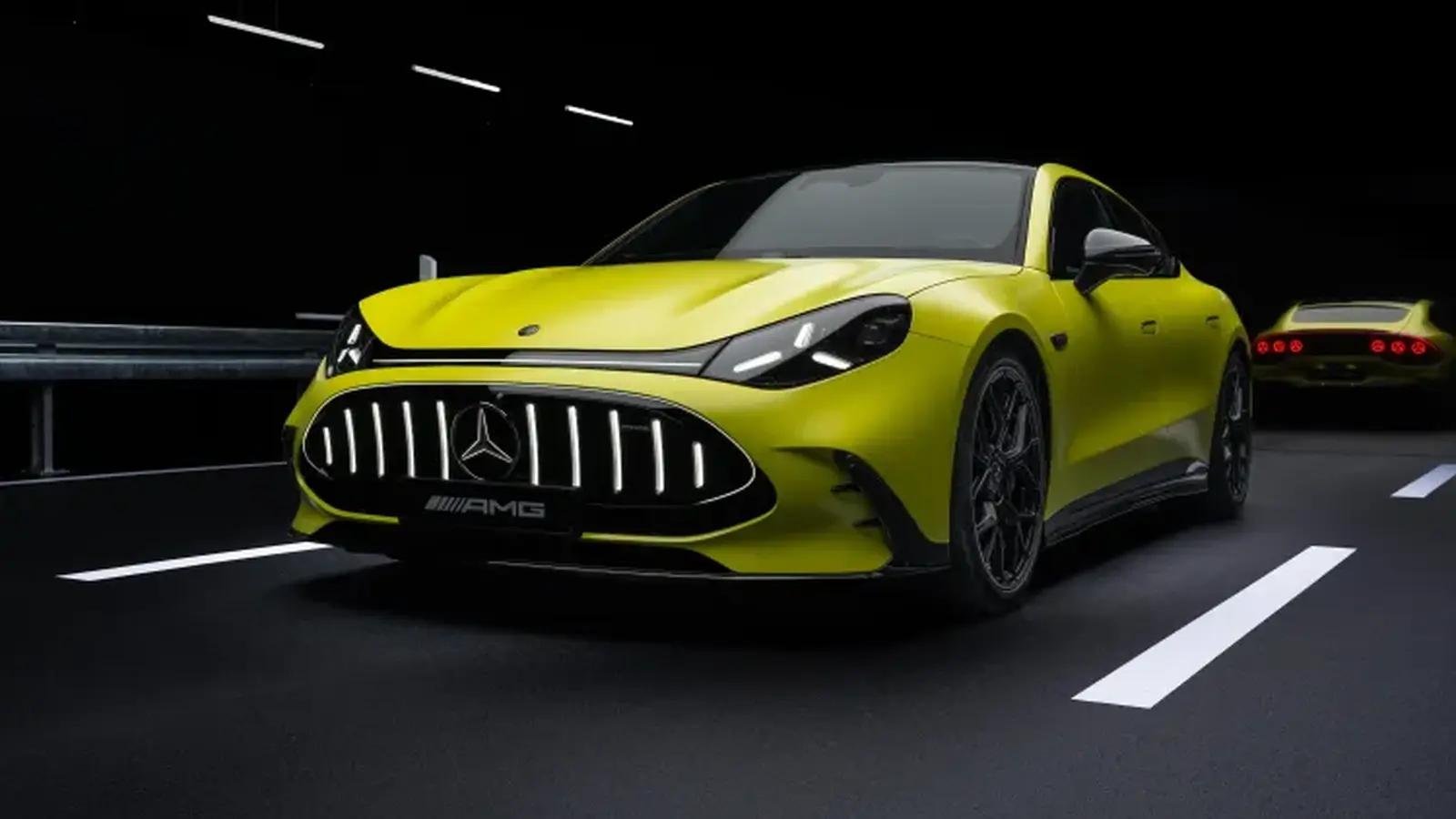
Two seconds to 60 mph used to be hypercar territory. Now Mercedes wants that shock factor in a four door electric AMG.
The new Mercedes AMG GT 4 Door Coupe marks a serious turning point for the brand’s performance EV ambitions. This is not just another fast electric sedan wearing an AMG badge. It is a ground up statement, shaped by lessons from Mercedes’ experimental technology program and aimed squarely at drivers who still care about repeatable performance, thermal control, and track credibility.
At the heart of it sits a three motor setup built around axial flux units developed by YASA, the Mercedes owned specialist known for compact, high output electric motors. Combined output reaches as much as 1,153 hp and 1,475 lb ft of torque, numbers that push this car deep into super sedan territory. Mercedes says the slim disc style design of these motors allows them to be far lighter and more compact than conventional radial motors while still delivering enormous power.
That matters because electric performance is never just about headline acceleration. Anyone can build one brutally fast launch. The hard part is doing it again and again without the battery cooking itself or the powertrain backing off. Mercedes appears to have attacked that problem head on.

Built to stay fast
The battery is one of the most interesting parts of the whole car. Mercedes uses tall, very narrow cylindrical cells with a diameter of roughly 25 mm, or about 1 inch. Their shape is designed to move heat away from the core quickly, which is critical in a high demand performance EV. Then comes the more unusual bit. Mercedes developed a non conductive oil that flows directly around each individual cell, providing direct cooling without risking electrical short circuits.
The company says this Formula 1 inspired setup delivers 20 kW of cooling power, roughly four times the cooling capacity of the battery in a standard EQS. In plain English, that means the AMG GT 4 Door Coupe is being engineered for consistency, not just bragging rights. Repeated hard launches. Track sessions. Fast charging under pressure. This is where Mercedes clearly wants to separate itself from the usual electric performance crowd.
The battery chemistry is equally ambitious. Mercedes says the pack uses a nickel cobalt manganese aluminum cathode paired with a silicon containing anode, helping it achieve an energy density of more than 298 Wh per kilogram. That should support both stronger performance and better efficiency, even if the brand has not yet published the final range figures.
Charging is another headline feature. The car runs on an 800 volt electrical architecture and can accept DC fast charging at up to 600 kW. According to Mercedes, that allows a 10 to 80 percent top up in just 11 minutes. It can also switch between 800 volt and 400 volt systems when needed and supports five major global DC charging formats, including NACS and CCS2. For buyers in Europe and beyond, that flexibility could matter just as much as raw speed.
And yes, the performance claims are wild. Mercedes says this electric AMG GT can sprint from 0 to 60 mph in about two seconds, putting it in the conversation with some of the quickest production cars on sale anywhere.
There is also the question every traditional AMG fan will ask. What does it sound like?
Mercedes knows silence alone will not satisfy every enthusiast, so it built an extensive synthetic sound experience into the car. More than 1,600 sound files, derived from the AMG GT R, are used to simulate engine character, exhaust style pops, and even traction break and shift events during virtual gear changes. The car also has dedicated sounds for unlocking, entering, and charging. Some drivers will love that theatrical layer. Others may roll their eyes. Either way, Mercedes is not pretending that emotion no longer matters in the electric era.
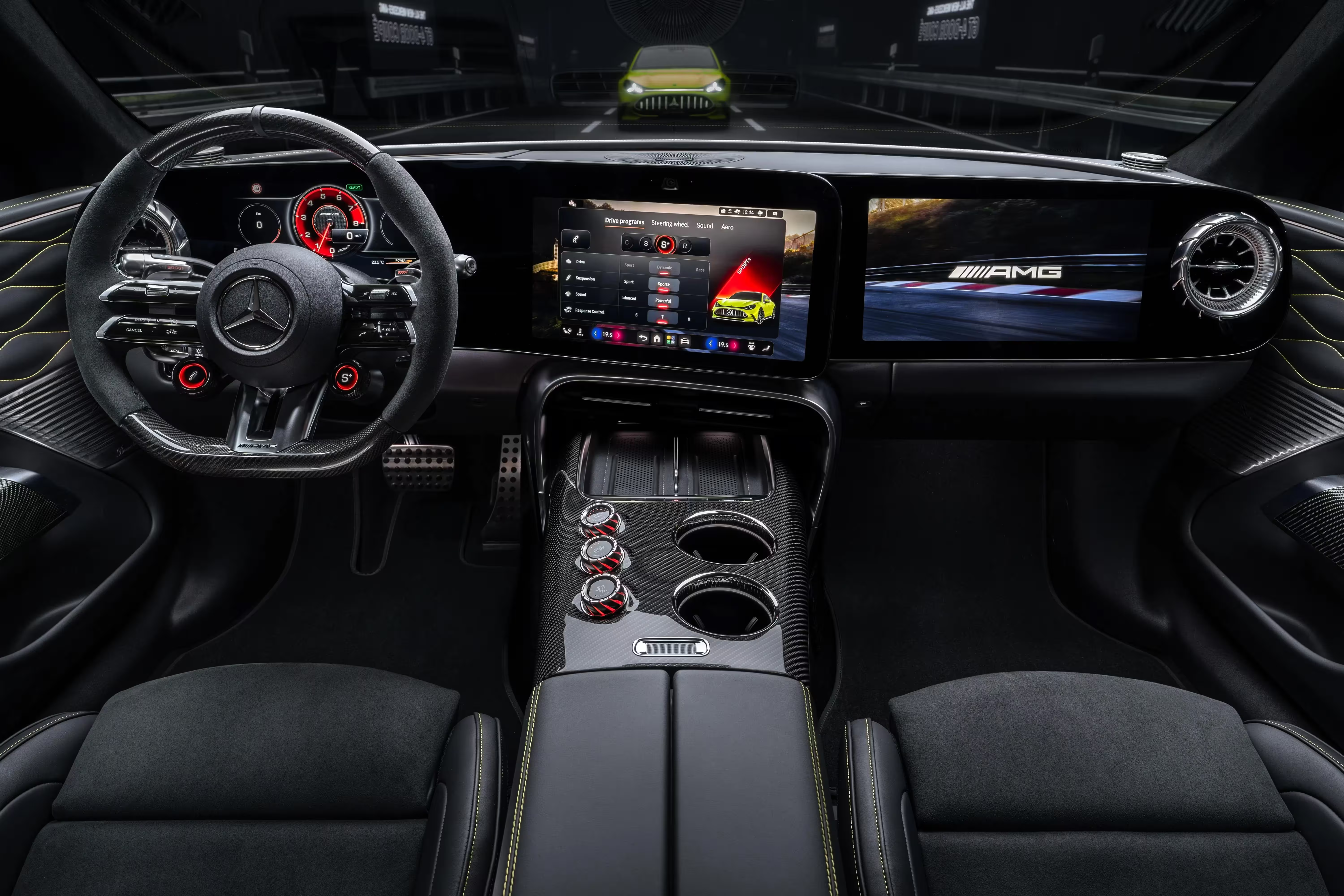
One brain, three screens, and a new AMG mindset
The technology story does not stop at the motors and battery. Mercedes has consolidated the vehicle’s electronic architecture around what it calls the AMG Race Engineer Core, running on the new MB.OS software platform. Instead of relying on numerous smaller processors spread across different systems, the car uses one central high performance chip to coordinate major functions such as driving dynamics, charging, suspension behavior, and battery thermal management.
That approach should allow faster communication between systems and more precise control when the car is being pushed hard. In a performance EV, milliseconds matter. If the chassis, power delivery, regenerative braking, and cooling systems can react as one, the whole car feels sharper and more natural.
Inside, Mercedes has gone fully digital without dialing back the drama. The cabin features three displays housed beneath one continuous glass surface: a 10.2 inch driver screen, a 14 inch central multimedia display angled toward the cockpit, and a 14 inch passenger screen, all powered by MB.OS. Drivers can monitor detailed live data including aerodynamic performance, thermal loads, and energy use in real time, which feels entirely appropriate in a car that is part grand tourer, part rolling engineering lab.
Mercedes has not announced pricing yet, but timing is already on the table. The AMG GT 55 version is expected to arrive in late 2026, with the more potent GT 63 following in early 2027.
For years, electric performance cars have been accused of feeling a little too easy, a little too clinical, a little too much like software flexing its muscles. Mercedes seems determined to answer that criticism with hardware, heat management, and old school AMG attitude. If the production car delivers what the numbers promise, this could be one of the most important electric performance launches of the decade.

“I cover automotive innovation, electric vehicles, and the future of mobility — where technology meets sustainability.”

Discussion
Leave a Comment