
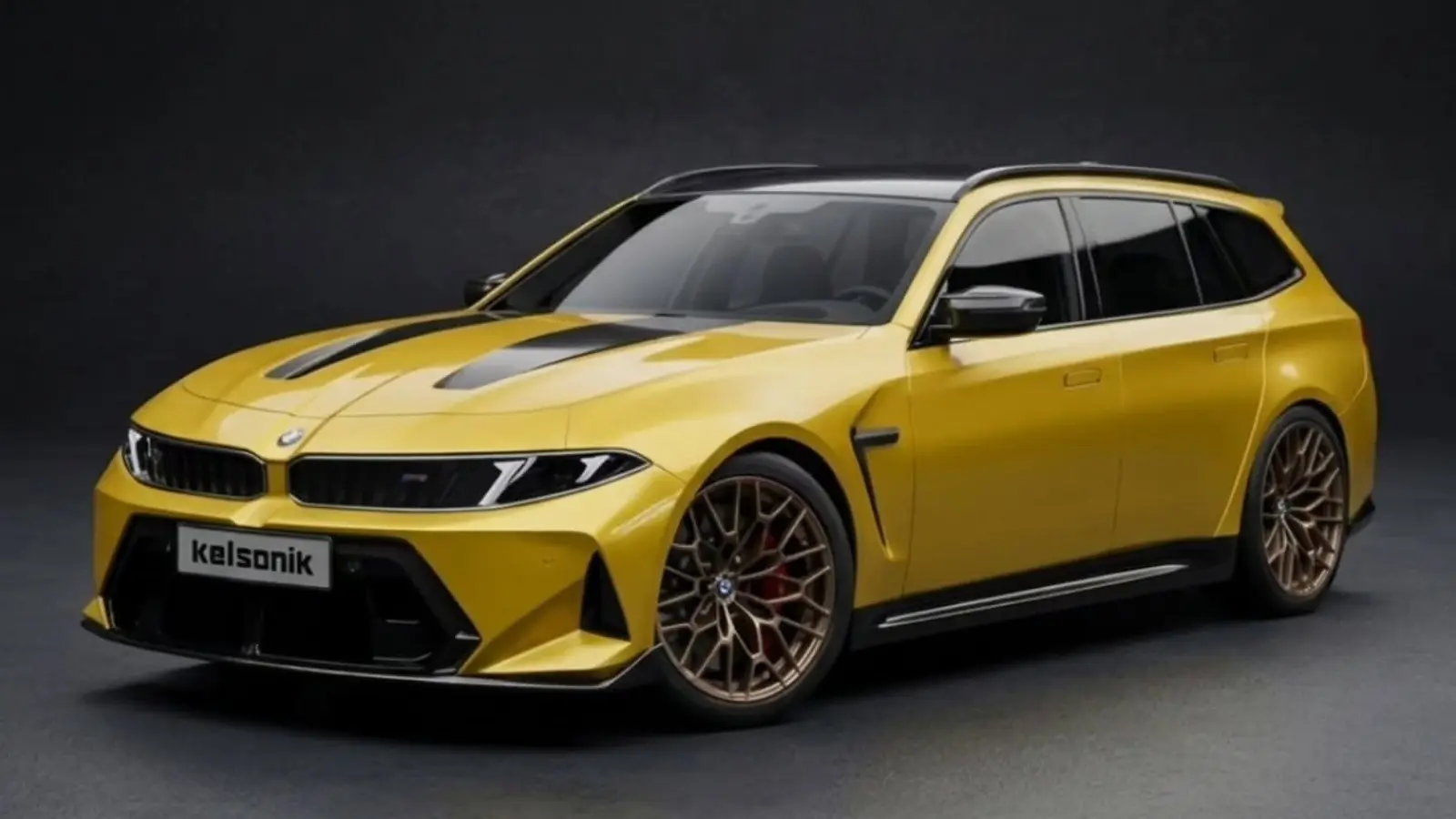
Picture a station wagon that snarls. Bright yellow paint, gold-spoke wheels catching sun, and a diffuser that looks like it was carved from a carbon-fiber surfboard. That’s the scene Nikita Chuicko—known online as kelsonik—has painted with pixels: a speculative BMW M3 Touring that mashes the Neue Klasse language with an internal-combustion heart.
When CGI becomes a design testbed
BMW faces pressure from all sides. Mercedes-AMG has just launched an electric successor to the GT 4-Door Coupe that divided opinion, while Audi is quietly readying its third-generation Q7 and a full-size Q9. BMW’s response has been pragmatic: new trims and refreshed models, pricing updates for the iX3 and 7 Series in Australia, and the eagerly awaited 2027 M2 with M xDrive. Still, concept renders from artists like kelsonik do a different kind of work: they imagine possibilities, test visual cues, and stir public debate.

Kelsonik’s approach borrows freely from the Neue Klasse aesthetic that BMW is rolling out across its next generation. The render keeps the proportion and LED signature familiar, then stages a muscular rewrite for M GmbH: oversized bumper vents, aggressive side intakes, and visible carbon fiber accents. It’s tailored for a Touring body—roofline stretched, cargo area emphasized—but the mood is pure performance. The rear gets a new taillight treatment, a hulking carbon diffuser, and quad outlets that insist this wagon can roar as well as haul.
There’s chemistry in the details. The front fascia reads like the i3 sedan’s Neue Klasse face, but reworked for airflow and cooling demands. The result feels plausible rather than fantastical. And those gold Y-spoke alloys? They split opinion. Some will see bravado. Others will see a designer having fun with contrast: satin black trim, exposed carbon aero bits, and a yellow-gold finish that refuses to fade into the background.

Why do these renders matter? Because they probe a question automakers are wrestling with: how to keep high-performance, traditionally combustion-powered character alive as architecture and electrification strategies evolve. BMW has publicly signaled a twin path—electric M models and ICE or hybrid equivalents—and artists like kelsonik sketch one way that balance might look on the road.
The Touring badge carries particular weight in BMW lore. The M5 Touring’s success in select markets proved there’s appetite for wagons that combine utility with high-performance engineering. If BMW chose to bring an M3 Touring to North America this time, it wouldn’t be merely nostalgic. It could be a statement about versatility: a car that’s fast, practical, and unmistakably BMW.

So where does that leave us? Renders are not blueprints. But they do nudge conversations and nudge design teams. Whether BMW follows this particular aesthetic or not, kelsonik’s image reminds us that Neue Klasse can be interpreted with a more aggressive, analogue-minded stance. It’s a design exercise that asks: can the soul of an ICE M car survive in a family of cars increasingly defined by batteries and software?
Opinion will split. Some will applaud the bold palette and exposed carbon. Others will prefer a quieter, more subtle M Touring. That’s exactly the point. Good design provokes. It invites feedback. It starts debates—online and in the real world—about what the next generation of performance BMWs should feel like.
Do you think this yellow-gold remix belongs on the road? Or should the M3 Touring stay restrained, letting performance speak without the flash? Either way, the render is a reminder that even in an era of electrification, imagination still drives the conversation.

“Cars are evolving faster than ever. I cover electric vehicles, smart mobility, and the future of transportation worldwide.”

Discussion
Leave a Comment