
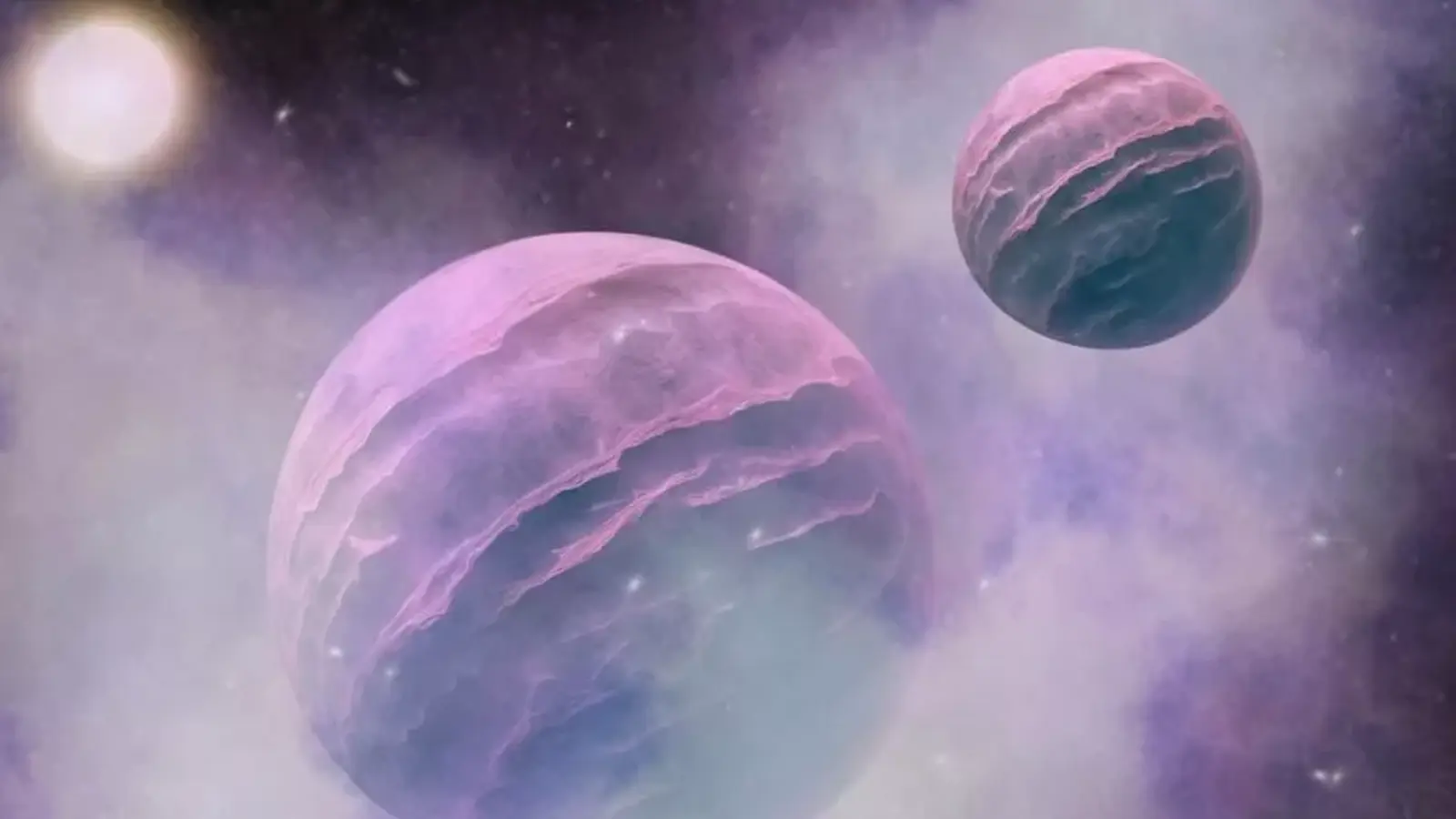
Picture a planet the size of Jupiter that would scarcely weigh more than a kitchen sponge. That is not a thought experiment any longer. Astronomers have identified two gas giants, TOI-791 b and TOI-791 c, whose bulk densities are so low they undercut common household comparisons: each is less dense than a marshmallow.
How light can a giant planet be?
These siblings orbit a star some 1,110 light years away and challenge our sense of what a planet can be. TOI-791 b tips the scales at roughly 0.038 grams per cubic centimetre; TOI-791 c registers about 0.047 grams per cubic centimetre. For context, typical marshmallow density is about 0.05 g/cm3, Jupiter is 28 to 35 times denser than these worlds, and Earth has a density near 5.5 g/cm3. The researchers from the University of Oxford likened the planets' bulkiness to a fresh mound of shaving foam — voluminous and airy.

These are not small anomalies. Among nearly 6,300 confirmed exoplanets, fewer than 40 qualify as the extreme, 'puffed-up' class to which TOI-791 b and c belong. That rarity is why this discovery matters: it offers a laboratory to probe planetary inflation, atmospheric composition, and the physics of formation in cold regions of planetary systems.
From long South Pole nights to precise densities
The discovery combined data from NASA's TESS mission with ground-based observations conducted from telescopes at the South Pole. The polar winter provided an observational asset: long, uninterrupted nights allowed astronomers to record complete transits lasting around 11 hours, without daybreak interrupting the sequence. By carefully measuring the timing and shape of these extended transits, the team inferred the planets' sizes and, together with mass constraints, derived the astonishingly low densities.
These two planets also display a dynamical intimacy. They sit in a 5:3 orbital resonance, meaning that for every five orbits completed by the inner planet, the outer companion completes three. Such resonances hold clues to the migration history and gravitational interactions that sculpt a system over time.

- Names: TOI-791 b and TOI-791 c
- Distance: ~1,110 light years
- Density: 0.038 and 0.047 g/cm3
- Resonance: 5:3 orbital relationship
Hydrogen and helium are the most likely constituents of these puffy envelopes. If their cores are small and heavy elements scarce, the result is a low-mass, extended atmosphere that inflates the planet's radius while contributing little to its total mass.
Why does this matter for planetary science? Because extremes test theory. Models of planet formation and atmospheric evolution must account for how such bloated gas envelopes can form and survive. Are these planets relics that formed far from their star where gases condense and remain light? Or did they migrate inward and retain an unusually massive, low-density atmosphere? The answer will refine our broader understanding of gas-giant assembly and atmospheric loss mechanisms.
Follow-up observations are already planned. The James Webb Space Telescope will target these worlds to search for spectral signatures of carbon, nitrogen and oxygen-bearing molecules. Detecting such elements — or establishing their scarcity — will narrow the list of plausible formation pathways.
Discoveries like TOI-791 b and c shift how astronomers classify the diversity of planetary systems. They remind us that nature still produces configurations both unexpected and instructive, and that careful observation, especially from unique sites like the Antarctic plateau, continues to pay scientific dividends.

“My work centers on sustainability, energy, and environmental science — examining how innovation can lead to a greener future.”

Discussion
Leave a Comment
Comments (2)
Not convinced about density calc. what about stellar activity or grazing transits? 11h South Pole runs are neat but need more checks
wow a marshmallow planet?? mind blown. if they really are that puffy, planet models gotta change fast... curious about the spectra, hope JWST delivers