
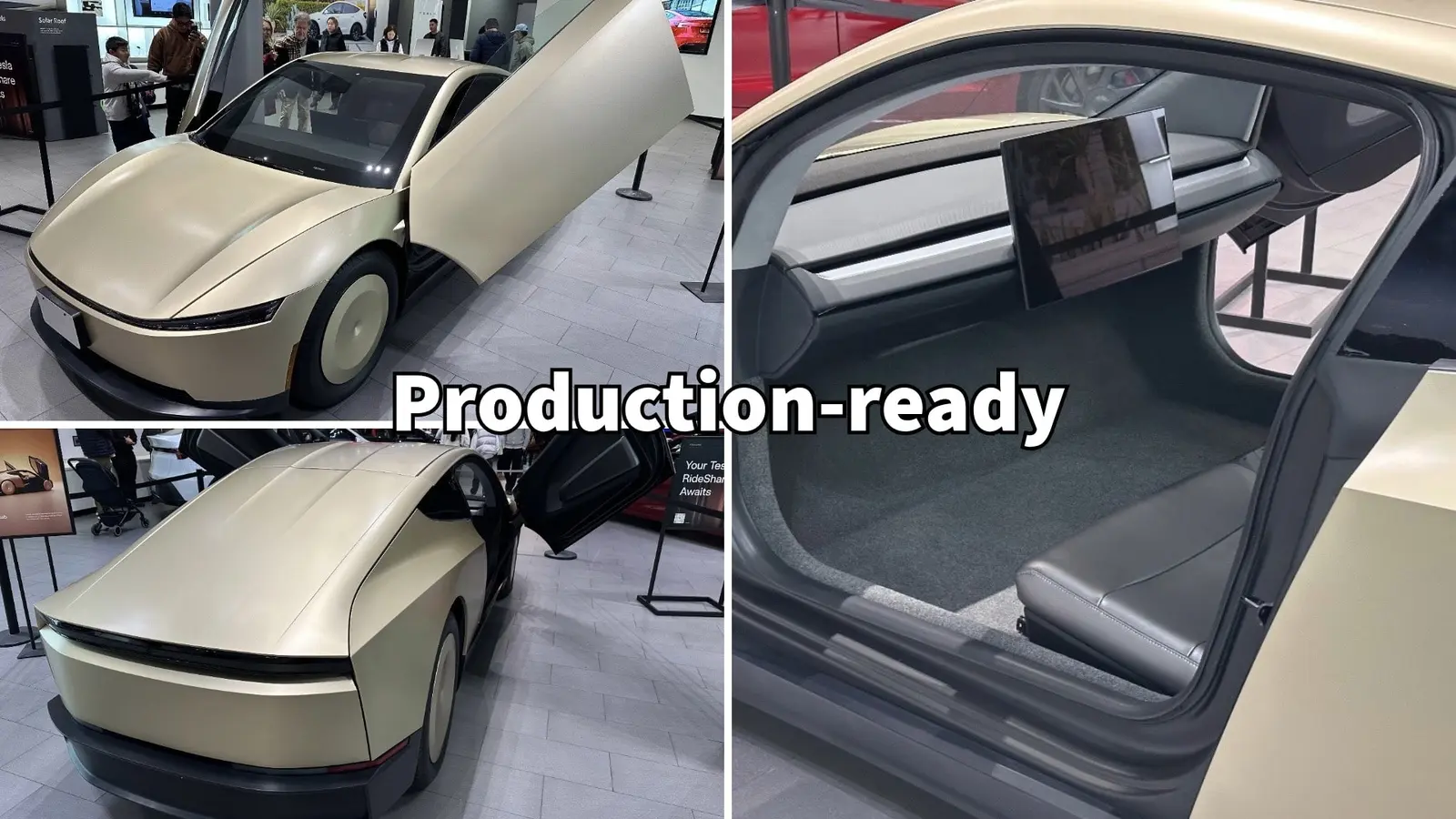
Tesla displays near-production Cybercab at Santana Row
Tesla quietly put a production-intent Cybercab on display at its Santana Row showroom in San Jose, offering one of the clearest looks yet at the companys robotaxi flagship. The example lacked a steering wheel and pedals, underlining Tesla's commitment to a wheel-free cabin, but also showcased a series of subtle design and engineering changes that suggest the model is nearing production readiness.
What changed from the early prototypes
Observers who examined the vehicle in person noted a number of purposeful updates compared with the original 2024 reveal prototypes. Key exterior revisions include revised front and rear bumpers that fully integrate production lighting and orange reflectors, a larger front lip, and a slightly forward-shifted B-pillar. The tailgate sits higher than on the unveiling car, a likely tweak for improved aerodynamics and packaging.

From the side the Cybercab now features frameless windows and larger door openings. That complements new powered door struts reported by viewers, indicating Tesla is refining passenger access for ride-hailing or private-use scenarios. Small but telling items were added as well, such as two windshield wipers replacing the single wiper seen on the launch prototype.
Interior evolution: more practical and passenger-focused
Inside, the cabin has been reworked for comfort and usability. The dashboard and door trims adopt a cleaner layout with a Model 3/Y-inspired dash architecture, while seats and headrests are newly designed. Passengers gain noticeably more legroom and ambient lighting has been added to enhance the onboard experience — features that matter for a vehicle intended to carry multiple fares or serve as a private autonomous shuttle.

Tesla also appears to be balancing radical autonomy goals with practical realities. Although Elon Musk has repeatedly characterized the Cybercab as a pure robotaxi without traditional controls, company engineers have at times fitted test mules with steering wheels and mirrors for public-road validation. Tesla maintains these are temporary measures for testing and will be omitted from production units if regulatory approval and autonomous tech milestones are met.
Design and market context
The Cybercab represents a strategic bet for Tesla as it pivots from selling cars to operating autonomous mobility services. By canceling a compact EV that shared the same platform, Tesla trimmed program complexity to focus resources on making a steering-wheel-free vehicle viable. Still, the firm appears pragmatic: executives have hinted that a limited-control option could be fitted if autonomy timelines slip or regulations demand operator controls at launch.

How the Cybercab stacks up against the competition will depend less on raw powertrain specs and more on autonomy, cost of operation, and regulatory acceptance. Traditional OEMs are developing their own ride-hailing and robotaxi concepts, but few have committed to completely removing driver controls for consumer sale the way Tesla has publicly proposed.
Highlights and takeaways
- Production-intent features include integrated production lights, orange reflectors, and reworked bumpers
- Cabin updates deliver more legroom, new seats, ambient lighting, and a Model 3/Y-style dash
- Frameless windows, larger door openings, and powered struts improve access and usability
- Cybercab on display lacked steering wheel and pedals, though test vehicles sometimes carry temporary controls

For enthusiasts and industry watchers the Santana Row display is the latest signal that Tesla is narrowing the gap between concept and production for a vehicle designed around autonomy rather than driver engagement. The firm still faces regulatory and technical hurdles before a wheel-free Cybercab can operate as a private sale or fleet vehicle, but these refinements show Tesla is tackling fit, finish, and everyday practicality alongside its ambitious self-driving goals.
Whether the Cybercab arrives as a pure robotaxi or a hybrid offering optional controls will shape its market positioning. Either way, the new details seen in San Jose — small aerodynamic changes, production-grade lighting, and a more passenger-centric interior — make clear Tesla is preparing a vehicle built not just to impress on stage, but to function reliably in commercial operation.

“Cars are evolving faster than ever. I cover electric vehicles, smart mobility, and the future of transportation worldwide.”

Discussion
Leave a Comment