
4 Minutes
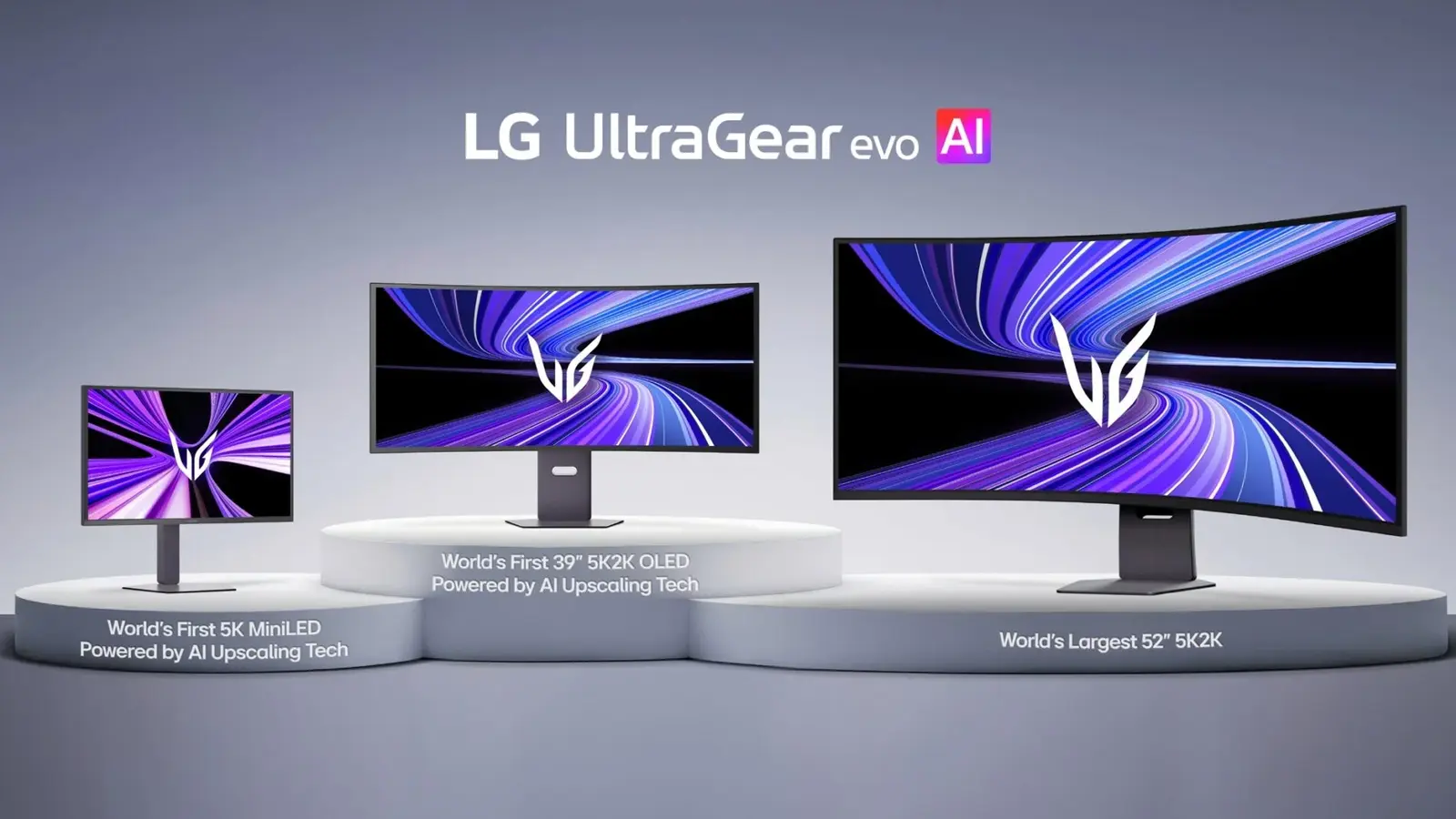
LG has launched UltraGear evo, a premium gaming monitor family debuting at CES 2026. The series centers on on-device AI that brings near-5K clarity, smart scene tuning and audio optimization to three flagship monitors — OLED, MiniLED and a massive 52-inch panel.
AI first: sharper images without upgrading your GPU
What makes UltraGear evo feel different is LG’s built-in AI. The company says its 5K AI Upscaling works in real time on the monitor itself, improving image fidelity before frames reach your GPU. That means smoother upscaling from lower resolutions, scene-aware visual tweaks and even AI-driven sound adjustments — all designed to balance picture and audio without extra CPU or GPU strain.

39-inch 5K2K OLED — 39GX950B
The 39GX950B uses Primary RGB Tandem OLED to boost brightness, color accuracy and panel lifespan while delivering deep blacks and vivid hues. Its 1500R 21:9 curved ultrawide preserves the vertical height of a 32-inch screen but gives much wider horizontal real estate, running at 142 PPI and carrying VESA DisplayHDR True Black 500 certification.
Dual Mode lets you choose between 165Hz at native 5K2K or a blistering 330Hz at WFHD for competitive play. Response time is rated as fast as 0.03ms (GtG), letting you swap between cinematic visuals and esports-level speed with no compromise. The same on-device AI handles 5K upscaling, scene optimization and audio enhancement.
27-inch 5K New MiniLED — 27GM950B
The 27GM950B is billed as the world’s first 5K New MiniLED monitor tuned to minimize blooming. It uses 2,304 local dimming zones and Zero Optical Distance engineering to shrink the gap between LEDs and the panel, eliminating halo artifacts while preserving fine detail in bright and dark areas. Peak brightness reaches 1,250 nits and the panel is certified VESA DisplayHDR 1000.

Like its larger sibling, the GM9 supports Dual Mode: 165Hz at native 5K and 330Hz at QHD, with 1ms GtG response time. On-device AI again provides 5K AI Upscaling, AI Scene Optimization and AI Sound to enhance both picture and audio in real time.
52-inch 5K2K panoramic display — 52G930B
At 52 inches the 52G930B is LG’s biggest 5K2K gaming monitor yet. The screen preserves the vertical height of a 42-inch 16:9 display while expanding to a 12:9 panoramic aspect, offering roughly 33% more horizontal workspace than a standard UHD monitor. A 1000R curvature wraps your peripheral vision for immersive play, and the panel carries VESA DisplayHDR 600 certification. It runs at 240Hz so frame rates and resolution scale consistently at this larger size.
Want near-5K clarity without buying a new graphics card? LG’s on-device AI is the headline feature across the lineup — upscaling lower-res content, optimizing scenes and balancing audio automatically.

CES 2026 reveal and availability
LG will showcase UltraGear evo at CES 2026 across two exhibit zones: a community-driven "Dream Setup" inspired by Reddit gamers and a SimCraft racing experience highlighting the 39-inch GX9. LG also confirmed the UltraGear GX7 (27GX790B) will be available globally on the opening day of CES 2026.
Each model targets different players: the 39-inch OLED for immersive single-player and creators, the 27-inch MiniLED for high-brightness precision, and the 52-inch for expansive, wraparound simulation and multitasking. Together they signal LG’s push to combine high-resolution hardware with monitor-level AI features for smarter, less GPU-dependent gaming experiences.
Source: gizmochina


Comments
Tomas
Feels a bit overhyped, not gonna lie. 5K2K at 330Hz seems like marketing flex. 52-inch 240Hz tho, who has that desk space? but OLED looks tempting
mechbyte
AI upscaling on the monitor itself? sounds wild but kinda fishy. Will it add latency, or just smear detail? need side-by-side tests, fast.

Leave a Comment