
Rising reentries: what is happening in low Earth orbit
Since 2019 SpaceX has launched thousands of Starlink satellites to build a global internet constellation. Jonathan McDowell, a noted astrophysicist at the Smithsonian Astrophysical Observatory, told EarthSky that one to two Starlink satellites are now reentering Earth's atmosphere every day after reaching the end of their approximately five-year operational life. He warned this rate is increasing as constellations expand.
This pattern — frequent controlled reentries of short-lived satellites — reflects a broader shift in low Earth orbit (LEO). Commercial operators are rapidly populating altitude bands below about 1,200 kilometers with thousands of mass-produced, low-cost satellites. While operators design many of these spacecraft to deorbit and burn up on reentry, the sheer volume of objects raises new environmental and safety questions.
Why short lifespans and controlled reentries matter
Most Starlink units are designed with a planned operational life near five years. At end of life operators attempt a controlled deorbit so the vehicle burns up in the atmosphere. That practice reduces the long-term orbital population but moves material into the upper atmosphere and stratosphere.
Atmospheric contamination and the ozone risk
Scientists are concerned that repeated reentries release metals and combustion byproducts into the stratosphere. Some research warns that cumulative deposition of metallic species and particulates may alter chemical cycles and, in extreme scenarios, contribute to ozone depletion. The uncertainties remain large: estimates range from negligible to potentially significant impacts, depending on reentry rates, composition, and atmospheric chemistry.
Scale of the problem: constellations, launches, and collision risk
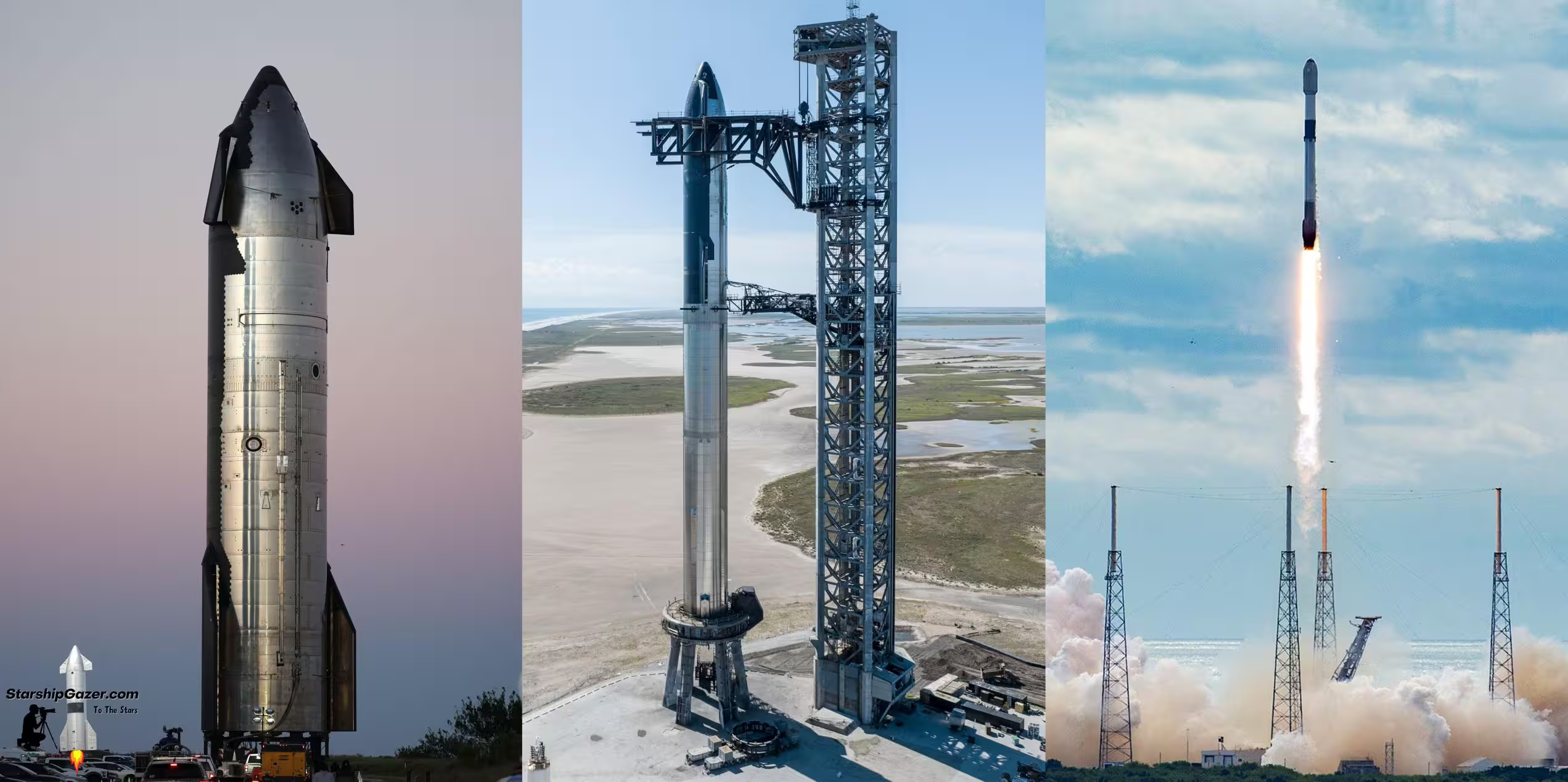
SpaceX now operates several thousand active Starlink satellites and continues frequent launches. Industry and competitors are also accelerating deployment: for example, Amazon's Kuiper project plans over 3,000 satellites and began launching its first tranche recently. McDowell has estimated that when major constellations are fully deployed we could see roughly 30,000 satellites in LEO from commercial and international programs, plus tens of thousands of additional objects at higher altitudes.
More satellites means more traffic, more conjunctions, and more potential for collisions. SpaceX satellites account for a large share of close approaches in LEO today. The Federal Aviation Administration and other agencies have also flagged growing risks related to reentries that survive to impact the ground; a 2023 FAA analysis suggested a dramatic increase in potential ground-impacting fragments under certain future scenarios.
Kessler syndrome and chain-reaction collisions
The most feared outcome is the Kessler syndrome: a cascading series of collisions that exponentially increases orbital debris and renders some orbital regions hazardous or unusable. McDowell and other experts say the immediate risk of a runaway Kessler event in the very low Starlink orbital shells is limited because those altitudes permit faster natural decay. However, crowding could push competitors to higher orbits where debris persists for decades or centuries, increasing long-term collision risk.
Solar activity also modulates risk. During solar maxima, enhanced atmospheric drag can cause orbital decay for many small satellites, but severe space weather events could also damage fleets simultaneously and create sudden surges of debris. Historical records and modeling show that periods of strong solar activity correlate with increased satellite losses.
Mitigation, policy, and technical responses
Operators and regulators have several levers to reduce risk. Technical approaches include designing satellites for reliable controlled deorbiting, improving passivation to avoid explosions, incorporating drag enhancement devices, and developing on-orbit servicing and active debris removal technologies. Policy measures include stricter licensing conditions, binding disposal timeframes, debris mitigation standards, and international coordination to limit harmful practices and allocate orbital slots responsibly.
Yet technical fixes alone may not suffice if launch and deployment rates continue to accelerate. Comprehensive solutions will require transparent tracking of objects, real-time collision avoidance coordination, and global governance mechanisms proportional to the scale of commercial deployments.
Expert Insight
Dr. Maya Chen, an orbital debris specialist at the Center for Space Safety, notes: 'Frequent, controlled reentries are better than leaving failed satellites in orbit, but they are not impact-free. We need better atmospheric models, materials accounting, and stricter lifecycle rules for satellites. Coordinated international standards and aggressive investment in debris removal are essential if we want to preserve safe access to LEO.'
Conclusion
The rapid expansion of large satellite constellations is reshaping Earth orbit. Daily reentries of Starlink satellites reflect both responsible end-of-life practices and the broader challenge posed by massive, short-lived fleets. The central questions are scientific, technical, and regulatory: how much atmospheric contamination will repeated reentries cause, how can collision risk be minimized, and what global policies are needed to prevent a future dominated by orbital debris. Without timely, cooperative action from industry and governments, the convenience of space-based internet services may come with long-lasting costs to orbital and atmospheric environments.


“The cosmos has always fascinated me. I write about space missions, astronomy, and the technologies pushing humanity beyond Earth.”

Discussion
Leave a Comment
Comments (2)
Is this really true? If 1-2 Starlinks reenter daily, what's the long term ozone impact, anyone?
wow didn't expect that... thousands burning up daily? feels like we're trading atmosphere for wifi