

Bitdeer posts sharp rise in Bitcoin production and revenue
Bitdeer Technologies Group reported a dramatic increase in Bitcoin production in the second quarter of 2026, driven by a rapid expansion of its self-mining capacity and ongoing investments in mining hardware and infrastructure. The company mined 2,694 BTC in Q2 2026, nearly five times the 565 BTC it produced in the same quarter a year earlier, while revenue grew 47% year over year to $228.8 million.
Q2 highlights and financial snapshot
Self-mining revenue accounted for a meaningful portion of the quarter, generating $168.4 million as Bitdeer scaled its average self-mining hashrate to roughly 69.5 exahashes per second, a 389% increase year over year. That higher compute capacity helped lift Bitcoin production significantly and allowed Bitdeer to slightly beat consensus revenue estimates. Analyst expectations compiled by Yahoo Finance had placed consensus revenue near $225 million for the quarter.
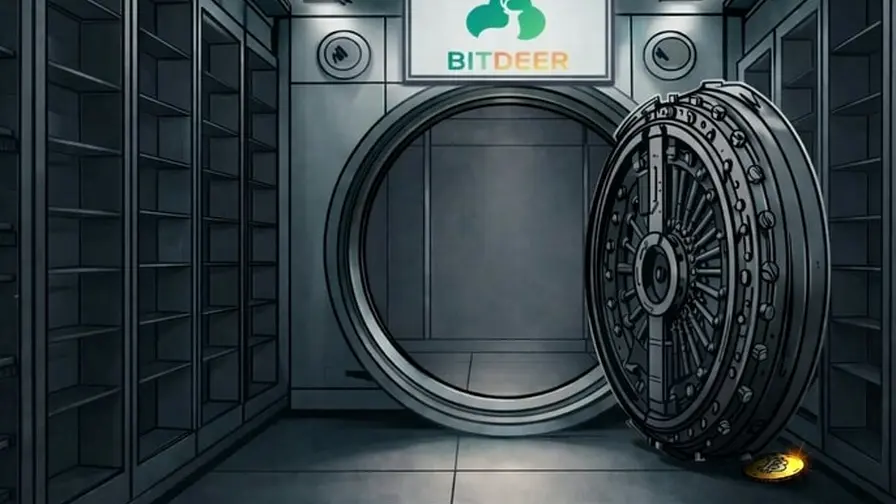
Despite the production surge, Bitdeer finished the quarter with only 150 BTC on its balance sheet, a steep decline from 1,502 BTC a year earlier. The drop followed the company's February decision to liquidate 943 BTC, a sale the firm described as a liquidity move rather than evidence of a strategic exit from Bitcoin mining.
Net loss widened to $92.3 million from $62.9 million a year earlier. The result reflects continued investment in growth initiatives, operating expenses for expanded mining operations, and ongoing development of AI and data center ventures.
Self-mining expansion and monthly production spikes
Bitdeer's quarterly output benefited from concentrated production gains in May and June. Operational updates showed the firm had reached roughly 73 EH/s in self-mining capacity by June. The company produced 990 BTC in June and 921 BTC in May, together accounting for over 70% of Q2's Bitcoin output. Those monthly runs represent year-over-year increases of several hundred percent for the same months in 2025, underscoring how rapidly Bitdeer's on-chain production has scaled as it deploys additional machines.
The mining expansion is being supported by a mix of in-house hardware initiatives and continued deployment of third-party equipment. Bitdeer is accelerating manufacturing through its SEALMINER program and the construction of a domestic production facility designed to cut dependence on external suppliers.

SEALMINER manufacturing push in Nevada
In July Bitdeer announced a $36 million manufacturing site in Sparks, Nevada, intended to produce critical components for its SEALMINER Bitcoin rigs. The Nevada facility, which secured state and local incentives including reduced qualifying sales taxes, is scheduled to enter commercial production before the end of 2026. Bitdeer framed the plant as a mining-equipment initiative specifically, distinct from its AI infrastructure projects, and said the location would help onshore key component production and reduce supply-chain exposure.
Treasury moves, liquidity and market reaction
The company’s balance sheet actions have drawn attention. After the February BTC liquidation, Bitdeer held 150 BTC at quarter end, down from 1,502 BTC a year earlier. Management said the sale was intended to improve liquidity and support operations and growth initiatives. At the end of Q1 the company reported $297.7 million in cash and restricted cash and about $1.9 billion in borrowings, reflecting significant leverage while the firm scales.
Investors reacted modestly to the results: Bitdeer shares rose roughly 1.5% in premarket trading after the release, following a roughly 15% decline over the prior month.
AI data center agreement in Norway diversifies revenue mix
While continuing to invest in Bitcoin mining, Bitdeer has expanded into AI and high-performance computing infrastructure. On Aug. 4, the company disclosed that its Tydal Data Center subsidiary signed a 16-year colocation and services agreement with Volta Tydal AS to occupy 121 megawatts of critical IT capacity in Norway. The deal is billed as a long-term revenue contract with an initial projected value of approximately $4.7 billion over the 16-year term, and an eight-year renewal option that could raise the total to about $8 billion if exercised.
Volta plans to use the capacity for a major AI lab running NVIDIA GPUs, with Dell Technologies supplying project technology. Under the agreement, the tenant will reimburse electricity costs and make monthly contract payments averaging roughly $202 per kilowatt of IT capacity for the first 16 years, with payments growing 3% annually per Bitdeer’s projections. Management has forecast average annual revenue of about $2.4 million per IT megawatt and a project net operating income margin near 90%, though it warned these figures are internal projections rather than GAAP measures and exclude financing, depreciation, corporate costs and other items.
The Tydal contract follows earlier work converting a Norwegian site to a larger AI facility based on NVIDIA reference designs. Bitdeer said that after allocating approximately 133 MW of gross power to fulfill the Volta commitment, it plans to develop two additional halls totaling 47 MW for potential AI and high-performance computing clients in the second half of 2027.
Financing needs and credit support for Tydal
Completing the contracted capacity at Tydal will require significant capital. Bitdeer estimates about $500 million in additional capital expenditure, roughly $4 million per contracted IT megawatt. The company plans to look to additional debt to finance construction and related infrastructure.
To underpin Volta’s obligations, affiliates of J.P. Morgan and another global bank have arranged letters of credit totaling about $1.3 billion, subject to customary conditions. Bitdeer emphasized that contract payments depend on the agreement remaining in force for the full initial term and that Volta holds a no-fee termination right after 10 years; the eight-year extension is optional. Bitdeer also retains termination rights if Volta fails to meet specified milestones tied to the package.
Business model: balancing mining operations and new infrastructure

Bitdeer is pursuing a dual strategy: scale self-mining to capture Bitcoin issuance and secure long-term revenue through AI colocation and services. The company has emphasized internally developed mining hardware, onsite manufacturing for SEALMINER components, and co-located AI capacity conversions as central elements of its growth plan.
These capital-intensive initiatives have weighed on near-term profitability. Bitdeer posted a consolidated net loss of $92.3 million in Q2 2026, wider than the $62.9 million loss a year earlier. The firm also recorded a $159.5 million net loss in Q1 2026, when revenue was $188.9 million. Management is choosing to invest in both compute infrastructure for Bitcoin mining and AI cloud services even as those decisions press operating results.
On the AI side, Bitdeer reported an AI cloud annualized run-rate revenue near $76 million in June with utilization around 95%, indicating healthy demand for compute capacity even as projects ramp.
How Bitdeer compares within the sector
Other publicly traded miners have also diversified into AI and digital infrastructure. Marathon Digital and TeraWulf, among others, disclosed moves into large-scale AI or data-center leases earlier in 2026. Bitdeer’s approach differs in that it is simultaneously expanding self-mining hashrate and manufacturing proprietary mining hardware while building out AI colocation through long-term contracts like Tydal’s.
That combination can amplify revenue stability if the AI agreements perform and mining operations remain efficient, but it also raises capital and execution risk. Investors will watch Bitdeer’s ability to convert contracted AI revenue into free cash flow, manage borrowing costs, and continue deploying SEALMINER capacity without major delays.
Near-term outlook and key watch items
Key metrics to follow in coming quarters will include:
- Self-mining hashrate and month-by-month BTC production, which drove the Q2 surge
- Treasury BTC balance and any further sales or accumulations
- Progress and capital deployment at the Nevada SEALMINER manufacturing facility
- Tydal construction milestones, financing terms, and Volta liquidity support execution
- Quarterly cash flow trends, borrowings, and cost of financing
Bitdeer has signaled it will use debt to fund part of the Tydal build and other projects; market reaction will reflect both execution of the Norway project and the company’s ability to grow Bitcoin production while managing leverage.
In summary, Bitdeer delivered a striking operational performance in Q2 2026, scaling Bitcoin output and revenue while continuing to invest heavily in mining hardware and AI data centers. Those investments could diversify revenue and improve long-term margins, but they also contribute to larger near-term losses and elevated financing needs as the company executes on a broad infrastructure strategy that bridges Bitcoin mining and AI compute services.


“With a background in economics and digital markets, I write about startups, finance, and the trends transforming the global economy.”

Discussion
Leave a Comment
Comments (3)
SEALMINER in Nevada and a $4.7B Norway deal, bold play. big capex, letters of credit help but termination clauses worry me. lets see..
Revenue jump is nice but net loss widens and $1.9B borrowings? who backs that risk, curious how they service debt if BTC dips.
Wow 2,694 BTC in one quarter? insane ramp, but selling 943 BTC to stay liquid... hope that wasnt a panic move. impressive ops tho