

a widening gap between demand and courses
A recent OKX report highlights a pronounced mismatch between student and parent appetite for crypto and blockchain education and the actual availability of related university courses. The data show overwhelming support for integrating digital-asset topics into college curricula, yet formal program offerings remain sparse across accredited U.S. business schools. This article unpacks the report's key findings, examines where students are learning about crypto, and explains the real-world implications for universities, industry partners, and regulators.
Key takeaways from the OKX New Money Curriculum report
The OKX study found striking levels of support for college-level crypto and blockchain education. Roughly 90% of students and 87% of parents said they want higher education to include crypto and distributed-ledger topics. Many respondents went further than optional coursework: 27% of students and 32% of parents believe crypto and blockchain instruction should be required parts of the undergraduate experience.
Yet formal course availability lags far behind. A separate academic review of 533 U.S. universities with business schools accredited by the Association to Advance Collegiate Schools of Business found only about 28% offered at least one blockchain-related class. That review examined course catalogs across business, computer science, engineering, and other departments rather than limiting itself to dedicated blockchain degrees.
Course depth and subject focus
Depth of coursework varied widely. Of the institutions offering blockchain content, many provided a single introductory class; only 76 schools ran two or more blockchain-related courses. Two universities stood out by offering at least 10 relevant classes. The most common subjects across campuses included blockchain fundamentals, smart contract development, and cryptocurrency economics, reflecting a basic-to-intermediate focus rather than broad, multidisciplinary crypto curricula.
Why the divergence matters for crypto literacy
The contrast between demand and course supply has consequences for how young adults form opinions about decentralized finance, token economics, custody, and the regulatory landscape. Where formal education is scarce, students often turn to alternative sources that may vary in accuracy and depth. That raises concerns about practical skills such as private-key management, wallet security, tax reporting, and protection from fraud.
Social media rises as students primary crypto classroom
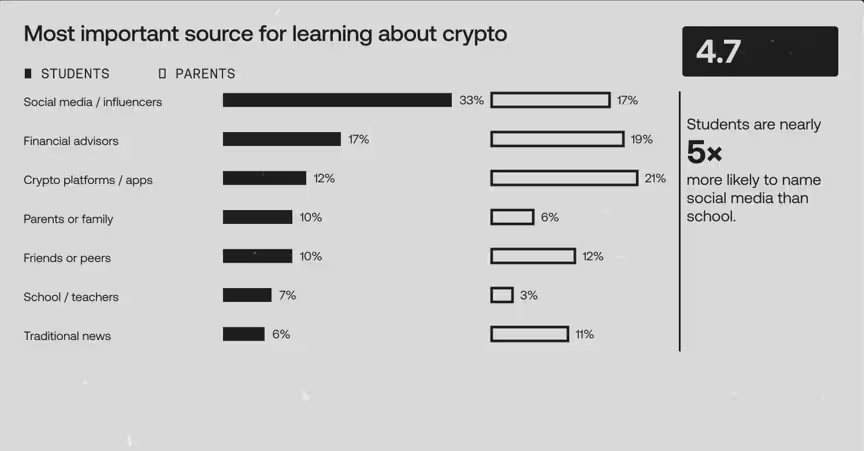
With only a minority of universities offering structured classes, many students report learning about crypto through social platforms. According to OKX, 33% of students named social media or influencers as their most important source for crypto knowledge, compared with just 7% who cited schools, teachers, or professors. Financial advisers accounted for 17%, while crypto platforms and apps were the main source for 12% of students.
Source: OKX’s New Money Curriculum report
Differences between students and parents
Parents showed a different mix of information channels. The OKX data indicate crypto platforms and apps rank first for parents at 21%, followed by financial advisers at 19% and social media at 17%. Friends and peers and traditional news outlets play smaller roles among parents than among students. The takeaway: students are markedly more likely to rely on social channels and influencer content, while parents lean toward regulated platforms and professional advice.
Students teaching parents — intergenerational knowledge transfer
Even when classroom offerings are limited, student-acquired knowledge often flows back into households. OKX found that 47% of students reported they had taught a parent or guardian something about crypto or investing. Conversely, 43% of parents said their college-aged child had shared investing or crypto insights with them. Roughly one-quarter of students said the content they shared was explicitly about crypto.
Perception of knowledge and trust
Both groups tend to perceive students as relatively well-informed: 53% of students said college-aged peers know more about crypto than their parents, and 51% of parents agreed. Only a small portion believed parents were more knowledgeable. Trust translated into potential action: 56% of parents said they would definitely or probably allow a college-aged child to make a crypto transaction on their behalf, though just 9% of students reported actually completing a transaction for a parent.
Investment attitudes and portfolio preferences
While students express substantial interest in digital assets, their investment preferences remain measured. The OKX findings show 52% of students view crypto purchases as long-term investments, while only 6% characterize them as entertainment. Among parents, 48% perceive crypto as long-term investment and 9% as a hobby. Most students — 89% — believe some crypto exposure can be part of a responsible portfolio, though 11% say the appropriate allocation should be zero.
Bitcoin salary interest — appeal and tax realities
Crypto interest extends beyond investing into compensation preferences. The OKX report notes that 56% of students would definitely or probably accept a job that paid 20% of their salary in Bitcoin; parent support was even higher at 62%.

Source: OKX’s New Money Curriculum report
US tax treatment and payroll complexity

For U.S. workers, receiving Bitcoin or other digital assets as wages does not eliminate ordinary tax obligations. The IRS treats crypto wages as ordinary income subject to federal withholding, Social Security, Medicare, and unemployment taxes. After receipt, the employee typically holds the tokens as capital assets; any later sale or exchange may trigger capital gains or losses calculated relative to the value when the crypto was received.
Operationally, crypto payroll presents additional hurdles: valuation at pay date, tax reporting, withholding mechanisms, volatility management, and payroll infrastructure integration. These obstacles help explain why industry-wide adoption of crypto compensation remains limited despite employee interest. A 2025 analysis cited by market observers showed crypto-sector compensation in digital assets rose to under 10% of total pay for sector workers, indicating growth but far from mainstream status.
Industry partnerships and university programs
Some crypto firms have begun funding academic programs to bridge the education gap. Ripple, for example, has sponsored multi-year partnerships that deliver financial literacy and digital-asset education, as well as research support and practical, hands-on learning opportunities like running ledger validators. These initiatives introduce students to real-world blockchain infrastructure and applied fintech projects, but they are industry-backed programs rather than evidence of systemic curricular adoption across higher education.
Examples of applied learning
Programs funded by industry partners often combine classroom instruction with lab work, student projects, and faculty research. One outcome is expanded access to experiential learning, including smart contract development, deployment on public ledgers, and interdisciplinary analysis of token economics. However, universities remain heterogeneous: some have built substantial offerings while many others still lack even a single blockchain course.
What universities, regulators, and industry can do
Addressing the gap between demand and course supply requires coordinated effort. Universities should consider integrating core crypto concepts into finance, accounting, computer science, and law curricula, emphasizing practical skills such as custody management, tax compliance, smart contract auditing, and regulatory frameworks. Accreditation bodies could develop guidelines that encourage consistent standards for crypto coursework and applied labs.
Regulators and tax authorities can help by issuing clear, accessible guidance on payroll treatment, reporting requirements, and consumer protections. Industry players — exchanges, wallets, and blockchain companies — can collaborate with academic institutions to co-design curricula, provide datasets and developer tools, and fund scholarships that broaden participation across demographics.
Improving educational outcomes
Better outcomes require assessment and measurement. Surveys should be complemented by competency testing that evaluates whether students and parents actually understand core topics such as private-key safety, custody options, tax liabilities, and the mechanics of token issuance. Universities should track placement and post-course behavior to determine whether graduates can apply their knowledge in careers spanning fintech, compliance, software engineering, and policy.
Conclusion: momentum and caution
The OKX report underscores robust support for crypto and blockchain education from both students and parents. Yet the supply of university courses still trails interest, leaving a large share of learners dependent on social media, influencers, and crypto platforms for knowledge. Closing this gap will require universities to move beyond sporadic, industry-funded programs and adopt more structured, multidisciplinary curricula that pair theory with practical training. Doing so would help ensure the next generation of crypto users, builders, and policymakers are informed, safe, and prepared to navigate an increasingly tokenized economy.

“With a background in economics and digital markets, I write about startups, finance, and the trends transforming the global economy.”

Discussion
Leave a Comment
Comments (3)
I teach CS labs, and yep students are way ahead on crypto basics. Industry grants helped start a lab but thats not a curriculum fix, accreditation and clear tax guidance needed, fast.
28% of schools offering a class? is that the full picture or just AACSB biz schools? curious if CS, engineering or law depts were included…
wow didnt expect ~90% demand. colleges seriously lagging, students learning from influencers and tiktok, yikes. Need real courses, pronto