
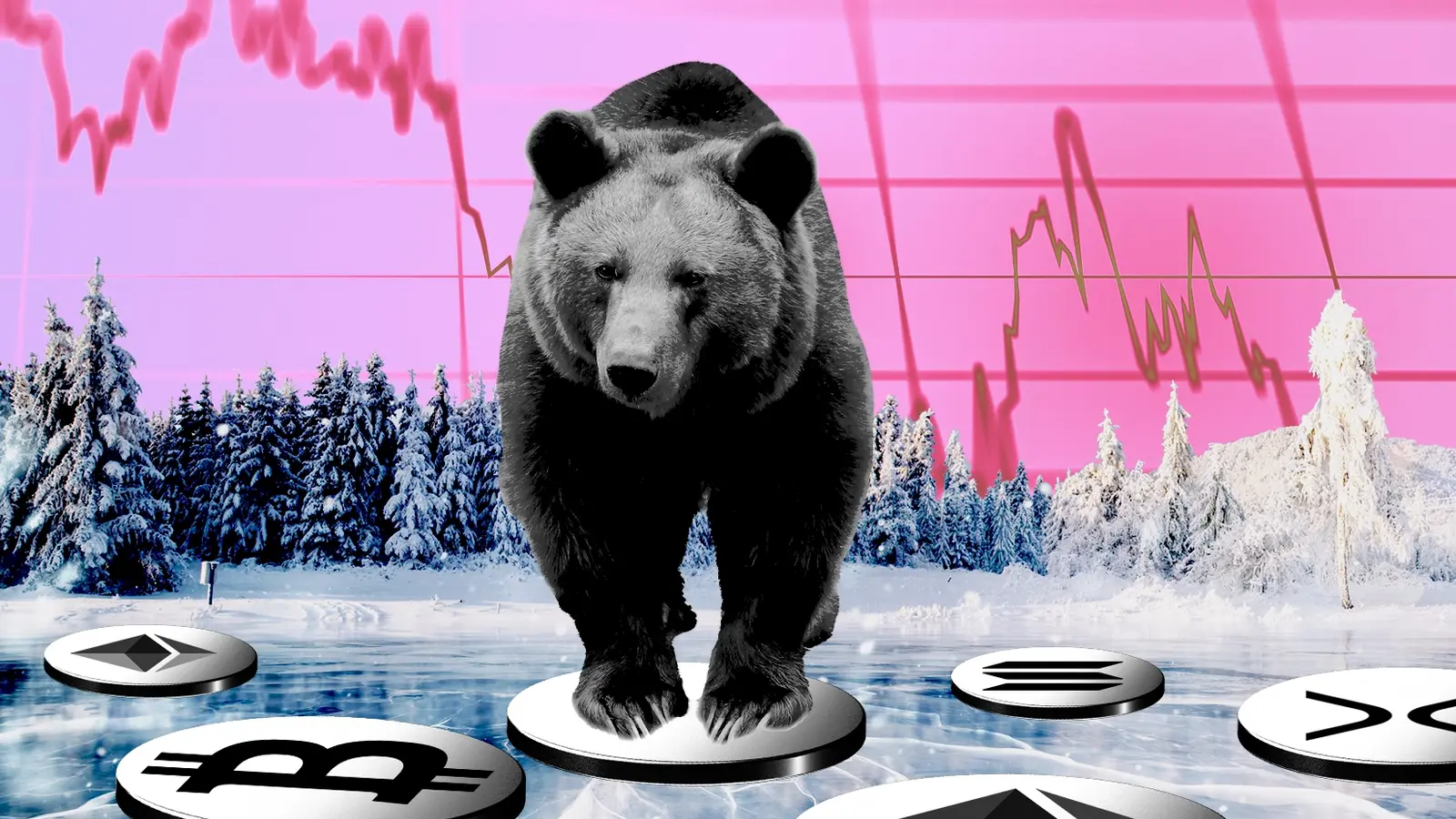
three consecutive quarters in the red
The crypto market recorded its third straight quarter of negative returns in Q2 2026, marking its longest losing streak since 2022, according to Bitwise's quarterly market review. The Bitwise 10 Large Cap Crypto Index fell 15.4% over the quarter, with eight of its ten constituents ending in the red. Spot Bitcoin exchange-traded funds—once a major source of institutional demand—also posted record quarterly outflows, amplifying selling pressure across digital assets.
Q2 drivers: ETF flows, correlations and trading activity
Bitwise described Q2 as "a tough quarter for crypto," noting declines across onchain activity, trading volumes and assets held in decentralized finance (DeFi) protocols. At the same time, the firm reported a rising correlation between crypto and traditional equities, linking digital asset price moves more closely to broader risk-on/risk-off dynamics in global markets.
Spot Bitcoin ETFs and institutional demand
Spot Bitcoin ETF outflows were a key contributor to the quarter's weakness. These ETFs have been an important conduit for institutional allocation to Bitcoin since their U.S. launch, but record withdrawals in Q2 indicate many investors reduced exposure as market conditions deteriorated. That trend contrasted with earlier in the cycle, when Bitcoin funds attracted more than $3.4 billion over seven consecutive weeks of inflows by May 2026.
Stablecoins and tokenized assets expand despite price pressure
Even as spot prices fell, settlement and tokenization activity continued to grow. Bitwise reported that stablecoin settlement volume reached roughly 2.3 times the volume processed by Visa, underscoring the scale of fiat settlement activity on blockchain rails. The firm noted that stablecoin issuers now hold larger U.S. Treasury balances than many sovereigns.
Settlement scale and transaction metrics
Under broader measurements, adjusted stablecoin transaction volume hit $10.9 trillion in 2025, with total settlement volume reaching $33 trillion. Visa itself has increased engagement with blockchain payments: its stablecoin settlement run rate was about $7 billion as of March 2026. These figures highlight how stablecoins function as a major backbone for crypto liquidity and payments even during periods of price weakness.

Tokenized real-world assets
Tokenized real-world assets (RWA) continued to expand, rising 50.3% in H1 2026 to $32.89 billion, per Bitwise. This sector — which includes tokenized government bonds, private credit and investment funds — is drawing institutional interest as asset managers and treasury teams explore blockchain-based custody and settlement efficiencies. Earlier reporting suggested the tokenized RWA market approached $34 billion, led by Treasury products and Ethereum-based tokenization efforts.
Prediction markets, DeFi platforms and crypto stocks outperform
Certain segments of the crypto ecosystem bucked the price downtrend. Prediction market trading volume surged to a record $43.2 billion in Q2, nearly 18 times the volume seen a year earlier, signaling heightened interest in event-driven markets and derivatives.
Crypto equities and platform revenue
Crypto-related equities outperformed many onchain tokens: the Bitwise Crypto Innovators 30 Index rose 30.6% during the quarter while large-cap crypto assets delivered double-digit losses. Bitwise also highlighted strong revenue figures for major decentralized platforms—Hyperliquid, PancakeSwap and Aave each generated about $900 million in revenue over the prior year—pointing to continued demand for decentralized trading, lending and derivatives.
Hyperliquid processed over $41 billion in seven-day perpetual futures volume by May 2026, with open interest near $9.4 billion, reflecting robust derivatives activity despite the broader market pullback.
Onchain fundamentals remain above the 2022 lows
Bitwise compared current network activity with the trough of the 2022 downturn and found meaningful improvement in several metrics. Ethereum transaction activity has grown roughly 13-fold since the 2022 bottom, DeFi total value locked (TVL) is up more than 60%, and stablecoin assets under management have roughly doubled. "It's only prices that haven't kept pace," Bitwise said, emphasizing that network usage and institutional participation have expanded even as spot valuations lag.
Outlook: structural growth, but near-term risks persist
Bitwise concluded that the industry is about twice the size it was at the previous cycle's bottom, driven by stronger onchain activity, tokenization and institutional flows. However, the firm cautioned that healthier fundamentals do not guarantee an immediate price recovery; elevated correlations with equities and volatile ETF flows could prolong near-term weakness.
For investors and market watchers, the Q2 review underscores a bifurcation: while macro and sentiment drivers pushed prices lower, structural adoption—stablecoin settlement, tokenized assets, prediction markets and resilient DeFi revenues—continues to advance. Traders, allocators and blockchain-focused institutions will likely keep a close eye on ETF flows, macro risk appetite and onchain indicators as signals for the market's next directional move.


“I cover automotive innovation, electric vehicles, and the future of mobility — where technology meets sustainability.”

Discussion
Leave a Comment
Comments (2)
Are tokenized RWAs really scaling that fast? figures look huge, feels like there could be double counting or reporting quirks. where's the custody risk?
Makes sense tbh, ETFs pulling out will drag everything. Stablecoin rails growing tho, nice infra but when do prices actually follow? kinda messy rn