
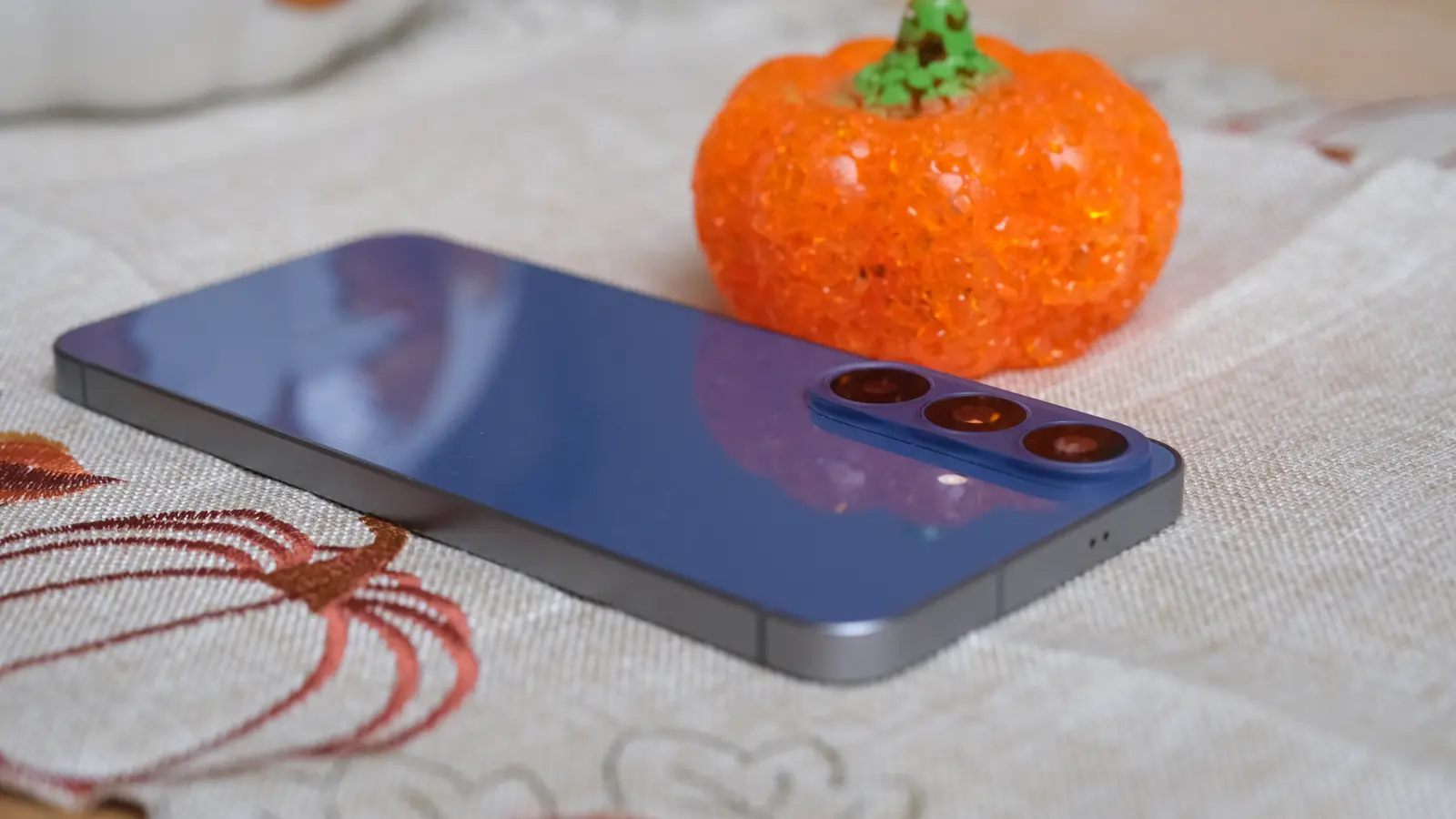
There is plenty to like about the Galaxy S26 FE, but buying one takes a little more thought. A quality display, a well-built body, a capable main camera and years of promised software updates make an appealing combination. The questions start when you look at battery life, base storage and the price gap between this phone and Samsung’s main flagships.
The FE range has always had a difficult job: deliver enough of the Galaxy S experience at a lower price, while leaving reasons to buy the more expensive models. The Galaxy S26 FE reflects that balancing act. Samsung is generous in some areas and surprisingly cautious in others.
This phone has a lot to offer in everyday use, but it is not necessarily the best choice for demanding gamers, keen videographers or anyone who leaves home early and does not see a charger until late at night. To understand where it fits, we need to look beyond the familiar Samsung styling and see which fans this Fan Edition is really trying to please.
.avif)
Design: Familiar, Well Built and a Little Too Glossy
If you like the design of recent Samsung phones, you will probably get along with the Galaxy S26 FE. Clean lines, a flat frame and vertically arranged cameras follow the familiar Galaxy formula. It looks close enough to the more expensive models that nothing immediately announces it as the cheaper option.
The differences become clearer in the details. The display borders are not as slim as those on Samsung’s main flagships, and the bottom border is slightly thicker than the other three. That does not make the phone unpleasant to use, but greater symmetry is a reasonable expectation at this level.
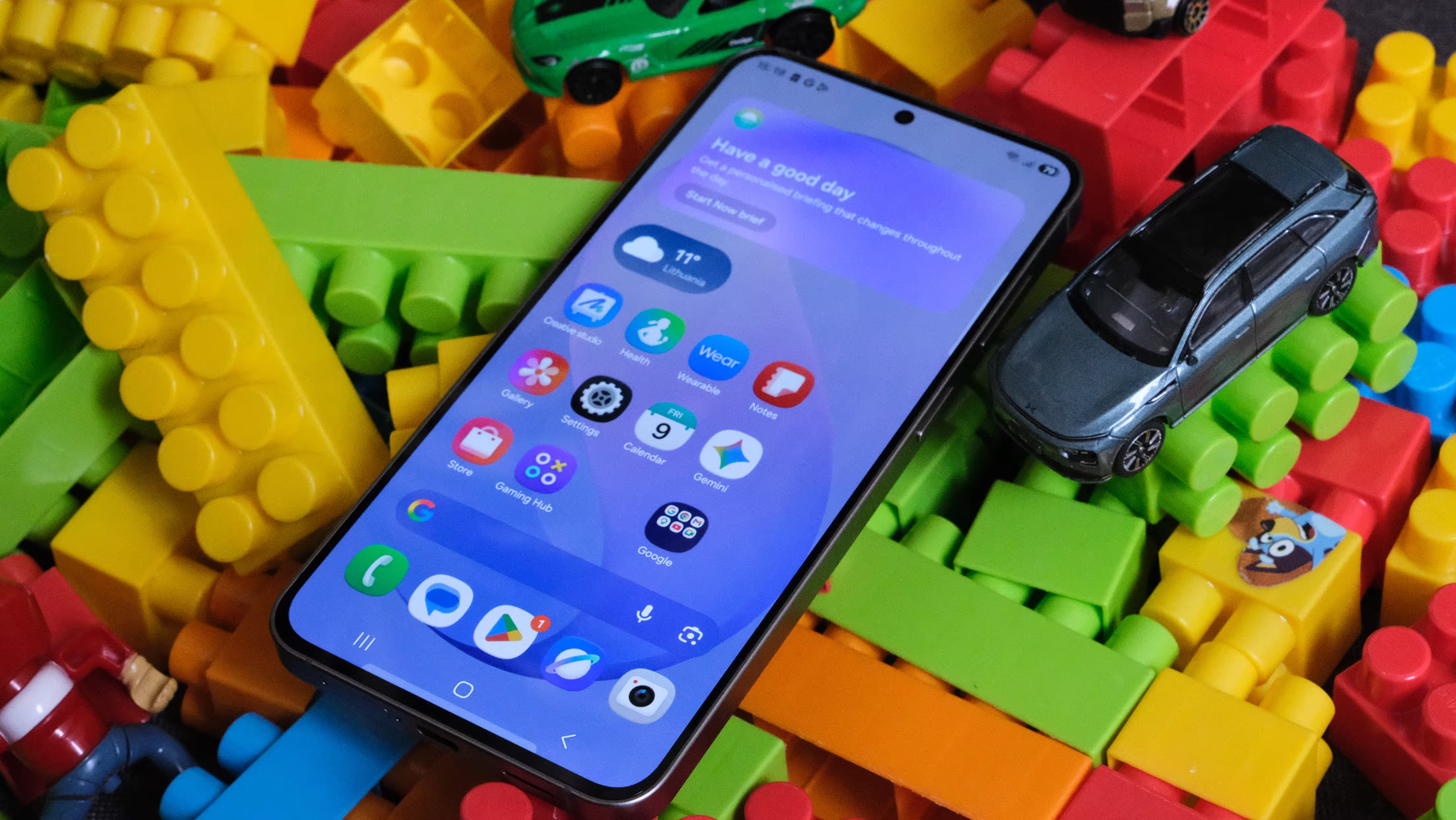
At 193g and 7.4mm thick, the body is relatively light and slim for a phone with a 6.7-inch display. Its width still makes one-handed use awkward at times, though. Light and compact are different things, and your thumb does not care about the weight specification when it is trying to reach the top corner.
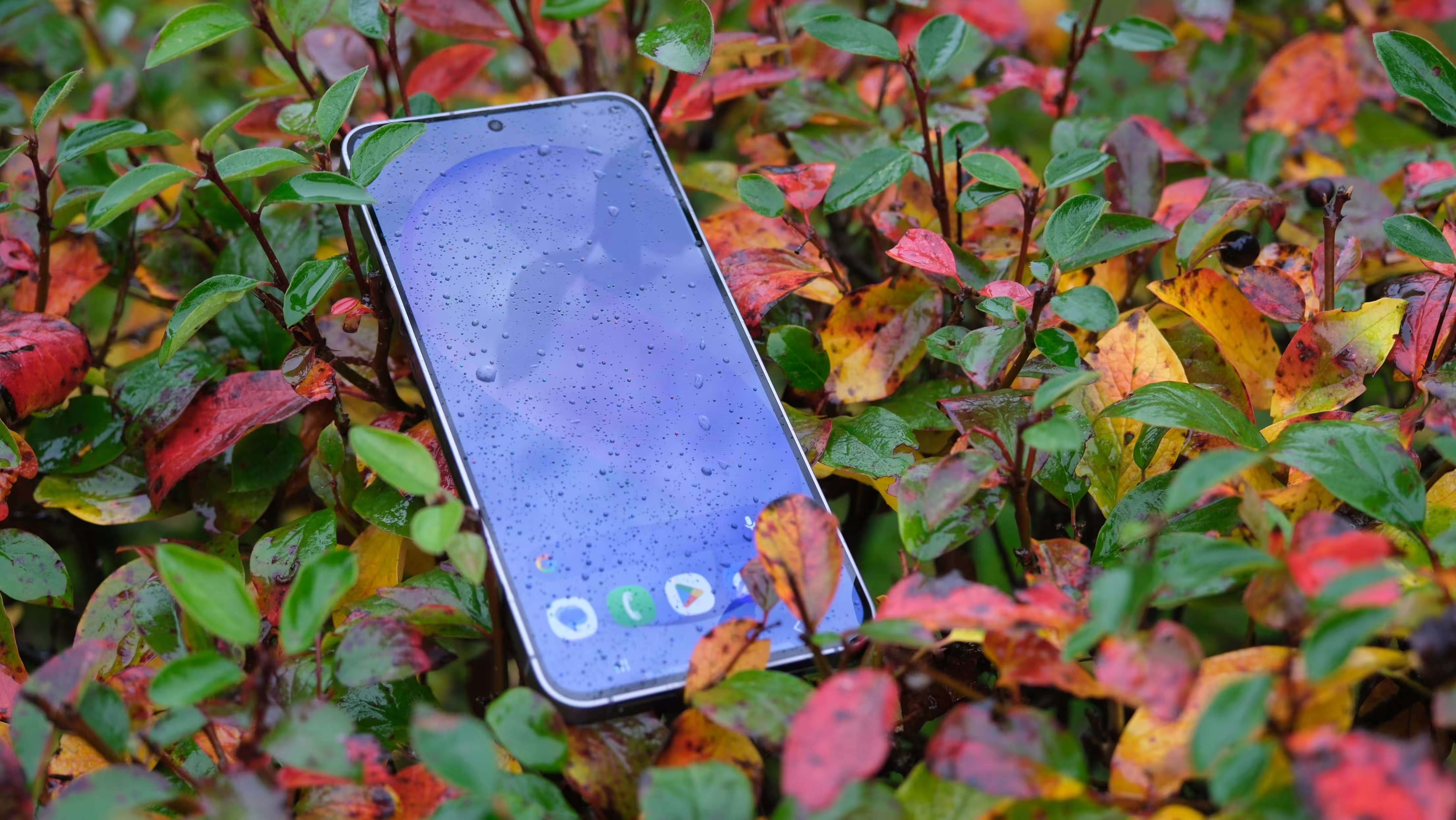
The combination of glass and an aluminium frame feels suitably premium. Gorilla Glass Victus+ on the front and back, together with an IP68 rating, makes a reassuring package. Water resistance should not, however, be mistaken for permanent protection against every encounter with liquids.
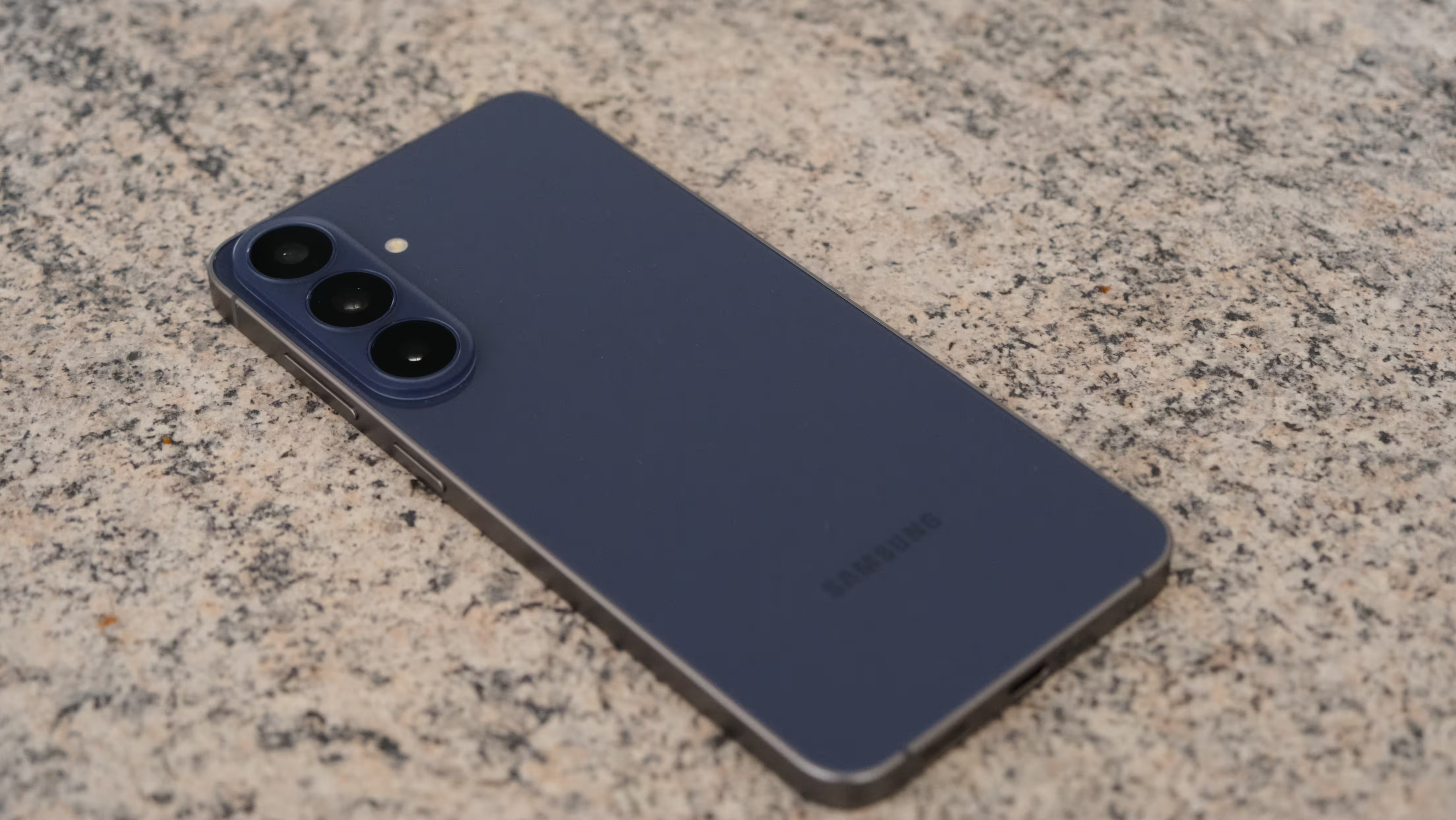
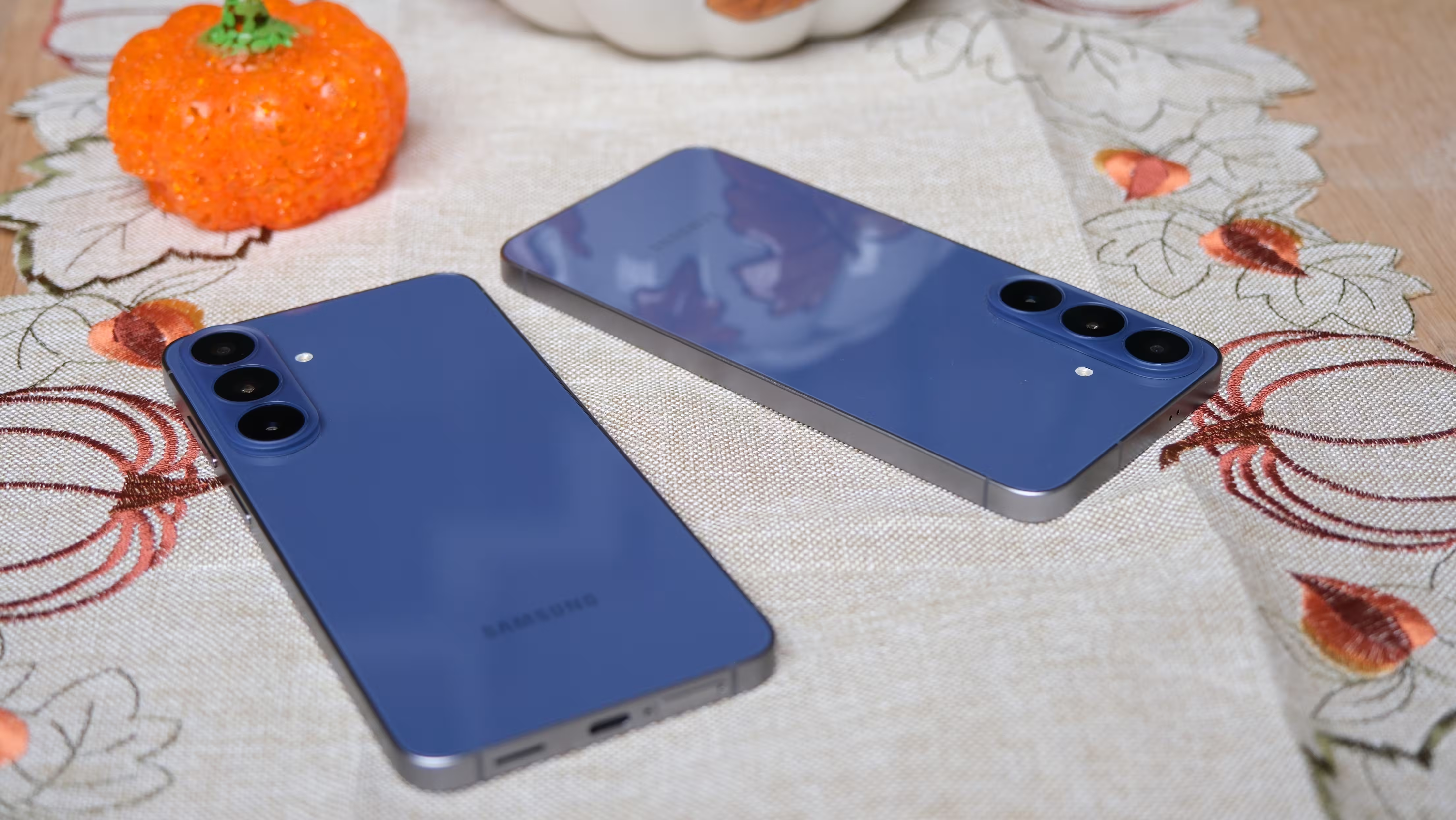
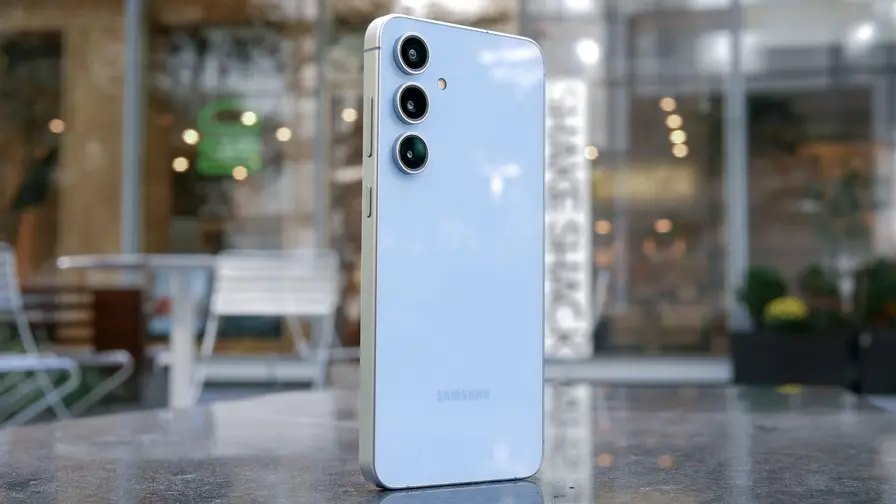
The more questionable choice is the glossy rear finish. It catches the light nicely, but collects fingerprints with equal enthusiasm. Lighter colours, such as white and pistachio green, hide marks more effectively. With darker finishes, wiping the back can become part of your daily routine.
The camera protrusions are reasonably restrained, and their finish works well with the body colour. The result is an attractive device that does not need elaborate decoration to get your attention.
The under-display fingerprint reader is optical. It works reliably, but does not offer quite the speed and feel of the ultrasonic readers in Samsung’s more expensive phones. Haptic feedback is also decent, although its taps are not as precise or substantial as those on the company’s higher-end models.
.avif)
Overall, design is one of the S26 FE’s strengths. My reservations are less about build quality and more about the increasingly familiar styling and that glossy back. I would welcome a fresher approach in future FE models, but this phone needs to be judged on what it offers today.
Display: Samsung Still Knows How to Impress
The screen is one of the quickest ways the Galaxy S26 FE makes a good impression. Its 6.7-inch Dynamic AMOLED 2X panel, with FHD+ resolution and a 120Hz refresh rate, provides an enjoyable experience for films, photos, social media and games.
Colours are lively, blacks are deep, and strong contrast gives images plenty of impact. If you like a punchier presentation, the default settings will probably suit you. Alternative colour settings are available if you prefer something more restrained.
.avif)
FHD+ resolution is sufficient at this size for normal use. Text is clear, and photos retain a satisfying amount of detail. In practice, the lack of a higher resolution matters less than some of the panel’s other limitations.
The most significant is the absence of LTPO technology. The refresh rate switches between 60Hz and 120Hz rather than dropping to very low levels for static content, as it can on some flagship displays. Scrolling remains smooth, but there is less flexibility to reduce power consumption.
Samsung quotes brightness of up to 1,900 nits. That should not be read as a constant, full-screen brightness level, but outdoor usability is good. Reading messages, following maps and framing photos outside do not present major problems. HDR content is another strength.
.avif)
At the other end of the scale, I would have liked a lower minimum brightness. For anyone who uses their phone in a dark bedroom, that can matter more than a headline figure for sunlight visibility. Software dimming options help, but the experience is not necessarily as comfortable as on Samsung’s best displays.
The stereo speakers are a good match for the screen. There is decent volume and separation, and the upper speaker contributes enough to make the stereo effect worthwhile. Watching videos without headphones is one of the more satisfying parts of using this phone. Dolby Atmos support and an equaliser provide further room for adjustment.
.avif)
The S26 FE delivers a display experience that feels close to the high end. The lack of LTPO and the minimum brightness level are reminders that it does not quite match Samsung’s best.
Performance: Fast for Everyday Life, with Some Gaming Caveats
Samsung has chosen the Exynos 2500 for the S26 FE, manufactured using a 3nm process and paired with 8GB of RAM. Depending on the market, storage options include 128GB, 256GB and 512GB.
.avif)
For everyday use, the hardware and software work well together. Switching apps, browsing, messaging and running two apps at once are not difficult tasks for this phone. If you are coming from an older mid-range device, responsiveness and app loading will probably be among the first improvements you notice.
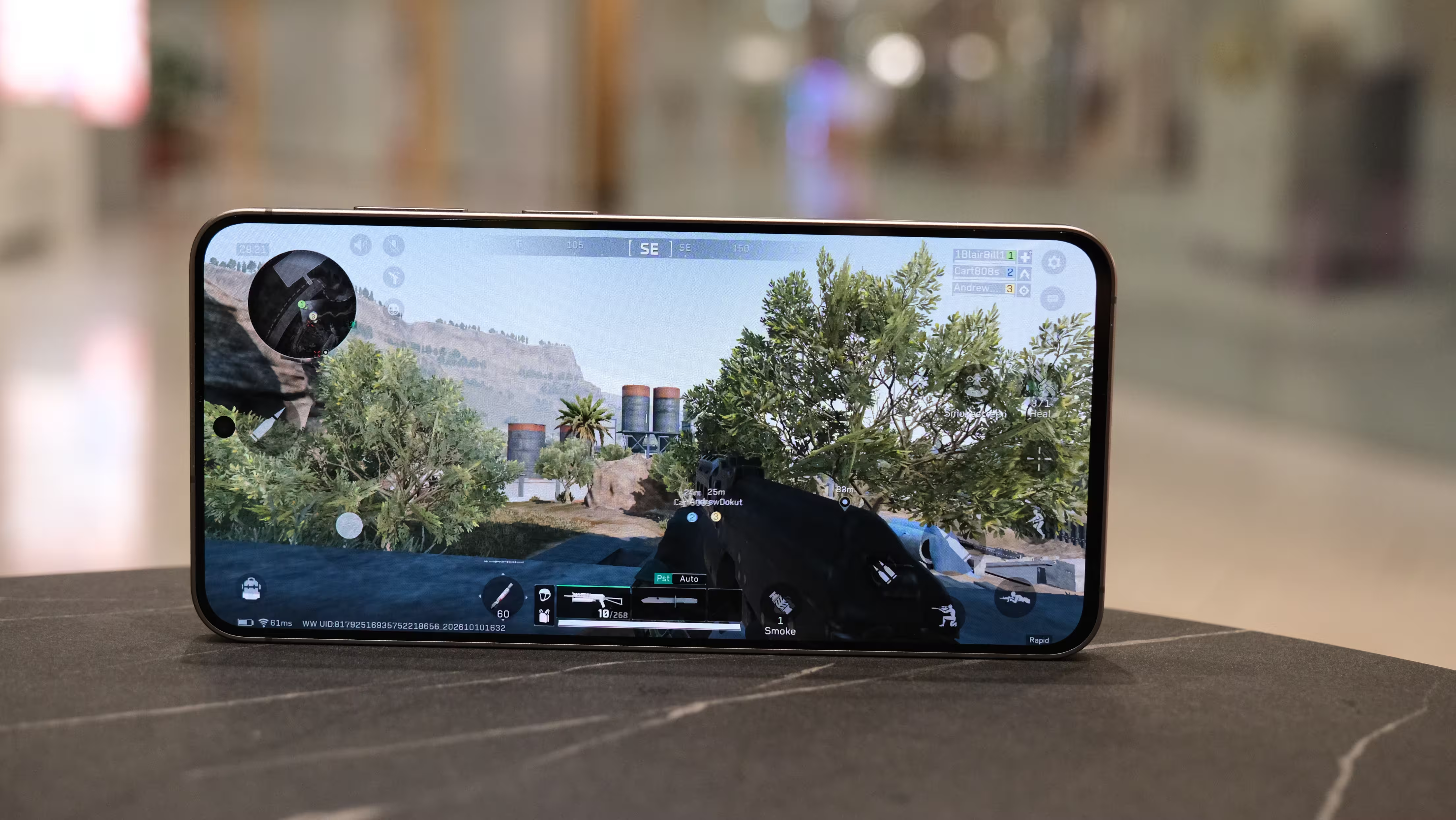
A smooth interface is not the same thing as sustained performance in demanding games, however. Results depend on the game, graphics settings and conditions. PUBG Mobile and Call of Duty Mobile perform well. In my testing, Genshin Impact and Fortnite also ran well, while Wuthering Waves occasionally suffered frame-rate drops.
.avif)
For most people who play games on their phones, the overall experience should be sufficient. The more demanding you are about maintaining high frame rates in heavy titles, the more carefully you should compare alternatives.
The body also gets warm under load. That is not unusual for hardware of this class, but sustained performance matters more than short bursts of speed during a long gaming session. If gaming is your main reason for buying, the S26 FE deserves to be compared with devices built around that priority. A Galaxy S badge does not settle the argument.
Base Storage: Saving in the Wrong Place
The 128GB starting configuration is one of the phone’s weakest decisions. The operating system, apps, a few large games and some 4K footage can quickly turn free space into a concern. For a device intended to last several years, starting at 256GB would have made more sense.
That is the version I would choose for long-term use, gaming or regular video recording. The base model may save money at checkout, but you can end up paying for that saving through repeated rounds of deleting files.
.avif)
The 8GB of RAM is enough for most current tasks, although it does not feel especially generous alongside the long support commitment. That does not mean we can declare the phone will inevitably become slow in a few years. Future performance depends on software, apps and usage.
It is also worth separating long-term software support from access to every future AI feature. Some features may have higher hardware requirements, and an operating system update does not automatically make a device eligible for everything.
.avif)
Another surprising choice is the USB connection. On the model I tested, data transfer was limited to USB 2.0 speeds, a step backwards from the USB 3.2 Gen 1 connection offered by earlier generations. If you regularly move large files to a computer using a cable, that limitation becomes more noticeable. A USB-C connector does not automatically mean fast transfers.
The overall picture is straightforward: the S26 FE is responsive and capable for general use, but its hardware does not justify paying any price for it.
Cameras: A Likeable Main Camera, Less Convincing Companions
The Galaxy S26 FE has a familiar camera arrangement: a 50MP main camera, a 12MP ultrawide and an 8MP telephoto with 3x optical zoom. There is also a 12MP front camera.
The range of focal lengths is useful. Having the same number of cameras as a flagship does not mean getting the same image quality from each of them, though.
.avif)
Main Camera: Photos Ready to Share
The main camera is the strongest part of the system. In good light, images are bright, colours are lively and detail is satisfying. Samsung’s processing tends to lift shadows and produce a look that is ready for social media without much editing.
That approach will not suit everyone. If you prefer neutral colour and restrained exposure, some shots may appear a little too bright or colourful. Nevertheless, for everyday photography, landscapes, food and family pictures, the main camera is an important reason to consider this phone.
Portraits are generally successful too. Subject separation works reasonably well, and brighter faces usually make for pleasing results. As with many phones, loose hair and complicated edges can still challenge the processing.
.avif)
 | .avif) | .avif) |
 .avif) | .avif) |
Low-light performance depends more heavily on the scene. A static subject with a reasonable amount of ambient light can turn out well. As light falls and subjects start moving, detail drops and blur becomes more likely. That matters more when photographing a child or pet indoors than when taking a night shot of a building that has kindly agreed to stay still.
Telephoto: Useful in Daylight, Limited After Dark
A genuine 3x optical zoom is a worthwhile addition. It helps with portraits, architectural details and subjects you cannot physically get closer to.
The 8MP sensor does not leave much room for further cropping, however. In good light, higher zoom levels can still be useful for capturing a moment or viewing on the phone’s screen. Move further beyond the optical range, and fine textures become softer.
.avif)
 | .avif) | .avif) | .avif) |
At night, expectations need to be lower. Having a telephoto camera on the specification sheet is valuable, but it does not match the main camera in every situation.
Ultrawide: Mostly About Fitting More into the Frame
The ultrawide is useful for architecture and broad landscapes, but it falls behind the main camera in detail and its handling of light. Noise increases and clarity drops as conditions get darker.
.avif)
Macro photography is not a strength either. Neither the ultrawide nor the telephoto offers the flexibility that close-up photography enthusiasts might want. This is an understandable compromise in a more affordable S-series model, but it is still a limitation worth recognising.
Selfies have pleasant colour and exposure in good light, although face brightening can occasionally look less natural than I would prefer. For group shots, check the edges before taking the picture rather than assuming everyone will fit comfortably.
Video: A Limitation When Switching Cameras
The main camera can record at 4K and 60fps, but using the ultrawide or telephoto means stepping down to 4K at 30fps. That matters if you like switching cameras while filming.
The front camera also supports 4K at 60fps and produces usable footage for vlogging. Stabilisation, facial exposure and detail are not equally consistent in every situation, however.
.avif)
Features such as Super Steady and horizon lock can help when recording on the move, but their results should not be assumed to be identical across recording modes and lighting conditions.
Overall, I find the S26 FE more appealing for everyday photography than for serious video work. The main camera does most of the heavy lifting. The ultrawide and telephoto add flexibility, rather than guaranteeing the same quality at three different focal lengths.
Software and AI: A Strong Reason to Stay with Samsung
The Galaxy S26 FE ships with Android 17 and One UI 9. Samsung promises up to seven generations of operating system upgrades and seven years of security updates. For someone who does not replace their phone every year, that commitment can be more valuable than many attention-grabbing features.
.avif)
One UI remains one of the most fully featured Android interfaces. Multi-window support, extensive settings, security tools and customisation options are central to its appeal. Good Lock provides further control for those who want to adjust more of the experience.
The software feels smooth, although you should not expect it to behave exactly like Samsung’s fastest flagship in every situation. Meanwhile, overlapping Google and Samsung apps can feel unnecessary to some users. Plenty of options are welcome, provided finding the right one does not become a project in itself.
AI: Some Features Are More Useful Than Others
Galaxy AI is part of the package, but I would not give every feature equal weight.
Call screening can help with unfamiliar callers. Translation and interpreter tools are useful where the relevant languages and regions are supported. Circle to Search makes it quicker to look up something on the screen, while photo-editing tools simplify tasks that would otherwise take longer.
.avif)
Now Brief brings daily information together, including weather, plans and reminders. Its usefulness depends on how much you use connected services and how much information you share with them.
For international buyers, language and regional availability deserve attention. Seeing a feature on a product page does not guarantee that it works fully in your preferred language, with your account or in your country. Some tools also need an internet connection, an account or a particular subscription.
To me, the software appeal of the S26 FE goes beyond a collection of AI features. Long support, multitasking and customisation are more convincing reasons to choose it.
.avif)
Battery and Charging: I Expected More
The Galaxy S26 FE’s 4,900mAh battery is not an especially exciting specification for a phone of this size and class. Capacity alone does not tell the full story, of course. Real-world endurance matters more, and that is where this phone feels average.
Using mobile data, navigation, the camera and social media can bring forward the need for a charge to the afternoon. Lighter use and more time on Wi-Fi improve matters, but I would not confidently put this phone in the category of devices built for heavy use from early morning to late at night.
.avif)
Battery life is not a major selling point here. If your working day is mostly spent at a desk, that may not bother you. For travellers, content creators or anyone frequently using maps and cameras, it becomes more significant.
The 45W wired charging offers some relief. Samsung quotes roughly 69% charge in around half an hour under its test conditions, but reaching that level took longer in my testing. Temperature, the charger, cable and simultaneous use all affect the result. I would still like Samsung to return to including a suitable charger in the box.
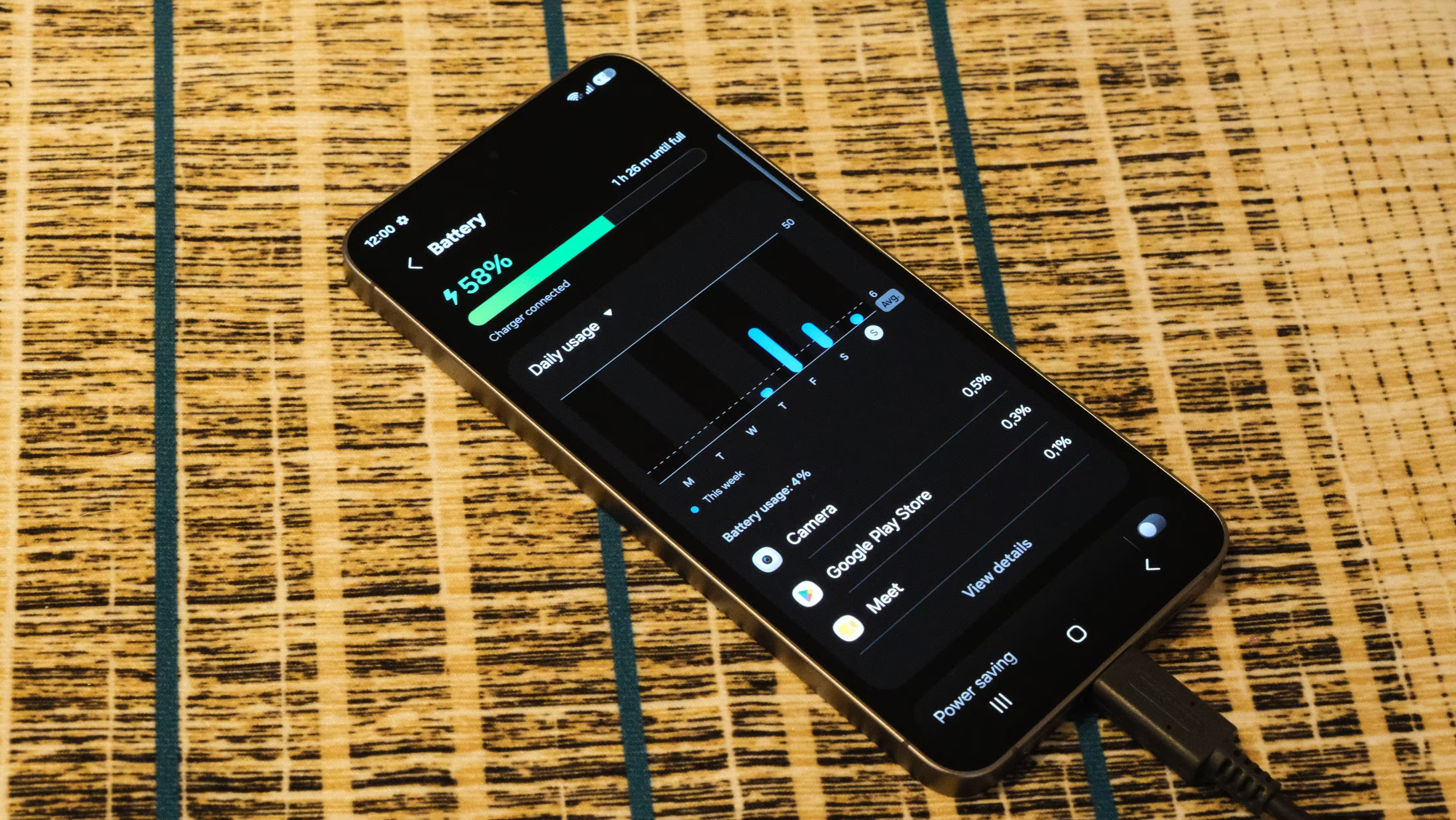
There is also 15W wireless charging and reverse wireless charging. The former is convenient for a charging pad on your desk; the latter can help top up compatible accessories when necessary. Although, when the phone’s own reserves are limited, sharing them is more an act of kindness than an everyday strategy.
The power adapter is sold separately. If you do not already have a compatible one, include it in the purchase budget.
.avif)
The charging options are reasonably complete, but they do not fully compensate for middling endurance. Wanting more battery headroom from a large phone in this category is hardly unreasonable. The battery technology matters less to me than being able to spend less time watching the remaining percentage.
Final Verdict: The Price Gap Makes the Decision
The Galaxy S26 FE is not a bad phone. In fact, it is well built and satisfying across much of everyday use. An attractive screen, good sound, a capable main camera, smooth performance and long software support form a package that will meet many people’s needs.
But a good phone is not automatically a good buy.
Average battery life, limited base storage, USB 2.0 transfer speeds and the quality gap between the main and secondary cameras need to be reflected in the price. If the S26 FE costs only slightly less than Samsung’s main flagship, choosing it becomes harder to justify. If the previous generation is substantially cheaper, a newer name is not enough on its own to warrant the difference.
Compare matching storage capacities and the actual price you will pay in your market. Retail discounts, trade-in offers and carrier promotions can change the calculation, but a conditional offer is not the same as a straightforward lower price. Warranty coverage and the cost of a compatible charger also belong in the comparison. Putting a 128GB model next to a 256GB alternative and judging value solely by the price difference does not tell the whole story.
The S26 FE makes the most sense for someone who prioritises a good screen, everyday photography, Samsung’s software and several years of use. Demanding gamers, keen videographers and buyers who put battery life first should examine other options too.
For existing S25 FE owners, the changes are not broad enough to make upgrading a necessity. This model is more appealing as a move from an older phone than as a replacement for last year’s FE.
My verdict is that the Galaxy S26 FE delivers much of what makes Samsung phones appealing, but it needs the right price to become a convincing recommendation. The phone has made its case. Now the price tag needs to do its part.
Related Posts


“Some times I write about breakthrough startups, digital ecosystems, and how innovation is changing the way we build businesses.”

Discussion
Leave a Comment
Comments (1)
Pretty balanced take. Screen and software sound great, but battery and 128GB base? meh. Price decides it.