

Samsung, South Korean Firms Push Back on OUSD Founding Claims
Samsung Electronics and several major South Korean companies have publicly denied formal involvement in the founding consortium behind Open Standard’s newly announced OUSD stablecoin. The issuer had named more than 140 organizations as founding partners who would jointly govern and share revenue from the stablecoin’s reserve assets. The rebuttals raise questions about the consortium model, governance clarity, and institutional support for the new stablecoin project.
What Samsung and Others Said
A Samsung spokesperson told local media that the company has not held formal consultations with Open Standard and is unsure what role it would play within the proposed consortium. Similar statements came from financial firms including Dunamu, Shinhan Bank and K-Bank, which said they had only received inquiries and were still evaluating potential participation rather than having approved any commitment.
At least one company reported learning it had been listed as a consortium member from press coverage, and expressed surprise that its name appeared among founding partners before any agreement had been reached. These public clarifications contrast with Open Standard’s announcement, which framed the listed organizations as active founding members responsible for collaborative governance and revenue sharing tied to the stablecoin’s reserves.
Background: Open Standard’s OUSD Proposal
Open Standard unveiled OUSD as a new stablecoin reportedly backed by reserve assets and governed by a consortium of more than 140 entities. The issuer said consortium participants would sit on a shared governance board to oversee issuance, reserve management, and other key functions. The proposed model positions OUSD as a consortium-governed stablecoin built around corporate partners and institutional stakeholders.
Consortium-based stablecoins are promoted for potential decentralised governance advantages and collective oversight of reserve assets, but they also face practical coordination challenges when multiple large organizations must align incentives and decision-making.
Industry Reaction and Comparisons
The swift pushback from South Korean firms has triggered broader scrutiny. Circle, a leading stablecoin issuer behind USDC, weighed in on the governance debate. Circle CEO Jeremy Allaire noted that large consortiums often struggle to coordinate efficiently, can suffer from misaligned incentives among participants, and may slow innovation. Industry observers have long debated whether consortium models can match the operational speed, transparency, and regulatory compliance of single-issuer stablecoins.

In parallel, Circle has been expanding institutional access to USDC. Standard Chartered recently rolled out an institutional service enabling eligible clients to mint and redeem USDC directly through the bank’s platform. Built in collaboration with Circle, that offering pairs fiat banking, custody, and digital asset infrastructure with public blockchain connectivity — allowing institutional clients to interact with USDC without separate accounts at Circle.
The Standard Chartered offering launched via the Dubai International Financial Centre and is planned to expand into additional jurisdictions pending regulatory approvals and market readiness. This move underscores the continued institutionalization of USDC as banks and large financial institutions seek integrated fiat-to-crypto rails.
Market and Investor Impact
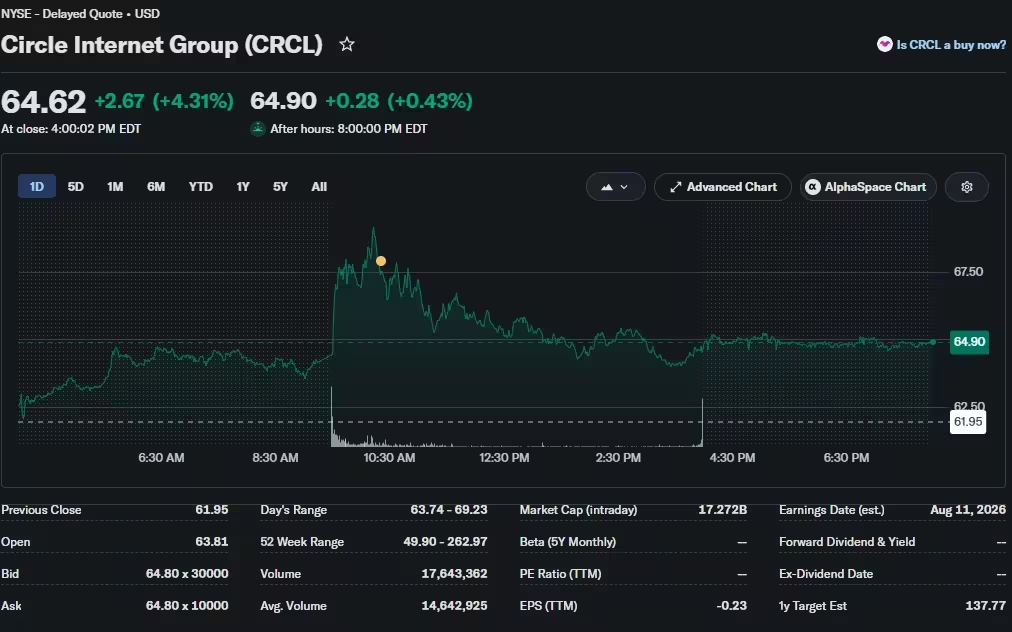
The disclosures and ensuing industry commentary influenced investor sentiment. Circle’s stock (CRCL) rebounded by as much as 4% to around $64.62 after earlier declines tied to the OUSD announcement and index rebalancing. Crypto-related equities gained as Bitcoin recovered toward the $62,000 level, suggesting broader market resilience amid the governance debate.
Implications for Stablecoin Governance and Regulation
The episode highlights several challenges for consortium-based stablecoin initiatives:
- Governance clarity: Accurate, contractual confirmation of member roles is essential to avoid reputational and legal fallout. Listing organizations as founding partners without explicit consent can create operational risk and regulatory scrutiny.
- Incentive alignment: Large, heterogeneous groups can have divergent priorities, complicating decision-making about reserves, minting, and redemption policies.
- Market trust: Stablecoin credibility depends on transparent reserve management, reliable redemption mechanics, and clear governance. Confusion about consortium composition may erode market confidence.
Regulators and institutional counterparties will likely scrutinize any new stablecoin architecture that relies on multi-party governance. For institutional adoption, banks and custodians require clear contractual frameworks to support minting, redeeming, custody, and compliance workflows on public blockchains.
What's Next for Open Standard and OUSD?
Open Standard now faces the task of clarifying its consortium roster and governance arrangements. For the project to gain traction with institutional partners, the issuer must provide verifiable agreements, transparent reserve policies, and an actionable governance roadmap. Without those elements, exchanges, banks, and investors may favor established stablecoins with proven operational and regulatory track records.

As the market watches, the broader debate over consortium governance for stablecoins will continue. The OUSD announcement and subsequent denials underscore the importance of explicit partner commitments and robust governance structures for any new stablecoin seeking institutional credibility on the blockchain and in regulated markets.

“I cover automotive innovation, electric vehicles, and the future of mobility — where technology meets sustainability.”

Discussion
Leave a Comment
Comments (2)
Feels overhyped tbh. Listing 140+ partners sounds like PR stunt, not governance. If that's real then who handles redemptions? messy
is this even true? firms getting named as founders without consent... risky move by Open Standard, could invite legal trouble, regulators will probe