

5 Minutes
Ethereum stuck under $3,000 — sideways price action into 2026
Ether (ETH) has been trading in a tight range around the $2,900–$3,000 band, prompting renewed questions about whether the $2,900 support level can hold. Repeated breakout attempts above $3,000 have failed, sapping short-term momentum and denting trader conviction. Across spot and derivatives markets, metrics that typically signal bullish demand have cooled, suggesting a period of stagnation for ETH heading into 2026 unless on-chain activity and decentralized application (DApp) demand pick up.
Derivatives show weak bullish leverage demand
One telling indicator is the futures basis. ETH monthly futures recently traded at roughly a 3% annualized premium to spot, significantly below the 5%+ premium many market participants consider normal under neutral conditions. That suppressed premium points to muted demand for leveraged long positions and a general reluctance among traders to pay up for forward exposure to ETH.
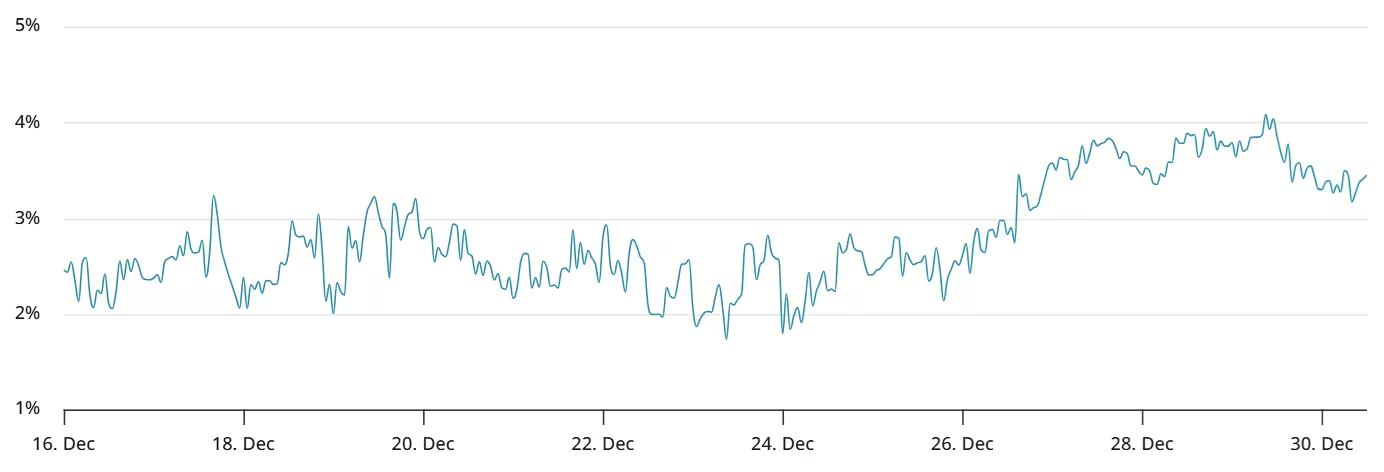
ETH 2-month futures basis rate
Falling network fees despite rising transactions
On-chain data complicates the narrative: transaction counts have ticked up, but network fees have declined markedly. Ethereum network fees dropped about 26% from their baseline while transaction volumes rose roughly 10% in the same window. At surface level, this suggests activity is not collapsing — yet fees are an important proxy for real economic demand on-chain.

Blockchains ranked by 7-day fees, USD.
To assess meaningful demand for ETH, it helps to drill into DApp-level fees. Fees generated by Ethereum DApps have been relatively flat over the past month and remain well below the October high of roughly $140 million. In short, Ethereum’s on-chain activity looks stagnant: transactions are occurring, but monetized usage that drives gas fees — DeFi swaps, NFT activity, and other value-bearing operations — has not materially surged.

7-day Ethereum decentralized application fees, USD
ETF flows: outflows temper institutional enthusiasm
Institutional appetite matters, particularly after the launch of spot Ether ETFs. Over the last two weeks, Ether-focused ETFs have seen net outflows totaling about $307 million since Dec. 17. While that figure represents less than 3% of total ETF assets and is not catastrophic, the outflows create psychological pressure amid repeated price failures above $3,000.
BlackRock’s iShares Ethereum Trust (ETHA US) remains the largest vehicle with about $10.2 billion in assets under management, underscoring how concentrated institutional flows can be.

Ether ETFs daily net flows, USD
Why the current mix matters
Combined, weak bullish leverage demand in futures, falling network fees, and ETF outflows create a low-conviction environment. Traders who see ETH repeatedly rejected at key resistance are likelier to reduce exposure, even if longer-term fundamentals remain positive. That dynamic can amplify sideways price action and reduce liquidity during attempted breakouts.
Macro environment and broader crypto market risks
Global economic headwinds are an additional constraint. With central banks less able to ease quickly in the face of tighter fiscal conditions and elevated inflation risks, risk assets — including cryptocurrencies — may remain under pressure until macro clarity improves. Risk-off sentiment often pushes speculative demand down, limiting the upside for ETH despite promising protocol-level progress.
What would enable a sustainable ETH rally?
A sustained recovery in Ether price will likely require a combination of factors: a visible uptick in DApp activity and on-chain fee generation, renewed institutional inflows into spot ETH ETFs, and higher demand for bullish leverage evidenced by a wider futures premium. Layer-2 adoption, tangible growth in DeFi and NFT activity, or a meaningful protocol upgrade that boosts utility could all catalyze stronger momentum.
Investors and traders should monitor on-chain indicators like gas fees, DApp fee revenue, futures basis rates, and daily ETF flows to judge whether the market is shifting from stagnation to expansion. Until those signals align, ETH’s path is expected to be range-bound with limited conviction for a decisive breakout above $3,000.
Key takeaways
- ETH remains capped below $3,000 after repeated breakout failures.
- Low futures premia and ETF outflows reflect weak bullish demand.
- Ethereum network fees have fallen even as transactions rose — DApp monetization is flat.
- A durable rally likely needs stronger DApp usage, rising fees, and renewed ETF inflows.
While the current data does not signal a market collapse, it does point to stagnation unless on-chain utility and institutional demand reaccelerate. Traders should keep a close eye on gas fees, DApp revenue, ETF flow trends, and derivatives premiums as leading signals for any meaningful change in ETH price trajectory.
Source: cointelegraph

Comments
Armin
I've seen this happen in my trading. Activity up but fees flat = not real demand. ETFs pulling money will keep ETH range bound, unless DApps pick up fast
blockvent
Is this even true? Futures premia low, fees falling but txs up, are bots just spamming cheap txs? ETF outflows smell like profit taking, or panic?

Leave a Comment