
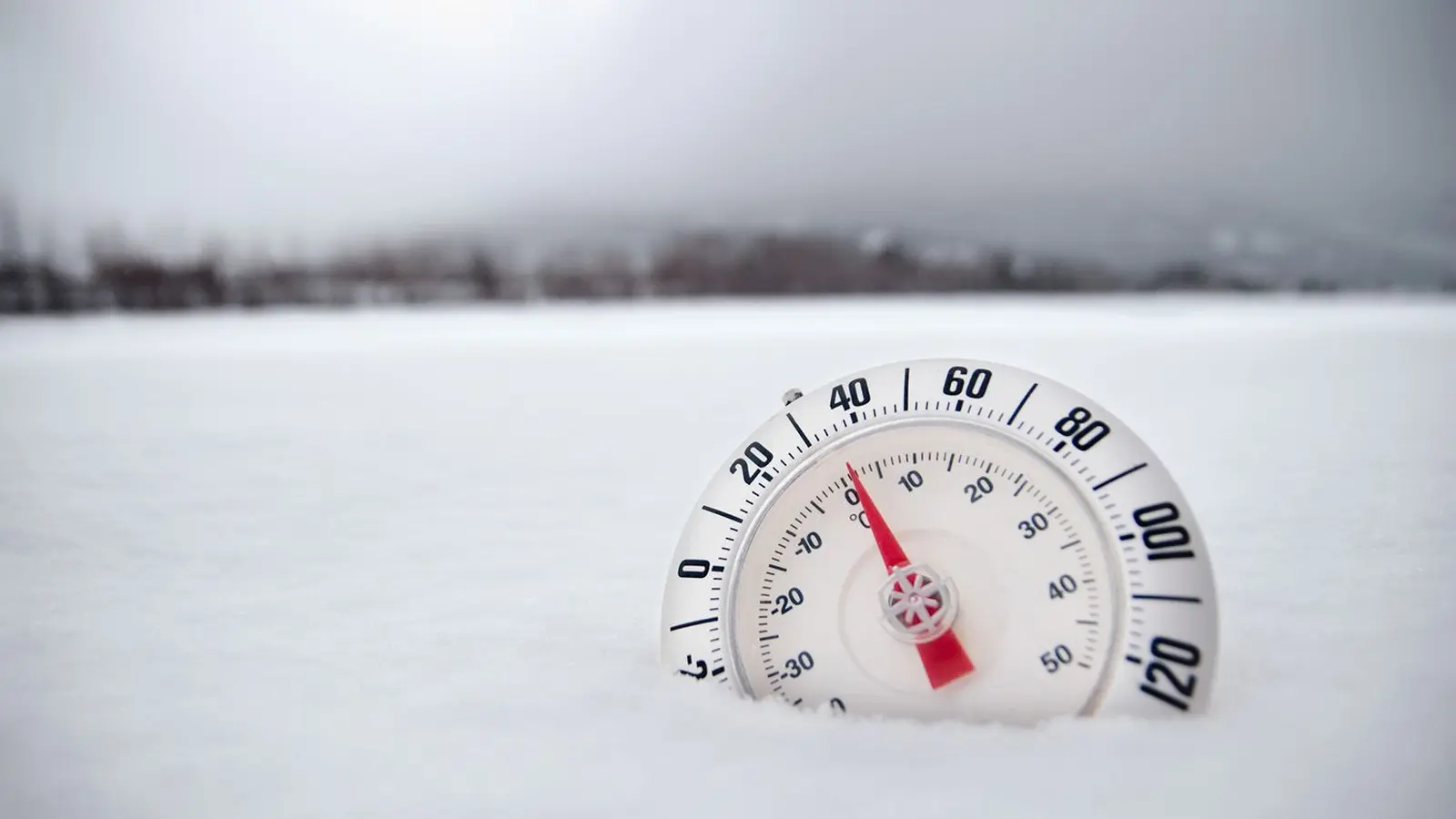
Absolute zero — zero kelvin — is the temperature where thermal motion of atoms would cease. It sounds simple: keep removing heat and eventually everything stops. But physics says we can approach this limit, not cross it. Here’s why absolute zero is fundamentally unreachable, how researchers cool matter to almost unimaginably low temperatures, and what physicists mean when they talk about "negative" temperatures.
What absolute zero really means
Scientists prefer the kelvin scale because it starts at absolute zero: 0 K corresponds to the complete absence of thermal energy. Temperature measures the average kinetic energy of atoms and molecules. At higher temperatures, particles move faster — vibrating in solids, sloshing in liquids, and streaming in gases. Lowering temperature removes kinetic energy and slows that motion.
Intuitively, you might imagine extracting just a little more heat until atomic motion stops completely. But the third law of thermodynamics forbids this in any finite sequence of steps. Often stated in the form Walter Nernst proposed, the law says that no procedure performed in a finite number of steps can bring a system to absolute zero. In practical terms, as a system becomes colder it becomes progressively harder to remove the remaining energy; the last fractions of thermal motion demand exponentially more resources or time.
How scientists get incredibly cold — but never zero
Everyday refrigeration moves heat from inside a box to the environment using a compression-expansion cycle. The same principle scales to low-temperature physics: coolants and staged refrigeration reduce temperature step by step. Liquid helium-4, for example, boils at about 4.2 K at atmospheric pressure and has long been the workhorse for cryogenic experiments. To go lower, laboratories use helium-3, dilution refrigerators, adiabatic demagnetization, and more.
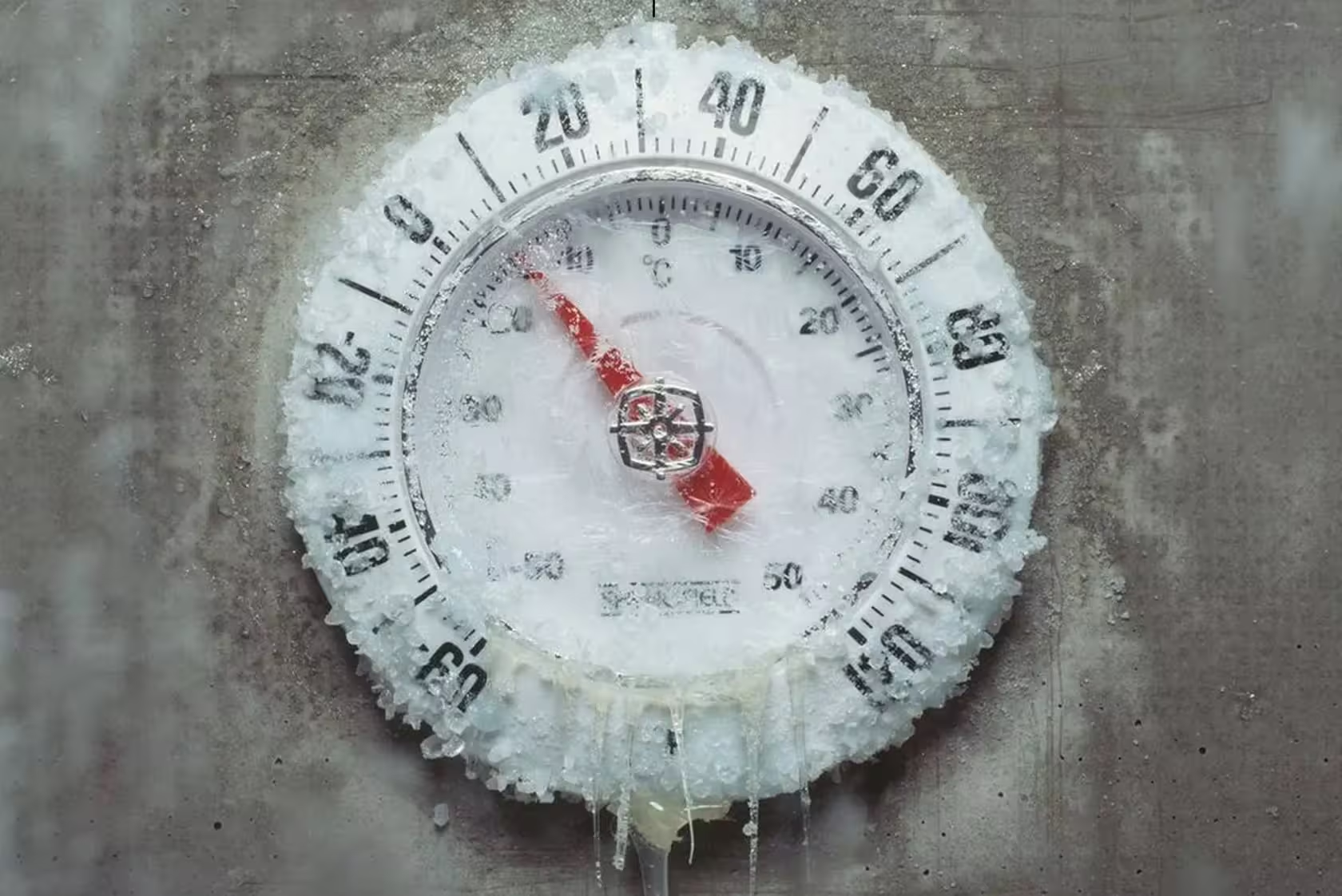
Laser cooling — the technique honored with the 1997 Nobel Prize in Physics — slows atoms by letting them absorb and re-emit photons. Carefully tuned laser beams create an "optical molasses" that reduces atomic velocities, cooling gases to microkelvin or even nanokelvin regimes. Evaporative cooling and sympathetic cooling further extend the range, enabling the creation of Bose–Einstein condensates and other exotic quantum states.
More exotic tricks, such as nuclear demagnetization and sophisticated magnetic or optical traps, have pushed sample temperatures down to billionths and even trillionths of a kelvin in carefully controlled systems. Experimentalists report temperatures on the order of 10^-9 to 10^-11 K in specialized setups. Yet every experimental record still sits above 0 K: thermodynamic laws and practical losses always leave a residual energy.
Why the third law prevents reaching zero
The third law can be framed in multiple ways, but a useful picture is entropy: as a system cools, its entropy approaches a minimum. To reach absolute zero would require removing every last bit of entropy — effectively isolating and ordering the system perfectly. Any realistic process encounters limits: finite steps, imperfections, quantum fluctuations, coupling to the environment, and the thermodynamic cost of control and measurement.
Recent theoretical work also shows that reaching 0 K would take infinite time in any physically reasonable model. In other words, the universe would need to be infinitely old to let a real system reach absolute zero under normal thermodynamic evolution.
Negative temperatures: colder than cold or hotter than hot?
Sometimes physicists talk about "negative temperatures." That sounds paradoxical: how can you be colder than zero? The answer lies in systems with a limited set of energy states where population inversion is possible. In such systems, adding energy can reduce entropy — the opposite of usual behavior — and the temperature parameter defined by thermodynamics becomes negative.
Negative-temperature states are not colder; they are actually hotter than any positive temperature. If you place a negative-temperature system next to a normal positive-temperature system, heat will flow from the negative-temperature system into the positive one. These inverted systems are useful in specialized research (e.g., certain spin systems or engineered quantum simulators) but do not violate the third law.
Why this matters: implications for technology and fundamental physics
Ultracold physics is more than a curiosity. Techniques for reaching near-absolute-zero temperatures enable quantum computing, precision metrology, atomic clocks, and exploration of novel quantum phases. The impossibility of absolute zero sets a fundamental constraint: while we can approach quantum ground states with great fidelity, there will always be thermodynamic and technical limits to perfection.
Expert Insight
"The third law is a practical boundary as well as a theoretical one," says Dr. Leila Morgan, a condensed-matter physicist. "In the lab we design ever more clever ways to decouple systems from their environment and squeeze out thermal energy, but we always contend with residual coupling and noise. Those small imperfections are what keep absolute zero forever out of reach — and they also drive innovation in cooling technologies and quantum control."
Understanding absolute zero is both a lesson in fundamental physics and an inspiration for precision engineering. We cannot freeze the universe completely, but the race to get closer and probe quantum behavior at ultralow temperatures remains one of modern science's most productive challenges.


“The cosmos has always fascinated me. I write about space missions, astronomy, and the technologies pushing humanity beyond Earth.”

Discussion
Leave a Comment
Comments
No comments yet. Be the first.