
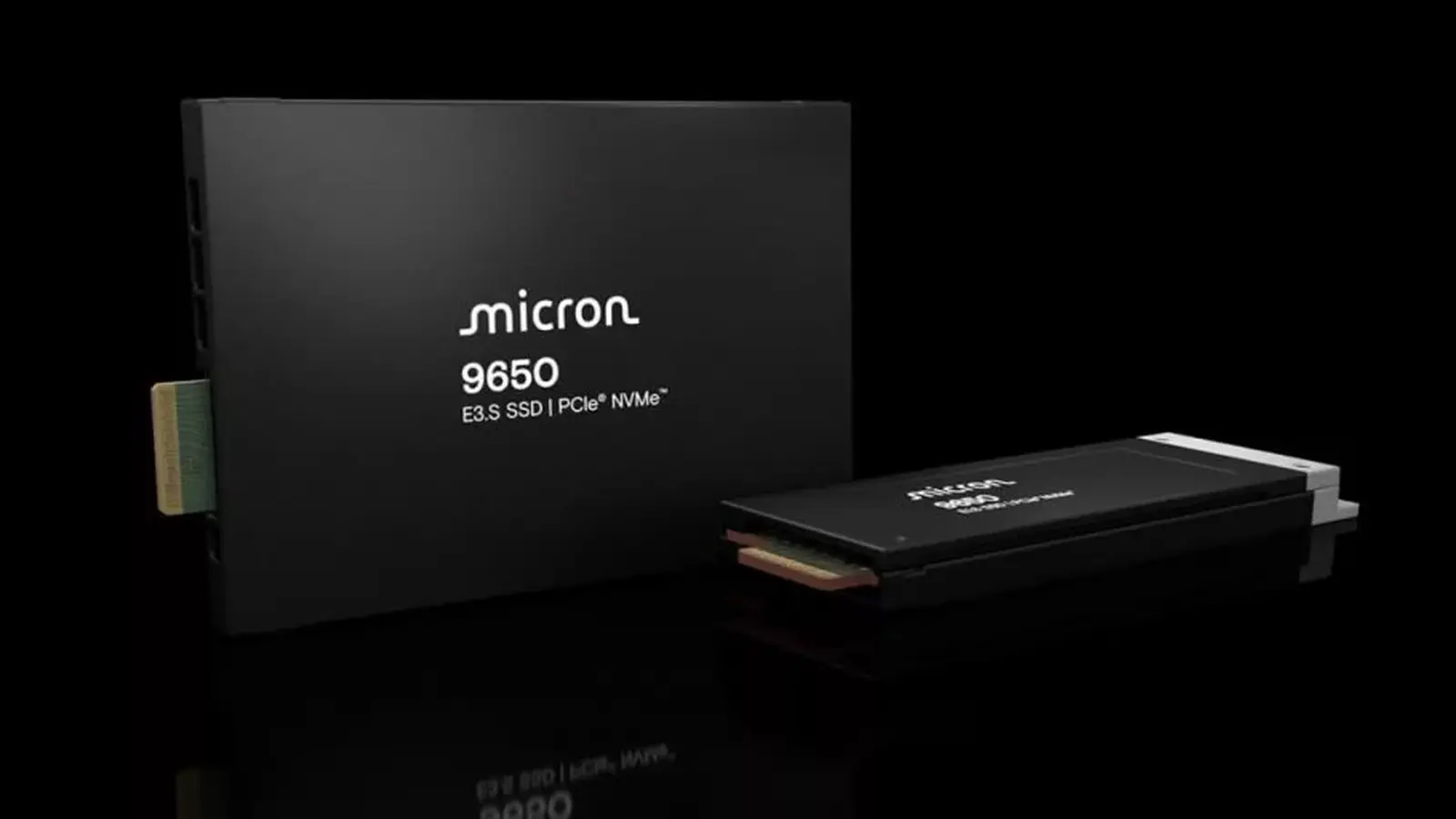
Micron has quietly begun mass production of the 9650 family, marking the first time PCIe 6.0 SSDs are being made at scale. The headline number is unmistakable: up to 28 gigabytes per second, roughly twice the throughput of current PCIe 5.0 drives.
These drives were designed with one thing in mind: feeding modern AI and cloud workloads. Micron is shipping the 9650 in server-focused E1.S and E3.S form factors to fit dense racks and purpose-built storage shelves, so think data centers, not desktops.
The 9650 arrives in two flavors, Pro and Max. Pro aims for sheer capacity, offering 7.68, 15.36 and 30.72 terabyte options. Max trades some capacity for tougher endurance and mixed-workload resilience, with 6.4, 12.8 and 25.6 terabyte SKUs that are tuned for sustained heavy reads and writes.

Performance claims are striking. Max models deliver roughly 400,000 higher IOPS under mixed read/write pressure compared with Pro, and random read performance can peak near 5.4 million IOPS — a real step-change for high-concurrency server tasks and model inference pipelines.
Despite doubling raw throughput over PCIe 5.0, Micron keeps peak power below 25 watts. Given the heat density inside server racks, Micron also took a rare step and certified liquid cooling support for the E1.S variant, giving operators another option to manage thermal limits without throttling performance.
This technology is squarely aimed at large-scale deployment. Micron expects the 9650 to accelerate large language model training and inference, high-speed GPU data feeding, and cloud storage tiers where bandwidth and IOPS matter most. It will not be a mainstream consumer part: home motherboards largely lack PCIe 6.0 support today, and broad desktop adoption is unlikely for several years.
Meanwhile, demand from hyperscalers and AI platform providers has already pushed advanced memory inventory toward enterprise customers, so retail availability will be limited. Watch how quickly software and system integrators adapt — because when storage catches up to compute, real-world AI workflows run noticeably faster.

“I love exploring gadgets, apps, and trends that redefine how we connect, work, and play in a digital world.”

Discussion
Leave a Comment
Comments
No comments yet. Be the first.