

Imagine a ring of humming servers orbiting the Earth, all powered by sunlight and zipping data across the sky. Romantic, right? Sam Altman laughed at that vision during a live interview in Delhi and called it, bluntly, ridiculous—at least with today's technology.
He didn't just mock the headline. Altman pointed to the cold arithmetic behind the glamour: launch costs that would make CFOs blanch, repair logistics that turn a simple broken chip into a months-long mission, and a host of engineering hurdles that haven't been solved. He conceded the idea could make sense someday, but not within the decade and not at meaningful scale.

Elon Musk, predictably, sees a different horizon. Inside xAI meetings and in public remarks, he’s pitched orbital datacenters as the next frontier—an immense constellation of satellites acting as distributed compute nodes. SpaceX's ambitions, he says, will accelerate after the company's move on xAI, scaling toward architectures the tech world has barely begun to imagine.
Google has already staked a middle ground. In late 2025 the company unveiled Project Suncatcher, with Sundar Pichai outlining plans to deploy solar-powered orbital facilities by 2027. It's a proof-of-concept of shifting compute off-planet, if not yet the final form Musk describes.
The pressure to rethink where compute lives is real. Big language models devour processing power. Terrestrial datacenters strain local water supplies for cooling. They tax power grids and, in some regions, have stirred community outrage over noise, land use, and environmental impact—think hot debates in Texas and Oklahoma. The U.S. now counts well over a thousand approved datacenter projects, roughly four times the number from 2010, and that growth is forcing engineers and executives to look for alternatives.
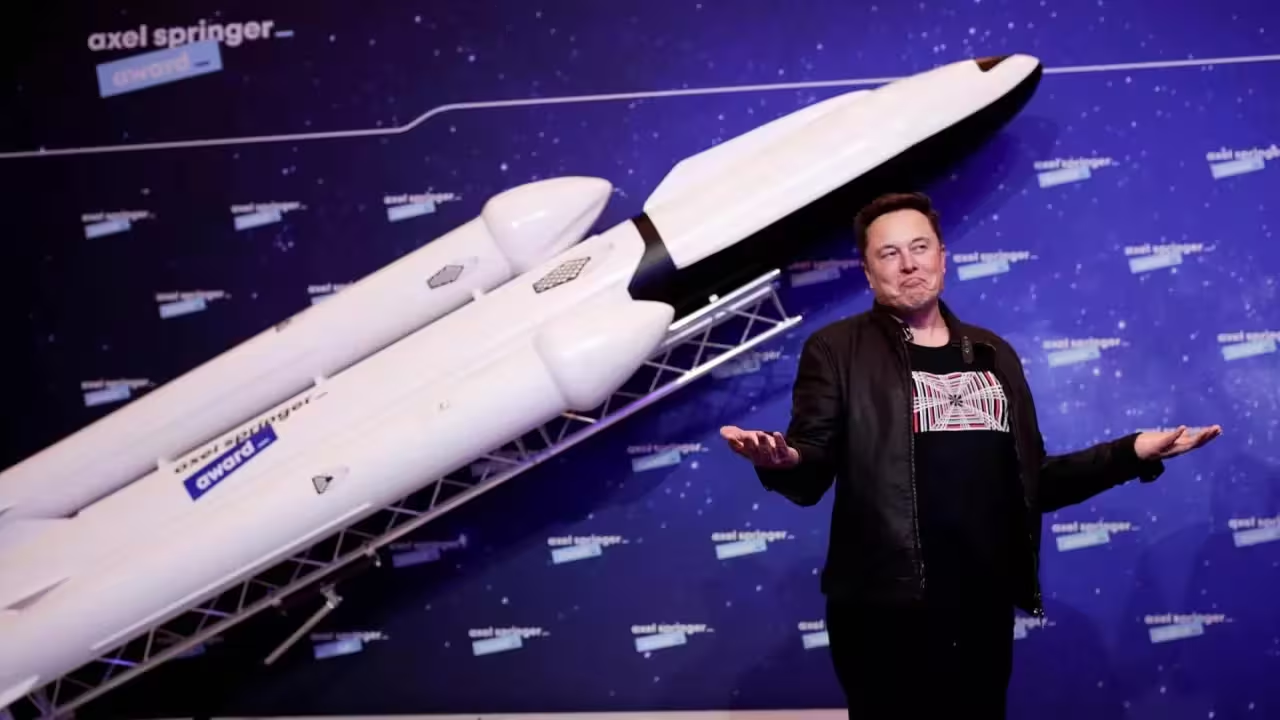
But hype doesn't equal feasibility: the numbers still favor land-based datacenters today.
So where does that leave us? A handful of corporate bets, a stack of engineering problems, and a public conversation about trade-offs: cost, resilience, environmental footprint, and sovereignty of infrastructure. Musk sells the moonshot. Altman grounds us with spreadsheets. Between them, the tech industry will decide whether orbital compute is a distant fantasy or the next chapter in cloud computing—and that debate will be far more interesting than the idea of servers in space itself.


“I cover emerging technologies, digital innovation, and the intersection of tech and everyday life. My goal is to make complex trends accessible and inspiring.”

Discussion
Leave a Comment
Comments
No comments yet. Be the first.